



A 75-year-old investor sits at a crossroads many retirees eventually reach: should he consolidate his holdings into something simpler, or keep managing individual stocks? His portfolio splits between defensive dividend payers (Johnson & Johnson, Verizon, Procter & Gamble, Coca-Cola) and a high-growth tech position (NVIDIA). The question isn’t whether his picks are good—it’s whether the mental overhead is worth it at this stage of life.
The Core Tension: Income Stability vs. Cognitive Burden
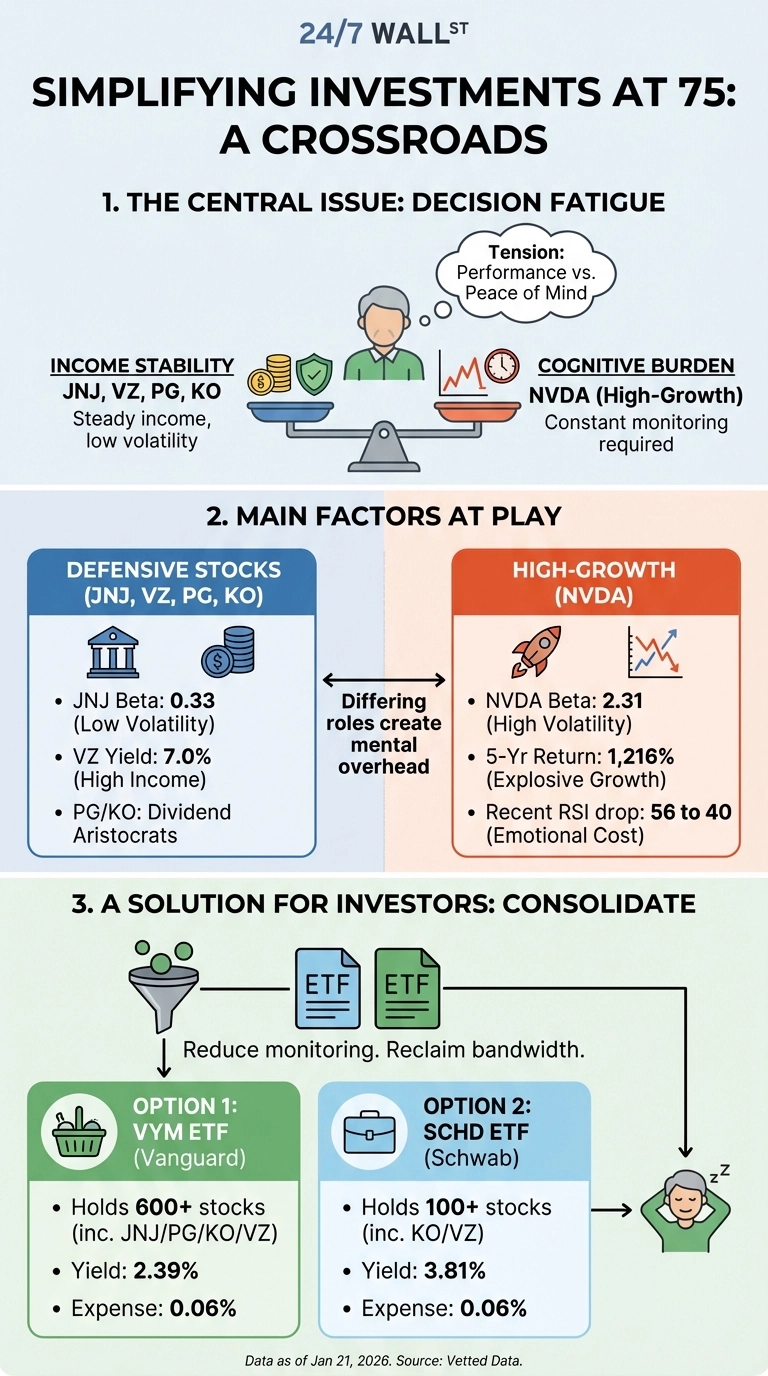
The real issue here isn’t performance. It’s decision fatigue. JNJ, VZ, PG, and KO represent classic dividend aristocrat territory—steady income, low volatility, minimal drama. JNJ’s beta of 0.33 means it moves one-third as much as the broader market. VZ yields 7% but has grown earnings just 0.5% year-over-year. These stocks don’t demand constant attention.
Then there’s NVIDIA. With a beta of 2.31, it swings more than twice as hard as the S&P 500. Over five years, NVDA returned 1,216% versus JNJ’s 52%. But that explosive growth comes with emotional cost: NVDA’s RSI dropped from 56 to 40 in two weeks this January, the kind of volatility that forces you to check your portfolio daily.
The Simplification Trade-Off
Two ETF options offer consolidation without abandoning the dividend focus: Vanguard High Dividend Yield ETF (VYM) and Schwab US Dividend Equity ETF (SCHD). VYM holds all four of his defensive picks – JNJ at 2.33%, PG at 1.63%, KO at 1.33%, VZ at 0.81% – plus 600 other dividend payers. It yields 2.39% with a 0.06% expense ratio.
SCHD takes a more concentrated approach with 100 holdings, tilting toward energy (20.4%) and consumer staples (18.3%). It yields 3.81%—notably higher than VYM—and includes KO (3.83%) and VZ (3.72%) as top-10 positions.
The math is straightforward: selling individual stocks for an ETF cuts monitoring from five positions to one. No more tracking quarterly earnings for each company, no more deciding whether to trim NVDA after a run-up, no more dividend reinvestment decisions across multiple accounts.
What Actually Matters Now
Start by asking: how often do you check these holdings? If NVDA’s swings cause stress or prompt trades, that’s a signal. The defensive quartet likely doesn’t—JNJ’s dividend has grown for 15+ consecutive years, requiring zero intervention.
Consider keeping the dividend stocks and selling NVDA into VYM or SCHD. This preserves the income stream you’ve built while removing the volatility that demands active management. Alternatively, consolidate everything into SCHD’s higher yield and accept slightly less diversification.
The real win isn’t maximizing returns—it’s reclaiming the mental bandwidth spent monitoring positions that no longer need your constant attention.














 Top Gaining Stocks
 Top Losing Stocks