Is Capital Group Dividend Value ETF Good For Retirees? | CGDV

Photo of Michael Williams
By Michael Williams Published

Quick Read

  • CGDV delivers only 1.4% yield despite 24% annual returns. Its tech-heavy allocation prioritizes growth over immediate income.

  • The fund generated $1,400 annually on $100K invested versus $3,800 from a 3.8% yielding alternative like SCHD.

  • Tech concentration at 24.5% creates volatility uncommon in dividend funds. Top three holdings are Microsoft, Broadcom and NVIDIA.

This post may contain links from our sponsors and affiliates, and Flywheel Publishing may receive compensation for actions taken through them.
Is Capital Group Dividend Value ETF Good For Retirees? | CGDV

© 24/7 Wall St.

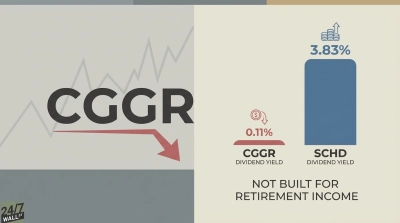
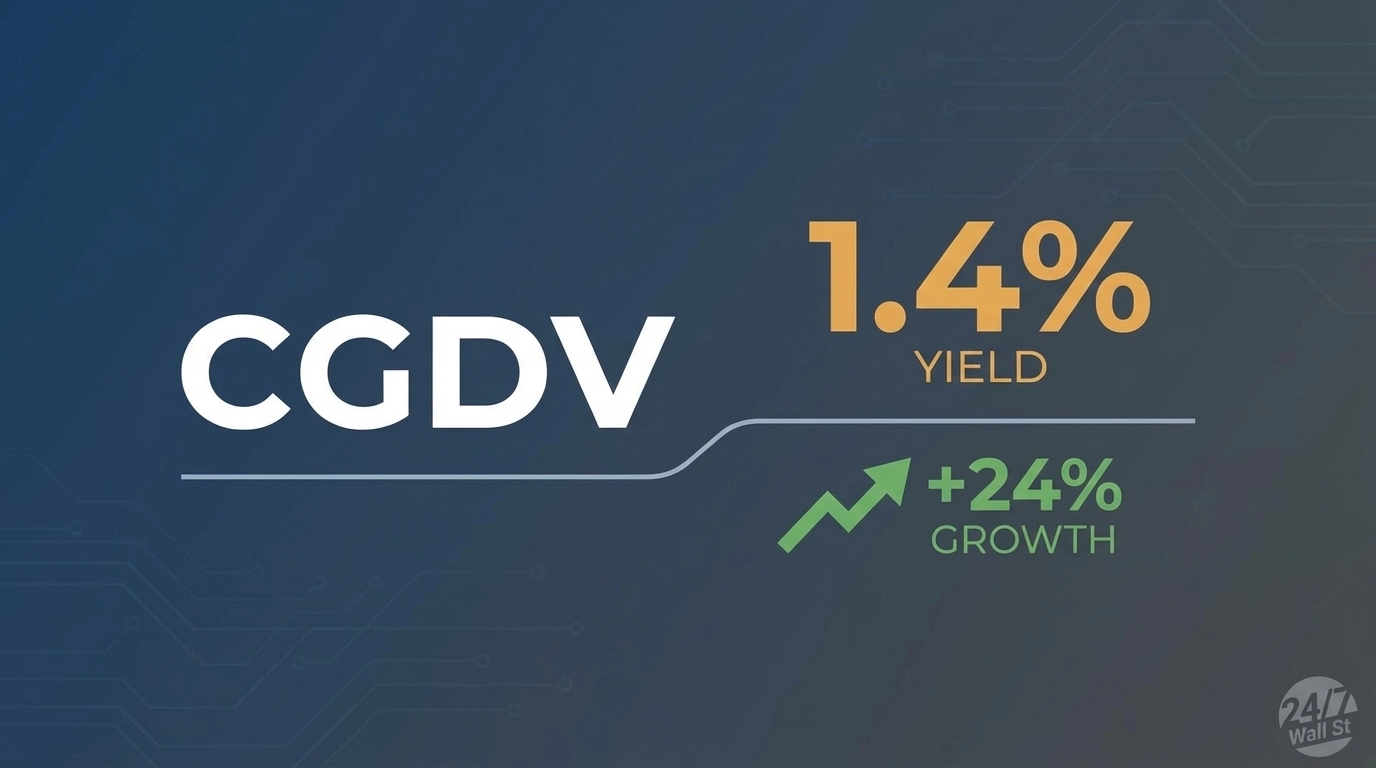
Retirees seeking dividend income face a fundamental choice: prioritize immediate cash flow or accept lower yield for capital appreciation. Capital Group Dividend Value ETF (NYSEARCA:CGDV | CGDV Price Prediction) delivers a 1.4% yield with tech-heavy exposure generating 24% annual returns. The question isn’t whether CGDV performs well, but whether its growth approach serves retiree income needs.

Built for Growth, Not Immediate Income

CGDV aims to produce income exceeding average U.S. stock yields while providing growth through dividend-paying companies. Five veteran managers with over 24 years of experience each run individual sleeves using Capital Group’s multi-manager approach.

Information Technology represents 24.5% of holdings, with top positions including Microsoft (NASDAQ:MSFT) (5.7%), Broadcom (NASDAQ:AVGO) (5.6%), and NVIDIA (NASDAQ:NVDA) (5.5%). This tech concentration drives performance but introduces volatility uncommon in traditional dividend funds. The 0.33% expense ratio remains competitive, and quarterly distributions grew from $0.49 in 2023 to $0.56 in 2025, demonstrating 14.5% year-over-year dividend growth.
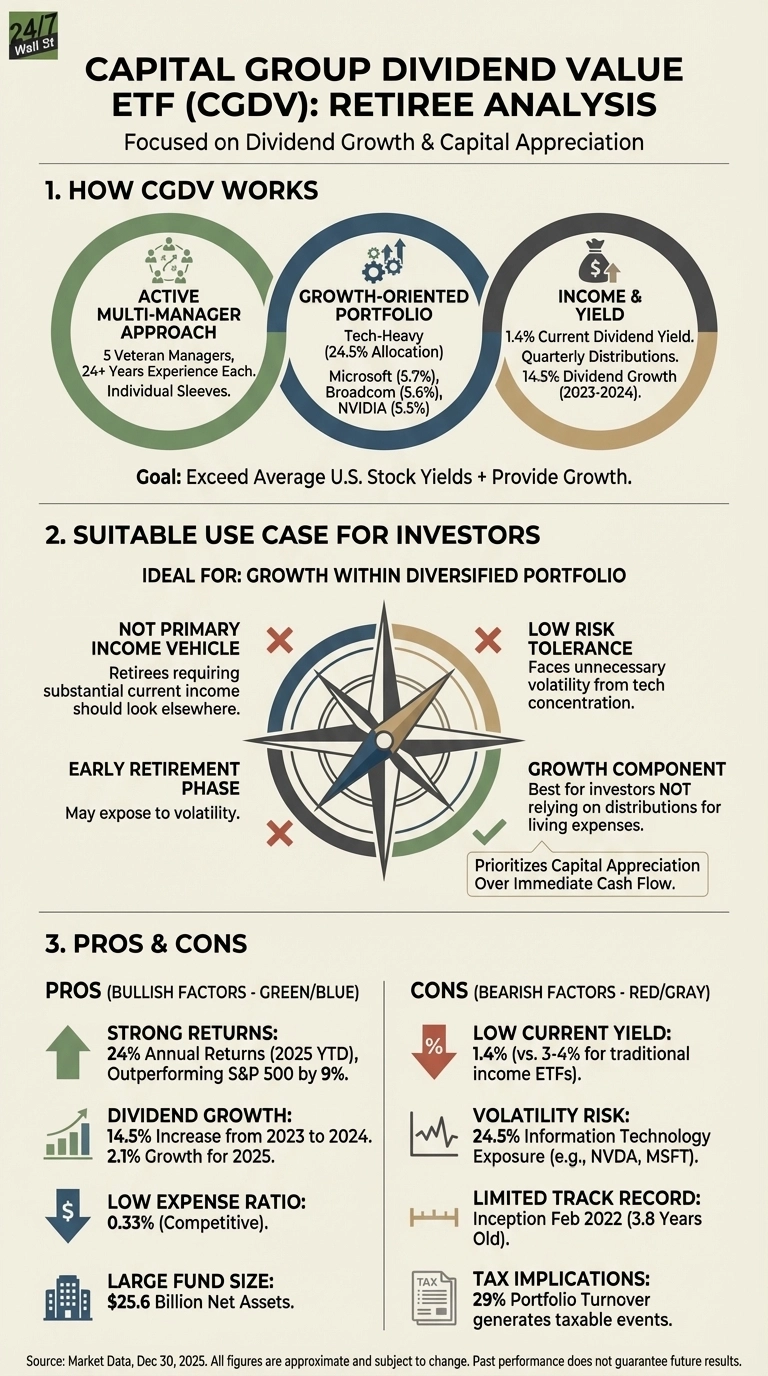
An infographic titled 'Capital Group Dividend Value ETF (CGDV): Retiree Analysis' focused on Dividend Growth & Capital Appreciation. Section 1, 'How CGDV Works', shows three interconnected circles: 'Active Multi-Manager Approach' (5 Veteran Managers, 24+ Years Experience Each), 'Growth-Oriented Portfolio' (Tech-Heavy 24.5% Allocation, with Microsoft 5.7%, Broadcom 5.6%, NVIDIA 5.5%), and 'Income & Yield' (1.4% Current Dividend Yield, Quarterly Distributions, 14.5% Dividend Growth 2023-2024). The goal is to 'Exceed Average U.S. Stock Yields + Provide Growth'. Section 2, 'Suitable Use Case for Investors', displays a compass icon surrounded by four quadrants indicating suitability: 'Not Primary Income Vehicle' (cross mark), 'Low Risk Tolerance' (cross mark), 'Early Retirement Phase' (cross mark), and 'Growth Component' (check mark, prioritizing Capital Appreciation Over Immediate Cash Flow). Section 3, 'Pros & Cons', lists 'Pros' in a green/blue column: Strong Returns (24% Annual Returns 2025 YTD), Dividend Growth (14.5% Increase from 2023 to 2024), Low Expense Ratio (0.33%), Large Fund Size ($25.6 Billion Net Assets). The 'Cons' are in a red/gray column: Low Current Yield (1.4% vs. 3-4% for traditional income ETFs), Volatility Risk (24.5% Information Technology Exposure), Limited Track Record (Inception Feb 2022, 3.8 Years Old), Tax Implications (29% Portfolio Turnover generates taxable events).
24/7 Wall St.
This infographic details the Capital Group Dividend Value ETF (CGDV), outlining its operational approach, suitable use cases for investors, and a balanced view of its pros and cons for retirees.

Performance Exceeds Expectations

CGDV outperformed the S&P 500 by nearly 10 percentage points in 2025. From October 2007 through August 2025, the underlying strategy generated 10.2% annualized returns gross of fees, outperforming the Russell 1000 Value Index by 2.7 percentage points annually. However, it lagged the S&P 500 by 29 basis points during that period.


The Income Trade-Off

Retirees must accept three significant tradeoffs. First, the 1.4% yield generates minimal current income. A $100,000 investment produces roughly $1,400 annually, versus $3,800 from a 3.8% yielding alternative. Second, tech-heavy exposure creates volatility and downside risk during sector rotations. Third, the fund’s 3.8-year track record provides limited evidence through complete market cycles.

CGDV’s 29% portfolio turnover generates taxable events. Retirees in higher tax brackets should weigh this against growth potential.

Wrong Fit for Traditional Income Seekers

CGDV fails two common retiree profiles. Those requiring substantial current income to cover living expenses should look elsewhere. The 1.4% yield cannot support meaningful withdrawal rates without depleting principal. Retirees with low risk tolerance or those early in retirement face unnecessary volatility from tech concentration and growth orientation.

Consider SCHD for Higher Current Income

Schwab U.S. Dividend Equity ETF (NYSEARCA:SCHD) offers a compelling alternative with a 3.8% yield and defensive sector positioning. The fund delivers nearly triple CGDV’s income while maintaining the same 0.06% expense ratio. SCHD allocates 19.5% to Energy and 18.4% to Consumer Staples, providing inflation protection and recession resistance that CGDV lacks.

CGDV works best as a growth component within a diversified retirement portfolio for investors who don’t rely on distributions for living expenses, but falls short as a primary income vehicle for retirees needing substantial cash flow today.


Photo of Michael Williams
About the Author Michael Williams →

I am a long time investor and student of business, and believe finding good companies that can become great investments is the best game on earth. After 20 years of writing and researching the public markets it is clear that individuals have never had more tools and information to take control of their financial lives. From ETFs and $0 commissions to cryptos and prediction markets there has never been a greater democratization of access to investing. 

I write to help people understand the investments available to them so they can make the best choice for their portfolio, whether they're starting out or looking for income in retirement. 

Featured Reads

Our top personal finance-related articles today. Your wallet will thank you later.

Continue Reading

Top Gaining Stocks

CBOE Vol: 1,568,143
PSKY Vol: 12,285,993
STX Vol: 7,378,346
ORCL Vol: 26,317,675
DDOG Vol: 6,247,779

Top Losing Stocks

LKQ
LKQ Vol: 4,367,433
CLX Vol: 13,260,523
SYK Vol: 4,519,455
MHK Vol: 1,859,865
AMGN Vol: 3,818,618