
Wake up! Social Security’s Real Threat Isn’t Insolvency, It’s Inflation

Photo of Michael Williams
By Michael Williams Published

Quick Read

  • Inflation eroding purchasing power poses a greater threat to retirees than potential Social Security policy changes.

  • Cost-of-living adjustments consistently lag actual price increases. Healthcare and housing costs often rise faster.

  • Delaying Social Security claiming creates a higher base benefit for future inflation adjustments to compound from.

This post may contain links from our sponsors and affiliates, and Flywheel Publishing may receive compensation for actions taken through them.
Wake up! Social Security’s Real Threat Isn’t Insolvency, It’s Inflation

© 24/7 Wall St.

Social Security’s trust fund faces funding challenges in the coming years, triggering headlines about benefit cuts and financial doom. But for most retirees, potential policy changes aren’t the real threat. The bigger risk is quieter and more relentless: inflation steadily eroding what each monthly check can buy.

Understanding this distinction changes how you should think about retirement income and when to claim benefits. Policy debates get attention, but inflation affects every retiree, every year, for decades.

The Inflation Risk That Never Stops

Inflation’s damage accumulates slowly over a typical retirement. Social Security’s cost-of-living adjustments are designed to protect retirees from inflation, but these adjustments consistently lag behind actual price increases. When inflation spiked in recent years, retirees endured months of eroding purchasing power before their benefits caught up.
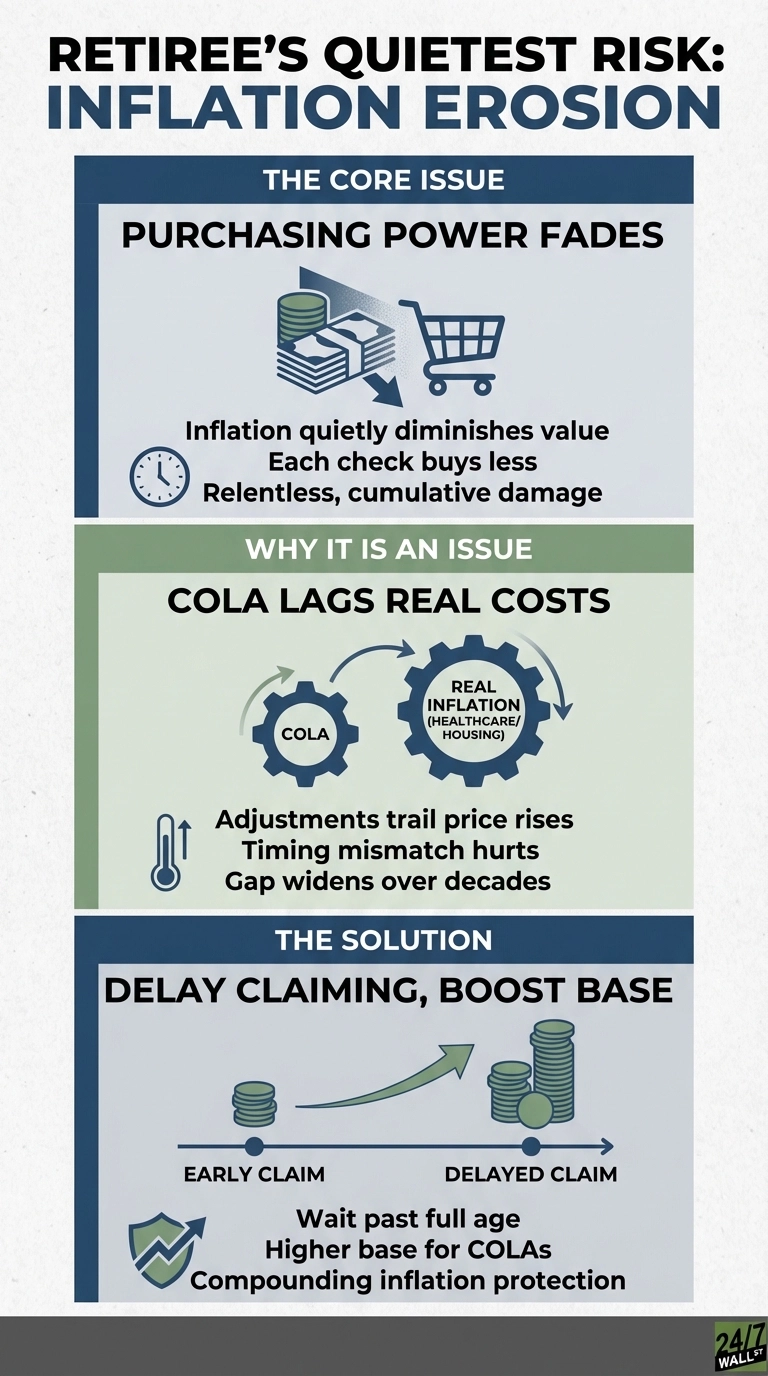
An infographic titled 'Retiree's Quietest Risk: Inflation Erosion' is divided into three sections. The first, 'The Core Issue: Purchasing Power Fades', shows money turning into a shopping cart with a downward arrow, symbolizing that inflation diminishes value and checks buy less, with an accompanying clock icon. The second section, 'Why It Is An Issue: COLA Lags Real Costs', depicts two interlocking gears, one labeled 'COLA' and the other 'REAL INFLATION (HEALTHCARE/HOUSING)', with arrows showing real inflation outpacing COLA, indicating adjustments trail price rises. A thermometer with an upward arrow reinforces this point. The third section, 'The Solution: Delay Claiming, Boost Base', illustrates a timeline showing 'EARLY CLAIM' with a small stack of coins and 'DELAYED CLAIM' with a much larger, growing stack of coins, indicating that waiting past full age leads to a higher base for COLAs and compounding inflation protection. A shield icon represents protection.
24/7 Wall St.
This infographic illustrates how inflation erodes retiree purchasing power over time. It explains why Cost of Living Adjustments (COLAs) often lag real costs and suggests delayed Social Security claiming as a solution to mitigate this risk.

This timing mismatch hits hardest for healthcare and housing costs, which often rise faster than the general inflation rate used to calculate COLAs. The gap between initial benefits and what’s needed to maintain living standards grows over time, explaining why many retirees feel financially squeezed despite receiving annual adjustments.

How This Changes Your Claiming Decision

The inflation risk makes delaying Social Security more valuable than many retirees realize. Each year you wait past full retirement age increases your benefit, creating a higher base for all future COLA increases to compound from.

Someone who claims early receives a lower starting amount that adjusts for inflation over time. Waiting longer means those same percentage increases apply to a larger base. Over a multi-decade retirement, that difference compounds substantially as each year’s inflation adjustment builds on a larger foundation.

What Actually Deserves Your Attention

Rather than fixating on policy debates, focus on building inflation resistance into your retirement plan. Consider drawing down other retirement accounts first if you can afford to delay Social Security. The guaranteed income stream that grows with inflation becomes more valuable as you age and face higher healthcare costs.

The stock market will have volatile years, with significant gains in some periods and sharp drawdowns in others. Social Security provides something different: inflation-adjusted income you can’t outlive. In a retirement that might span three decades, that protection against rising prices deserves careful consideration in your claiming strategy.


Photo of Michael Williams
About the Author Michael Williams →

I am a long time investor and student of business, and believe finding good companies that can become great investments is the best game on earth. After 20 years of writing and researching the public markets it is clear that individuals have never had more tools and information to take control of their financial lives. From ETFs and $0 commissions to cryptos and prediction markets there has never been a greater democratization of access to investing. 

I write to help people understand the investments available to them so they can make the best choice for their portfolio, whether they're starting out or looking for income in retirement. 

Featured Reads

Our top personal finance-related articles today. Your wallet will thank you later.

Continue Reading

Top Gaining Stocks

CBOE Vol: 1,568,143
PSKY Vol: 12,285,993
STX Vol: 7,378,346
ORCL Vol: 26,317,675
DDOG Vol: 6,247,779

Top Losing Stocks

LKQ
LKQ Vol: 4,367,433
CLX Vol: 13,260,523
SYK Vol: 4,519,455
MHK Vol: 1,859,865
AMGN Vol: 3,818,618