



IonQ’s (NYSE:IONQ | IONQ Price Prediction) business appears to have found a solid foundation. Fourth-quarter revenue, driving full-year revenue to $130 million — making IonQ the first publicly traded quantum computing company to cross the $100 million annual revenue mark.
Commercial customers now account for more than 60% of sales, with international revenue exceeding 30%. Yet losses widened as the company invested aggressively in scaling its semiconductor-based roadmap and next-generation systems. There’s a clear disconnect as the trajectory points to explosive growth and real-world adoption versus a story of heavy R&D spending.
Now, with IonQ doubling down on its government credentials with fresh military collaborations, is it the only quantum computing stock investors should consider buying?
Revenue Milestone Signals Rapid Expansion
IonQ didn’t just post strong numbers — it rewrote the quantum industry playbook. By becoming the first pure-play quantum stock to eclipse $100 million in annual revenue — Q4 revenue surged 426% to $61.9 million, pushing full-year revenue to $130 million
— the company proved that trapped-ion technology is moving beyond lab experiments into commercial traction. Management is guiding for $225 million to $245 million in 2026 revenue, nearly doubling the 2025 figure, while maintaining an 80%+ organic growth rate.
This isn’t hype. More than half the revenue now comes from paying enterprise customers who see quantum as a competitive edge in optimization, simulation, and machine learning. The rapid expansion is fueled by IonQ’s full-stack approach: hardware, cloud access, and error-corrected algorithms that deliver measurable value today.
While pure research still dominates many competitors’ books, IonQ’s commercial mix signals it is pulling ahead in the race to utility-scale quantum.
Making an Academic Push
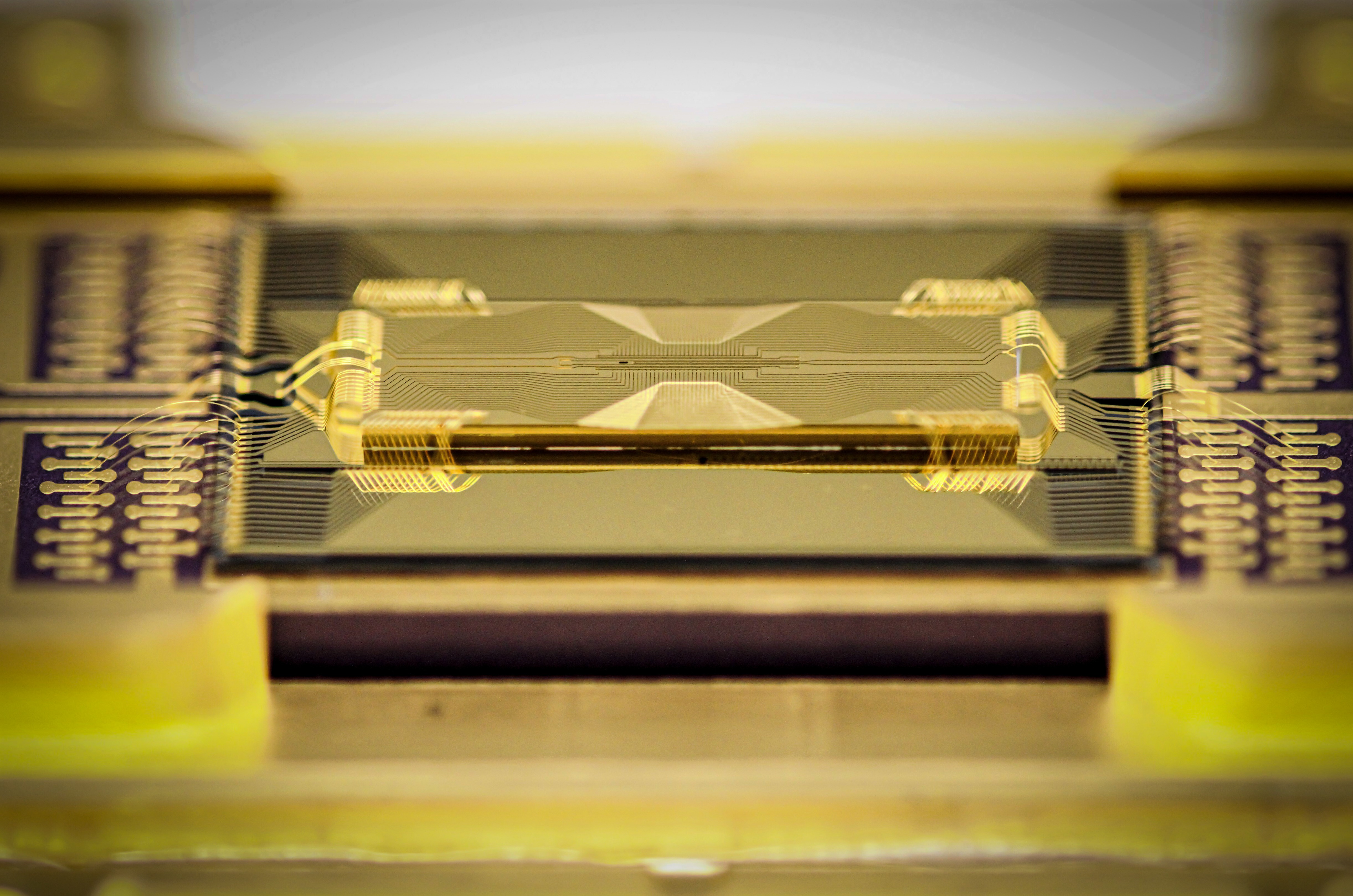
This morning, IonQ announced a landmark agreement with the University of Cambridge to establish the IonQ Quantum Innovation Centre — the company’s largest-ever academic collaboration in the U.K. The deal goes far beyond a simple research pact. IonQ will deploy its sixth-generation, chip-based 256-qubit system directly on campus, giving researchers and industry partners immediate cloud access to one of the most powerful quantum machines available anywhere.
The center will accelerate commercialization of quantum technologies across computing, networking, sensing, and security. It also positions IonQ to generate new intellectual property while training the next generation of quantum talent. For investors, this is more than prestige; it’s a clear path to future revenue streams as Cambridge’s ecosystem spins out startups and enterprise pilots that run on IonQ hardware.
IonQ’s Growing Defense Focus
Of equal — or perhaps greater — importance is IonQ’s deepening footprint in national security. Just yesterday, the company revealed a collaboration with the Applied Research Laboratory for Intelligence and Security (ARLIS) on the Air Force-backed SEQCURE program. SEQCURE (Securing Experimental Quantum Computing Usage in Research Environments) will define Zero Trust Architecture standards for future quantum systems. IonQ and ARLIS are analyzing commercial security practices to create continuous-verification frameworks that protect hardware, software, data, and cloud environments across federal and commercial settings.
This builds directly on IonQ’s February selection to participate in the Missile Defense Agency’s $151 billion SHIELD IDIQ contract. SHIELD — Scalable Homeland Innovative Enterprise Layered Defense — gives IonQ a seat at the table to compete for task orders delivering quantum computing, networking, and sensing solutions to the warfighter. With more than 2,400 other vendors also eligible, IonQ’s inclusion signals it is now viewed as a credible, mission-ready partner for the most sensitive defense applications.
Together, these moves transform IonQ from a promising quantum hardware player into a strategic national-security asset — exactly the kind of durable moat long-term investors crave.
Key Takeaway
Quantum computing was all the rage for a period, but the fever subsided as investors realized viable, fault-tolerant systems are still years away. The technological leaps required remain enormous, yet interest has ticked up again, and the long-term promise is undeniable. While many pure-play names continue to burn cash with little revenue to show, IONQ has set the foundation for tremendous growth opportunities. It is scaling revenue faster than any peer, forging elite academic partnerships, and embedding itself in the defense establishment that will ultimately fund and protect the technology’s most critical use cases.
When the quantum future finally arrives, investors who buy IonQ stock now at these lower price points should reap the rewards that latecomers will chase once every question mark disappears. In a sector full of speculation, IonQ is playing solid defense while positioning for offense. That makes it the only quantum computing stock worth owning today.













 Top Gaining Stocks
 Top Losing Stocks