


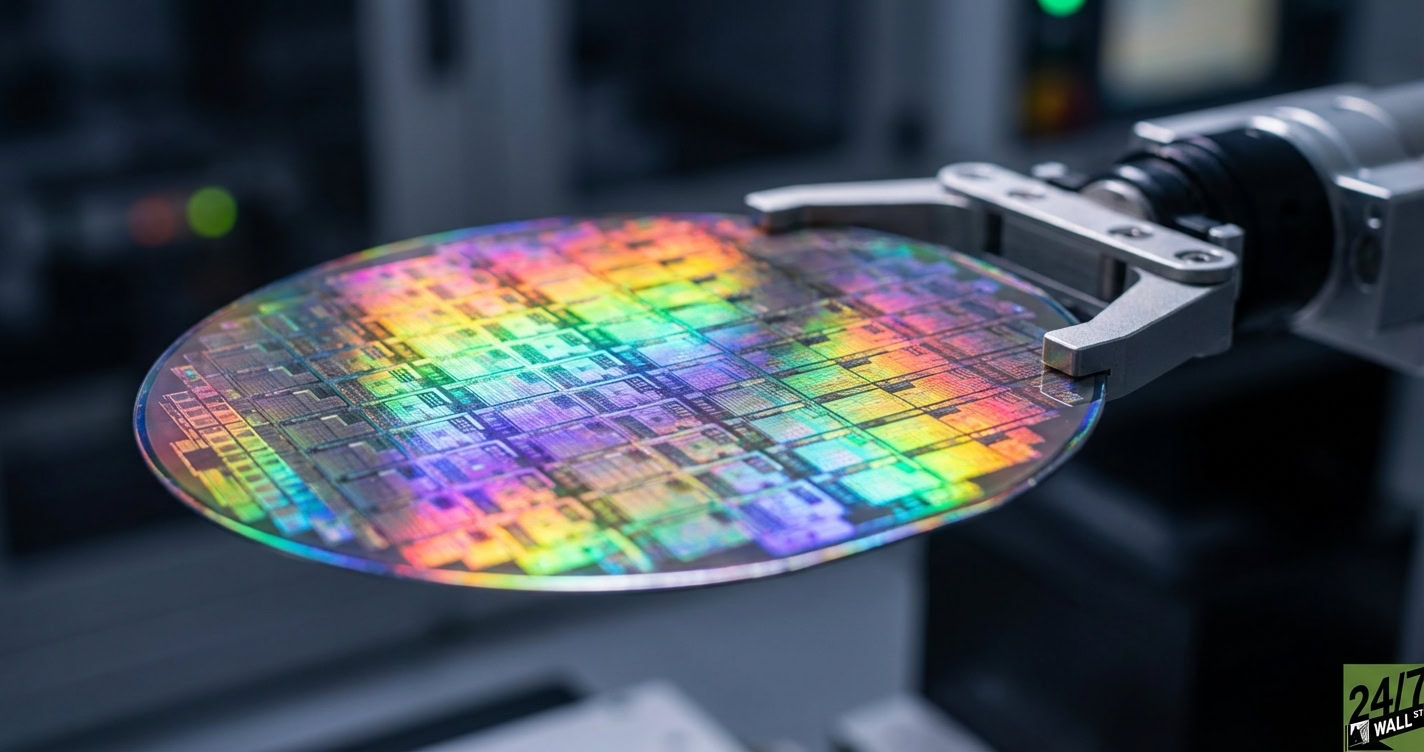
ASML (NASDAQ:ASML) dominates the semiconductor equipment market with its extreme ultraviolet (EUV) lithography technology, essential for producing the world’s most advanced chips. No competitors can match its precision in etching circuits at nanoscale levels, creating a monopoly on tools that power the AI surge.
Chipmakers like Taiwan Semiconductor Manufacturing (NYSE:TSM | TSM Price Prediction), Intel (NASDAQ:INTC), and Samsung rely on ASML machines to fabricate high-performance processors for data centers and AI applications. The stock has climbed 145% from its 52-week low, and is already up 32% in 2026 as demand keeps growing.
As ASML is scheduled to report fourth quarter earnings tomorrow before the market opens, one Wall Street analyst just hiked his price target to a Street-high $1,642 per share, 7% above his prior target and 16% above today’s trading price of $1,413 per share. At such a lofty price, is ASML stock a buy?
What ASML Delivers and Why Rivals Can’t Compete
ASML designs and manufactures lithography systems that use light to print intricate patterns on silicon wafers, a core step in chip production. Its EUV systems employ 13.5-nanometer (nm) wavelengths to create features below 5 nm — critical for next-generation semiconductors.
The company achieved this through over 30 years of R&D, starting in the 1990s when it pivoted from older deep ultraviolet (DUV) tech while competitors like Nikon and Canon abandoned EUV due to its complexity and costs. ASML’s edge comes from over 800 specialized suppliers, thousands of patents, and engineering feats like generating plasma with lasers to produce EUV light. This creates insurmountable barriers for rivals, as replicating the technology would require billions in investment and decades to catch up, solidifying ASML’s 100% EUV market share.
am
Why ASML Powers the AI Chip Race
EUV enables denser, faster chips vital for AI training and inference, fueling demand from Nvidia (NASDAQ:NVDA) and others building GPUs for cloud AI services. Without ASML’s tools, advanced nodes for AI workloads — like those in data centers from Apple (NASDAQ:AAPL), Google, and Qualcomm (NASDAQ:QCOM) — would stall.
This ties ASML to the AI boom, where global chip capex is rising: Taiwan Semiconductor plans to spend $56 billion, up 37%; Samsung, $40 billion, up 24%, SK Hynix, $22 billion, a 25% increase, and Micron (NYSE:MU), $20 billion, 45% more. Lithography absorbs about 25% of that spend, mostly flowing to ASML.
AI-driven orders have boosted ASML’s finances. In Q3, net sales hit 7.5 billion euros (or $8.78 billion) with a 51.6% gross margin and 2.1 billion euros in net income. Full-year 2025 sales are projected at 32.5 billion euros, up 15% year-over-year. Profits benefit from high margins on EUV systems, which command premium pricing.
A standard EUV machine costs $200 million to $300 million, while High-NA models reach $380 million to $400 million each. In 2024, ASML sold 44 EUV units, contributing 38% of system revenue. This scarcity drives scarcity value, with its market cap exceeding $547 billion as shares doubled since last April.
What Wall Street Forecasts
Wall Street expects Q4 earnings of $9.01 per share and revenue of $11.06 billion, up 23.4% and 11.9%, respectively, year-over-year. Management guided to 9.2 billion to 9.8 billion euro in sales (about $10.1 billion to $10.8 billion at current rates) and 51% to 53% gross margin.
The consensus outlook tops the high end, signaling analysts have optimism ASML will beat guidance again as it has for the past four quarters. They also believe Q4 orders may exceed 8 billion euros as AI capex ramps higher.
Key Takeaway
ASML’s legal monopoly on EUV in the exploding AI industry positions it as a must-buy, even above $1,400 per share. With no viable rivals and structural demand from AI compute needs, government subsidies, and edge tech, ASML offers enduring pricing power and growth. Risks like geopolitics exist, but its broad and deep moat ensures there is long-term upside in its stock.









 Top Gaining Stocks
 Top Losing Stocks