



One of a Kind Opportunities
Monopolies often carry a negative connotation, viewed as market-dominating giants that stifle competition and invite regulatory scrutiny. Governments worldwide, from the U.S. to the EU, have historically intervened to break up or regulate such entities to protect consumers and foster innovation.
Yet, natural monopolies can emerge organically when a company achieves unparalleled expertise, technological superiority, or market dominance through innovation rather than predatory tactics.
While these firms face potential competition and some have smaller rivals, their grip on their respective industries makes them compelling investment opportunities. Today, three companies stand out as monopolistic powerhouses, offering investors a chance to capitalize on their unmatched market positions.
Taiwan Semiconductor Manufacturing (TSM)
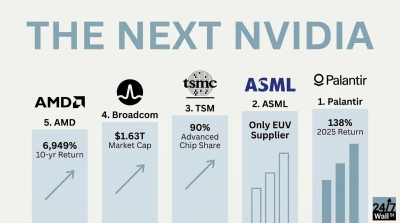
Taiwan Semiconductor Manufacturing (NYSE:TSM | TSM Price Prediction) dominates the global foundry market, particularly in advanced semiconductor fabrication. As the world’s largest pure-play foundry, TSM produces chips for tech giants like Apple (NASDAQ:AAPL), Nvidia (NASDAQ:NVDA), and Advanced Micro Devices (NASDAQ:AMD), commanding over 60% of the global foundry market and an even higher share in cutting-edge nodes like 3 nanometer (nm) and 5nm. Its monopoly stems from its technological lead, massive economies of scale, and unmatched production capacity.
The foundry’s advanced nodes are critical for artificial intelligence (AI), 5G, and high-performance computing, markets with explosive growth potential. Despite geopolitical risks, such as tensions over Taiwan, TSM’s role as the backbone of the global tech supply chain is unrivaled.
Smaller competitors like GlobalFoundries (NYSE:GFS) lag far behind in advanced process technology, and even Intel’s (NASDAQ:INTC) foundry ambitions are years away from catching up. TSM’s consistent revenue growth — projected at 25% to 30% annually through 2026 — and strong margins make it a must-own for investors betting on the semiconductor boom.
ASML Holding (ASML)
ASML Holding (NASDAQ:ASML) holds a virtual monopoly in extreme ultraviolet (EUV) lithography machines, the critical technology for manufacturing advanced semiconductors. These machines, costing upwards of $300 million each, are essential for producing chips at 7nm nodes and below, used in everything from smartphones to AI data centers.
ASML’s dominance is rooted in decades of R&D, complex supply chain partnerships, and intellectual property barriers that make it nearly impossible for competitors to replicate its technology in the short term. It is the exclusive supplier of EUV machines to giants like TSM, Samsung, and Intel.
While competitors like Nikon and Canon exist, they lack EUV capabilities, leaving ASML without serious rivals. With global chip demand soaring and ASML shipping increasing numbers of EUV systems — it is anecdotally sshipping five times more to Samsung and SK Hynix than to Micron Technology (NASDAQ:MU) — the company’s revenue growth is robust, with analysts projecting 20% annual increases through 2027. ASML’s monopoly makes it a cornerstone of the tech ecosystem, ideal for long-term investors.
Sherwin-Williams (SHW)
Although paint is ubiquitous and available from numerous manufacturers, Sherwin-Williams (NYSE:SHW) commands the U.S. architectural coatings market, holding an estimated 70% share of the paint and coatings industry.
Its dominance comes from its vertically integrated model, controlling production, distribution, and retail through thousands of company-owned stores. This setup allows SHW to maintain pricing power and brand loyalty with products like Valspar and its namesake paints.
The U.S. housing and construction markets, while cyclical, provide steady demand, and SHW’s scale deters smaller competitors like PPG Industries (NYSE:PPG), which struggle to match its distribution network.
Sherwin-Williams’ monopoly is less tech-driven but equally resilient, with consistent revenue growth (5% annually, on average, over the past five years) and strong margins. Its ability to pass on cost increases without losing market share makes it a defensive yet growth-oriented investment for portfolios seeking stability.












 Top Gaining Stocks
 Top Losing Stocks