



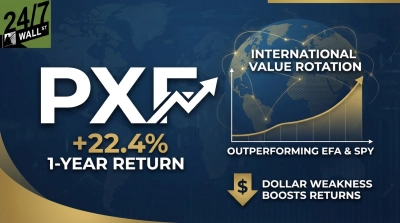
For investors seeking international developed market exposure without traditional market-cap weighting, Invesco RAFI Developed Markets ex-U.S. ETF (NYSEARCA:PXF) offers a fundamentally different approach. PXF uses Research Affiliates’ methodology to weight companies by sales, cash flow, dividends, and book value rather than share price. The result is a portfolio tilting toward value characteristics while maintaining broad diversification across developed markets outside the United States.
A Value Tilt With Global Reach
PXF’s portfolio reflects its fundamental weighting strategy through concentrated positions in established multinationals that generate substantial cash flows and dividends—the exact metrics RAFI methodology targets. Samsung Electronics (OTC:SSNLF) leads at 2.8% of assets because its semiconductor business produces massive revenue streams, while energy giants Shell (NYSE:SHEL | SHEL Price Prediction) and TotalEnergies (NYSE:TTE) together represent 3% of assets due to their dividend-rich business models. The fund also holds meaningful stakes in major international banks and automotive leaders like Toyota Motor (NYSE:TM), all selected for their strong fundamental metrics rather than market capitalization.
PXF’s fundamental weighting approach has delivered strong long-term results by identifying undervalued companies before markets recognize their worth. The fund nearly doubled capital over five years with a 96% return as the strategy of selecting companies by business fundamentals rather than market sentiment paid off. This value-oriented approach has accelerated recently as international stocks rebounded from years of underperformance, with the fund gaining 48% over the past year and pushing shares to around $71—significantly outpacing both U.S. markets and traditional market-cap weighted international alternatives.
Income Plus Capital Appreciation
PXF delivers more than just price appreciation—it generates meaningful quarterly income for shareholders. Income generation strengthened significantly in 2025 as the fund distributed $2.38 per share, a 43% increase from the prior year’s $1.66 driven by improving profitability among energy and financial holdings. This translates to a 2.5% yield that provides quarterly cash flow, with distributions varying seasonally based on when underlying companies pay dividends.
The Fundamental Weighting Tradeoff
PXF’s strategy comes with clear tradeoffs that stem from its fundamental weighting methodology. The fund’s emphasis on cash flow, dividends, and book value naturally leads to higher concentrations in traditional value sectors. Energy and materials companies represent roughly 10% of holdings because these businesses generate substantial cash flows and pay consistent dividends—exactly what RAFI methodology seeks. Financial services accounts for another 8% for similar reasons, as banks with strong balance sheets score highly on fundamental metrics. Meanwhile, information technology exposure sits near zero because many tech companies prioritize growth over current profitability and dividends.
This creates meaningful style drift during periods when growth stocks outperform value, and the 0.45% expense ratio runs higher than broad market-cap weighted alternatives. Currency exposure across the euro, British pound, Japanese yen, and other non-dollar currencies adds another layer of volatility that can either help or hurt returns depending on exchange rate movements.
PXF works best as a complement to U.S. equity holdings for investors who believe fundamental metrics provide better long-term value signals than market prices alone, and who can accept sector concentrations and higher costs in exchange for that approach.











 Top Gaining Stocks
 Top Losing Stocks