


The Invesco RAFI Emerging Markets ETF (NYSEARCA:PXH) has surged 38% over the past year as investors rediscover emerging market opportunities. This rally reflects a fundamental shift in how the fund approaches EM investing—using metrics like sales and cash flow rather than market cap to weight holdings. That methodology has delivered results, with shares climbing from around $20 to $27.70 by late January 2026.
With $1.7 billion in assets, the fund concentrates on Asia’s largest companies measured by fundamental strength rather than market hype. This approach leads to holdings like Tencent and HDFC Bank (NYSE:HDB | HDB Price Prediction)—established businesses generating consistent cash flows that justify their economic weight in the portfolio. The 0.49% expense ratio reflects Invesco’s ability to deliver this selective strategy without excessive costs.
Emerging markets spent years in the wilderness as investors favored U.S. equities. That changed when U.S.-China trade tensions eased and the Federal Reserve pivoted toward rate cuts. The International Monetary Fund now projects Asia-Pacific will drive the majority of global growth, with regional economies expanding at a healthy pace that justifies renewed investor interest.
Watch the Fed’s Rate Path and Dollar Weakness
U.S. monetary policy drives PXH’s performance through a clear mechanism: when the Fed cuts rates and the dollar weakens, emerging market borrowers face lower debt service costs while their equity valuations become more attractive to global investors. The Fed’s late-2025 pivot toward rate cuts triggered exactly this dynamic, catalyzing the capital flows that have powered PXH’s recent rally.
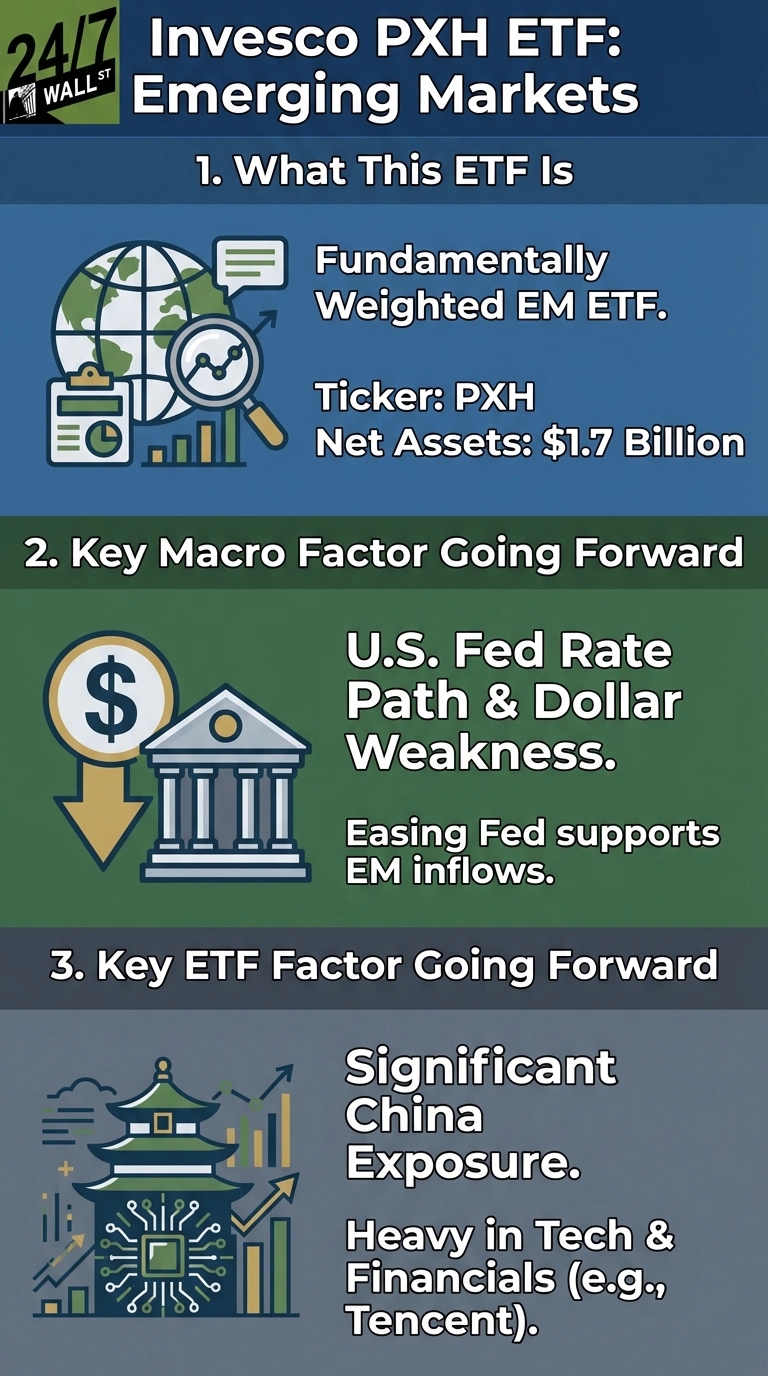
Investors should monitor Federal Reserve policy statements and monthly consumer price index releases. If inflation remains contained and the Fed continues easing, that creates a supportive environment for emerging market equities. Any reversal in rate policy or unexpected dollar strength could quickly reverse recent gains. The dollar index and 10-year Treasury yields serve as real-time indicators of this dynamic.
China Exposure Cuts Both Ways
Chinese financials and technology form the core of PXH’s portfolio, with Tencent and major banks combining for meaningful exposure. This concentration creates a direct bet on China’s economic trajectory and positions the fund to capture growth in high-value sectors like semiconductors and artificial intelligence. The fundamental weighting approach means these holdings were selected for their economic footprint rather than market hype.
The fund’s fundamental indexing methodology matters here. Unlike market cap-weighted funds that can become overexposed to overvalued names, RAFI’s approach weights companies by economic metrics like revenue and book value. This structure potentially offers better downside protection if China’s tech valuations compress, but it also means PXH may lag if momentum-driven rallies favor growth stocks. Investors can track this by reviewing Invesco’s quarterly fact sheets and comparing PXH’s sector allocations to traditional cap-weighted competitors like the iShares MSCI Emerging Markets ETF (NYSEARCA:EEM).
The key question for the next 12 months is whether the Fed maintains its dovish stance while China’s economic reforms gain traction, both of which would support PXH’s fundamental-weighted approach to capturing emerging market growth.










 Top Gaining Stocks
 Top Losing Stocks