



International value stocks have underperformed US counterparts for over a decade. But after DFIV’s 47% surge this past year, the question isn’t whether international value can work—it’s whether this moment represents genuine rotation or temporary reversal that could leave latecomers exposed.
Geographic Diversification With a Value Tilt
Dimensional International Value ETF (NYSEARCA:DFIV | DFIV Price Prediction) provides exposure to undervalued companies in developed markets outside the United States. The fund uses active, research-driven approaches to identify stocks trading below intrinsic value while emphasizing strong profitability metrics. Unlike passive international funds tracking market-cap-weighted indexes, DFIV systematically tilts toward value characteristics, financial health indicators, and smaller market capitalizations.
The return engine combines two forces: potential revaluation of underpriced stocks and dividend income. With current dividend yield near 3%, DFIV delivers meaningful cash flow alongside capital appreciation potential. The fund’s 16% annual turnover rate keeps trading costs and tax consequences relatively contained.
Top holdings reveal the strategy in practice. European energy giants like Shell (NYSE:SHEL) and TotalEnergies (NYSE:TTE) sit alongside financial institutions including Banco Santander (NYSE:SAN), HSBC (NYSE:HSBC), and Société Générale (OTC:SCGLY). Japanese industrials like Toyota (NYSE:TM) and materials companies such as BASF (OTC:BASFY) round out a portfolio heavily weighted toward sectors trading at depressed valuations.
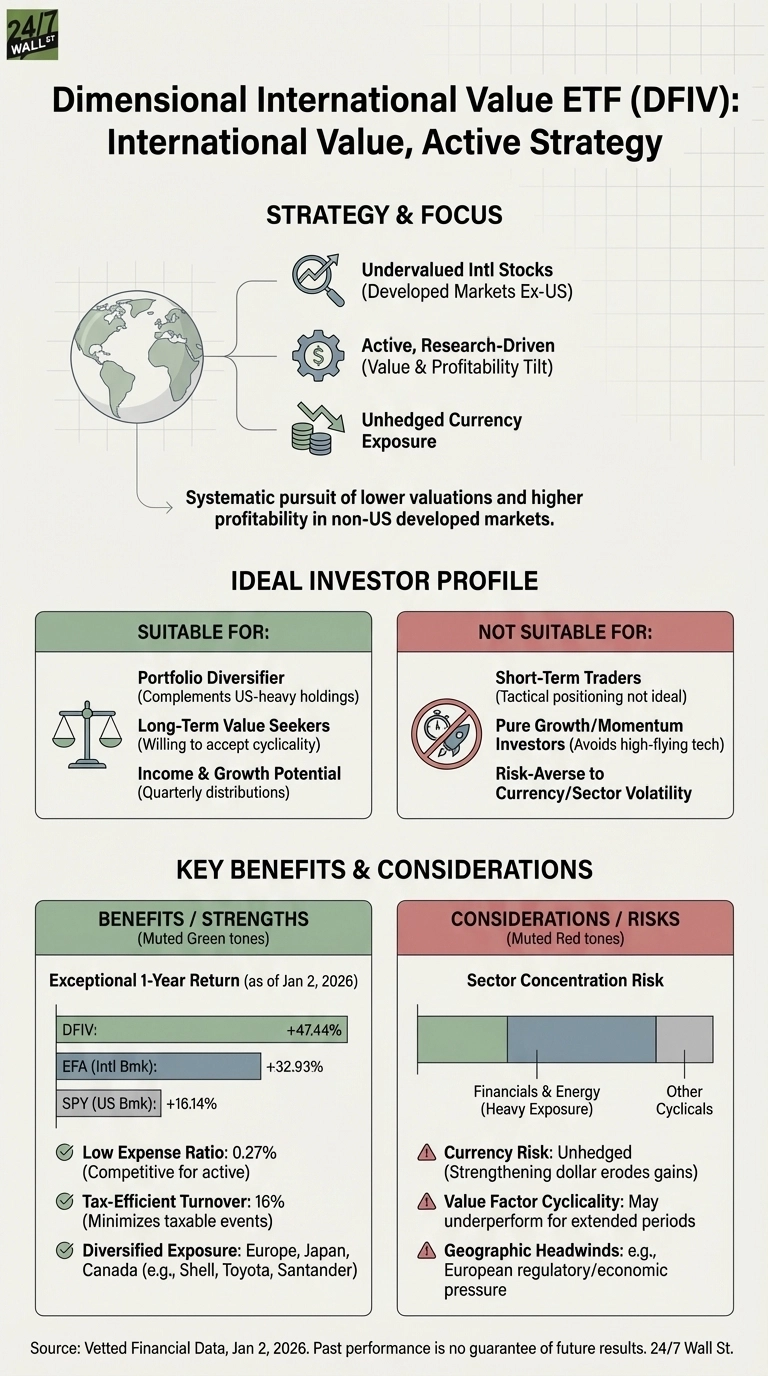
Exceptional Recent Performance Raises Questions
DFIV delivered spectacularly over the past year, gaining 47% compared to just 16% for the S&P 500. More striking, it outpaced the standard developed international benchmark iShares MSCI EAFE ETF (NYSEARCA:EFA) by roughly 14 percentage points and crushed US value strategies by over 30 percentage points.
This performance validates the international value thesis but complicates decisions for new investors. Much of the gain reflects catch-up after years of underperformance. Financial advisors have taken notice. As one institutional investor noted in late 2025, firms are making DFIV a top-five holding at allocation levels exceeding 5% of total portfolios, suggesting high conviction in the strategy’s continued relevance.
Currency Risk and Concentration Trade-Offs
International investing introduces complexities domestic strategies avoid. Currency fluctuations can amplify or diminish returns unpredictably. DFIV holds unhedged positions, meaning a strengthening dollar erodes gains even when underlying stocks perform well.
The portfolio concentrates heavily in European financials and energy companies—sectors vulnerable to regional economic slowdowns, regulatory pressure, and commodity price swings. While diversification across countries provides some buffer, sector concentration remains meaningful. Investors must accept cyclical volatility and the possibility that value factors underperform for extended periods.
Not for Short-Term Traders or Growth-Focused Portfolios
DFIV makes little sense for investors seeking momentum or growth characteristics. The fund explicitly avoids high-flying technology and healthcare innovators in favor of mature, often unloved businesses. Similarly, short-term traders will find the fund’s quarterly dividend structure and value orientation poorly suited to tactical positioning.
Consider VXUS for Broader International Exposure
Vanguard Total International Stock ETF (NYSEARCA:VXUS) offers a compelling alternative for investors wanting international diversification without the value tilt. VXUS charges just 0.08% annually versus DFIV’s 0.27%, provides exposure to both value and growth stocks across developed and emerging markets, and includes thousands of holdings rather than concentrating in specific sectors. The tradeoff: VXUS sacrifices potential alpha from active value selection in exchange for lower costs and broader market representation.
DFIV works best as a complement to US-heavy portfolios for investors comfortable with value factor risk and willing to accept currency volatility in exchange for international diversification and income generation.












 Top Gaining Stocks
 Top Losing Stocks