


The Virtus InfraCap U.S. Preferred Stock ETF (NYSEARCA:PFFA) delivers a 9.5% yield, but many retirees are missing it.
How PFFA Generates Its Yield
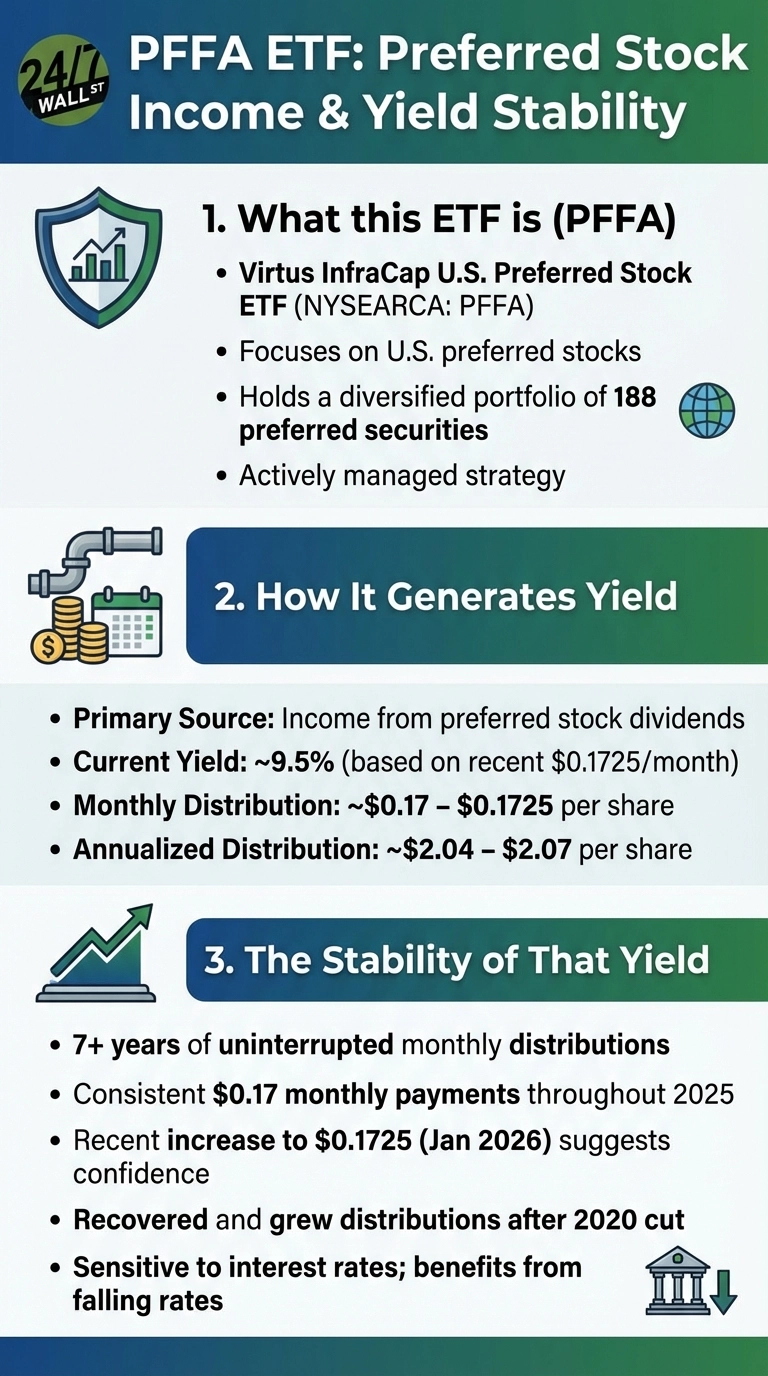
PFFA holds a diversified portfolio of 188 preferred securities issued by corporations. These preferred stocks function as a hybrid between bonds and common equity, with companies issuing them at fixed dividend rates that flow through to PFFA shareholders as monthly distributions.
The fund’s largest positions reveal a strategic approach to income generation. Financial powerhouses like Apollo Global Management (NYSE:APO | APO Price Prediction) and KKR (NYSE:KKR) anchor the portfolio with their convertible preferreds, providing stability through investment-grade credits. This quality foundation allows the fund to layer in higher-yielding components from energy infrastructure and regional banking, boosting the overall distribution rate while maintaining diversification across nearly 200 holdings.
The Interest Rate Factor
Preferred stock valuations move inversely to interest rates, which is the primary risk for PFFA’s dividend sustainability. When rates rise, fixed dividends become less attractive and prices fall. When rates fall, preferred stocks typically appreciate because their fixed yields look more compelling.
The Federal Reserve’s policy shift has created a supportive backdrop for preferred stocks. After aggressive rate hikes peaked in 2023, the Fed pivoted to cuts in 2024, making fixed-income securities more attractive. This environment has lifted PFFA’s price significantly while the fund maintained its distributions, demonstrating how rate policy directly impacts preferred stock valuations.
Total Return Reality Check
PFFA’s total return story goes beyond just the yield. The fund has delivered meaningful price appreciation over the past year, meaning investors collected high monthly distributions while their principal grew. This pattern of combining income with capital gains has held over longer periods, with the active management approach justifying the fund’s elevated expense ratio through outperformance.
The fund’s active management strategy comes at a cost through its elevated expense ratio, but this approach has delivered value through sector rotation and disciplined risk management. While the fund reduced its monthly payout during the March 2020 crisis, it has since recovered and grown distributions beyond pre-pandemic levels, demonstrating resilience through market stress.
Is the Dividend Safe?
PFFA’s dividend sustainability depends on three factors: the credit quality of preferred stock issuers, interest rate direction, and the fund’s ability to manage sector concentration risk. The diversified portfolio of 188 holdings provides a cushion against individual issuer problems. Major holdings like Apollo Global and KKR are investment-grade financial firms with stable business models.
If rates reverse and climb sharply, preferred stock valuations would compress, potentially forcing distribution cuts. However, the current economic environment suggests rates are more likely to remain stable or decline further, supporting PFFA’s ability to maintain its monthly payouts. For income investors willing to accept interest rate sensitivity, PFFA has demonstrated seven years of uninterrupted monthly distributions with gradual growth since the pandemic recovery.












 Top Gaining Stocks
 Top Losing Stocks