



Applied Digital (NASDAQ:APLD) has posted strong gains in 2026, rising nearly 68% year-to-date. The company has largely shaken off the concerns from last year over its heavy debt load used to finance rapid AI data center expansion.
Yesterday, its stock surged more than 14%, closing at $41.35 per share, and Nvidia (NASDAQ:NVDA | NVDA Price Prediction) deserves credit for the gain.
Debt Remains a Growing AI Headwind
The AI data center business runs on capital. Applied Digital carried over $2.6 billion in current and long-term debt against $1.9 billion in cash and equivalents at the end of its fiscal second quarter after a subsidiary issued $2.35 billion of 9.25% senior secured notes in November that are due in 2030 to fund new facilities and refinance older obligations. That coupon reflects today’s higher borrowing costs and underscores the leverage required to build power-hungry campuses ahead of revenue.
A Macquarie Group development loan facility subsequently closed in mid-December to provide up to $100 million for pre-lease planning and early construction. While the capital accelerates site readiness, it adds another layer of debt at a time when interest rates are not expected to fall materially in the near term.
Across the sector, the picture is similar. Hyperscalers issued $121 billion in bonds by the third quarter of 2025 — more than four times the prior five-year average — to finance AI infrastructure. Analysts at firms covering the space have highlighted the execution risks from the rising debt load: power delivery delays, slower-than-expected tenant ramp, and the possibility that AI capex budgets tighten. Applied Digital’s model depends on long-term leases being signed and paid; any slippage directly threatens its debt service coverage.
Nvidia to the Rescue?
On Monday, Nvidia announced a $2 billion investment in CoreWeave‘s (NASDAQ:CRWV) Class A common stock at $87.20 per share. The move deepens an existing partnership and brings CoreWeave’s total capital raised past $25 billion. However, critics immediately flagged the transaction as another example of the AI chipmaker’s circular financing deals — Nvidia investing in a major GPU buyer to support its own sales. CoreWeave’s CEO has previously said the allegation is “ridiculous,” noting Nvidia’s stake remains small relative to overall funding.
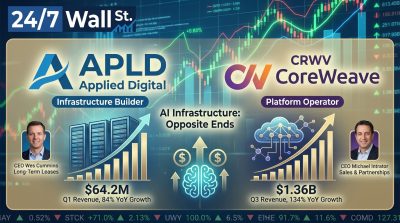
For Applied Digital, though, the transaction matters because CoreWeave is its anchor customer. The two companies have executed leases covering 400 megawatts (MW) of critical IT load at the Polaris Forge 1 campus in Ellendale, N.D. The agreements — finalized in stages through August — carry approximately $11 billion in anticipated contracted lease revenue, including $7 billion from the initial two roughly 15-year leases. The first 100 MW came online in late 2025, with additional phases scheduled for mid-2026 and 2027.
A financially stronger CoreWeave reduces near-term risk that the tenant might delay expansions or renegotiate terms. That perception alone helped lift Applied Digital shares yesterday. While the relief is real, it is only temporary. Its underlying debt and 9.25% coupon still must be serviced from lease cash flows that are still ramping up.
Key Takeaways
The Nvidia-CoreWeave transaction eases immediate pressure on Applied Digital by bolstering its primary customer and validating continued demand for AI infrastructure capacity. Execution risk on the 400 MW pipeline has diminished somewhat. However, the company is not out of the woods.
Leverage remains elevated, borrowing costs are high, and the broader sector continues to grapple with questions about the sustainability of debt-financed growth if hyperscaler spending moderates or power constraints grow. Applied Digital still needs flawless lease monetization and disciplined capital allocation to convert its backlog into durable free cash flow.











 Top Gaining Stocks
 Top Losing Stocks