



In a December 31, 2025 blog post titled “3 Money Moves to Kick-Off 2026,” Suze Orman urged readers to boost emergency savings to at least eight months of living expenses. She framed this with stark clarity: “There are signs the economy may be losing steam. That’s not a prediction. It’s just a reminder that recessions or climbing unemployment don’t tell us six months in advance that they are on the way. We need to be prepared.”
Orman’s message resonates because it strips away complexity and delivers a simple, actionable directive. Emergency savings isn’t about market timing or investment strategy—it’s about survival. Her eight-month recommendation offers a concrete target in an uncertain economic environment.
Where Orman’s Advice Holds Up
Economic data supports her caution. The labor market has softened noticeably, with unemployment rising over the past year while Americans simultaneously reduced their savings cushion by nearly a third. This combination creates the exact vulnerability Orman warns against—households face growing job insecurity precisely when they’ve depleted the financial reserves needed to weather potential layoffs.
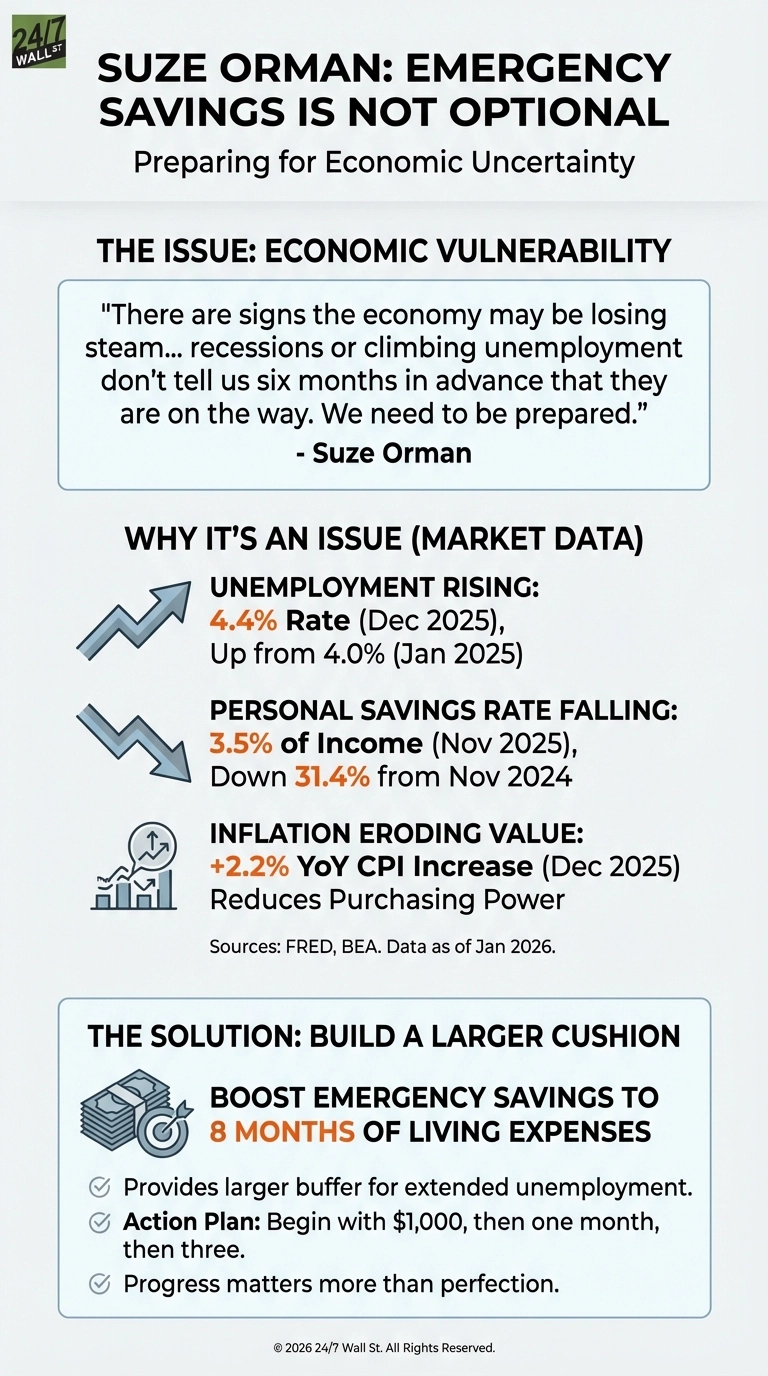
Consumer sentiment reflects genuine anxiety about job security, having plunged to near-recessionary levels as jobless claims spiked sharply in late 2025. These fluctuations demonstrate why Orman’s eight-month recommendation matters: households may need extended time to secure comparable work when employment conditions shift quickly.
Orman’s eight-month recommendation exceeds the traditional three-to-six-month guideline for good reason. Labor market volatility has become more pronounced, making a larger financial cushion critical for households that may need extended time to secure comparable work.
Where the Advice Needs Context
Eight months of expenses represents a substantial sum—$40,000 for a household spending $5,000 monthly. This target stands in stark contrast to the financial reality most Americans face, where a significant portion of households would struggle to cover even a modest unexpected expense without borrowing.
Orman’s advice doesn’t address the opportunity cost of large cash reserves. While today’s high-yield savings accounts offer meaningful returns thanks to elevated interest rates, inflation continues eroding purchasing power. For younger savers especially, this creates a tension between safety and long-term wealth building through retirement accounts.
How to Think About This Advice
Orman is right that emergency savings is not optional, but the eight-month target should be viewed as a destination, not a starting point. Begin with $1,000, then build toward one month, then three. Progress matters more than perfection.
Your personal target depends on job stability, household income sources, and risk tolerance. Dual-income households with stable employment may find six months sufficient. Single-income families or those in volatile industries should aim higher. The key question: How long could you realistically need to find comparable employment in your field?
Emergency savings advice is broadly framed by necessity. Individual circumstances shift outcomes considerably.












 Top Gaining Stocks
 Top Losing Stocks