Why Gold Crashed So Fast (And What Retirees Should Do With GLD Now)

Photo of Michael Williams
By Michael Williams Published

Quick Read

  • SPDR Gold (GLD) hit record prices in late January before collapsing. Trump’s nomination of Warsh as Fed chair triggered the selloff.

  • SPDR Gold generates no income and charges 0.40% annually. Treasury bonds now yield 4.24% with predictable cash flow.

  • Speculators in leveraged gold futures accelerated the decline. CME margin requirement hikes over the weekend triggered forced liquidations.

This post may contain links from our sponsors and affiliates, and Flywheel Publishing may receive compensation for actions taken through them.
Why Gold Crashed So Fast (And What Retirees Should Do With GLD Now)

© Shocked upset elderly couple (Shutterstock.com) by fizkes

Retirees who held the SPDR Gold Trust (NYSEARCA:GLD | GLD Price Prediction) as a portfolio hedge watched their insurance policy pay off in late January when gold hit record prices. The rally validated decades of conventional wisdom about precious metals protecting wealth during uncertainty. Then the bottom fell out, and within days that same hedge became a liability that has conservative investors questioning whether gold still belongs in retirement portfolios.


What Gold Actually Does in a Portfolio

GLD tracks the price of physical gold bullion. It generates no income, pays no dividends, and produces no cash flow. The fund holds gold bars in a vault and charges a 0.40% annual expense ratio. Your return depends entirely on whether gold prices rise or fall.

For retirees, this creates a fundamental problem. Gold doesn’t compound or grow earnings. It just sits there, waiting for someone else to pay more for it later. The appeal has always been insurance against currency weakness, inflation spirals, or financial system stress. When those fears intensify, gold rallies. When confidence returns, it crashes.

Why the Collapse Happened So Fast

President Trump’s nomination of Kevin Warsh as the next Federal Reserve chair triggered the selloff on January 30. Markets interpreted Warsh as a more hawkish, independent voice unlikely to slash interest rates aggressively. That strengthened the dollar and made non-yielding gold less attractive overnight.

But the mechanics made it worse. Speculators had piled into gold call options and leveraged futures contracts during the rally. When prices broke, forced selling accelerated the decline. The Chicago Mercantile Exchange then hiked margin requirements over the weekend, requiring traders to post more collateral and triggering another wave of liquidations. What started as a policy shift became a leverage-driven rout.
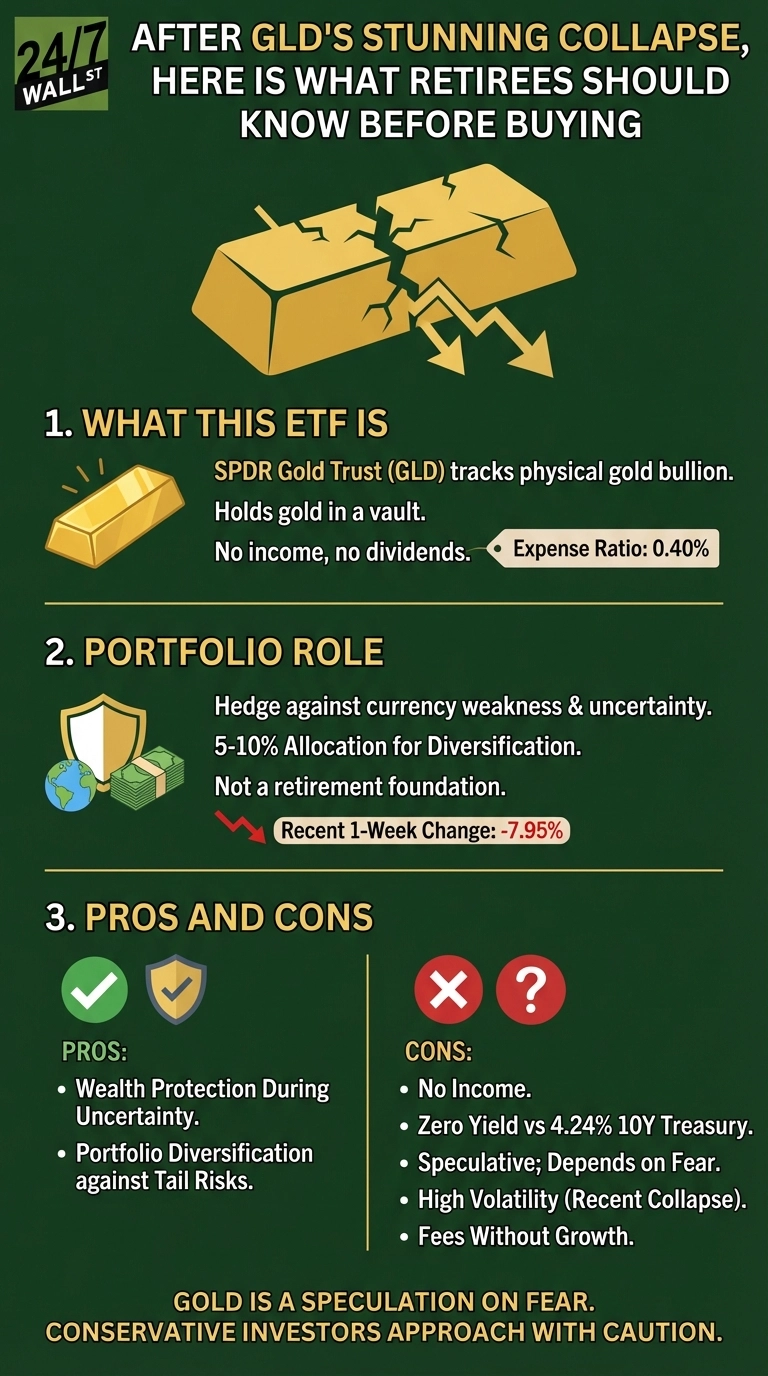
A dark green infographic titled 'AFTER GLD'S STUNNING COLLAPSE, HERE IS WHAT RETIREES SHOULD KNOW BEFORE BUYING.' It features an illustration of a shattered gold bar with downward arrows, symbolizing a market collapse. The infographic is divided into three sections. Section 1, 'WHAT THIS ETF IS,' shows a gold bar icon and states: 'SPDR Gold Trust (GLD) tracks physical gold bullion,' 'Holds gold in a vault,' 'No income, no dividends,' and 'Expense Ratio: 0.40%.' Section 2, 'PORTFOLIO ROLE,' displays icons of a shield, globe, and cash, with text: 'Hedge against currency weakness & uncertainty,' '5-10% Allocation for Diversification,' 'Not a retirement foundation,' and 'Recent 1-Week Change: -7.95%' highlighted with a red downward arrow. Section 3, 'PROS AND CONS,' is presented in two columns. The 'PROS' column, marked with a green checkmark and shield icon, lists: 'Wealth Protection During Uncertainty' and 'Portfolio Diversification against Tail Risks.' The 'CONS' column, marked with a red 'X' and question mark icon, lists: 'No Income,' 'Zero Yield vs 4.24% 10Y Treasury,' 'Speculative; Depends on Fear,' 'High Volatility (Recent Collapse),' and 'Fees Without Growth.' A concluding statement at the bottom reads: 'GOLD IS A SPECULATION ON FEAR. CONSERVATIVE INVESTORS APPROACH WITH CAUTION.'
24/7 Wall St.
This infographic outlines the SPDR Gold Trust (GLD) for retirees, detailing its nature, role in a portfolio, and a balanced look at its pros and cons following a recent significant price drop of -7.95% in one week.

The Real Tradeoff Retirees Face

Treasury bonds now yield 4.24%, creating a stark choice for retirees who need income. Unlike gold, which produces nothing and depends entirely on the next buyer paying more, Treasuries deliver predictable cash flow with government backing. This fundamental difference explains why many conservative investors view gold as a speculation rather than an income-generating foundation for retirement.

That doesn’t mean gold has no place in retirement portfolios. A modest allocation of 5% to 10% can still provide diversification against tail risks like currency crises. But retirees who need income and stability may view GLD as a hedge rather than a foundation.

The recent collapse proves that gold is not a stable store of value. It’s a speculation on fear, and fear is fickle. Conservative investors often approach precious metals with caution, understanding how quickly sentiment can reverse.


Photo of Michael Williams
About the Author Michael Williams →

I am a long time investor and student of business, and believe finding good companies that can become great investments is the best game on earth. After 20 years of writing and researching the public markets it is clear that individuals have never had more tools and information to take control of their financial lives. From ETFs and $0 commissions to cryptos and prediction markets there has never been a greater democratization of access to investing. 

I write to help people understand the investments available to them so they can make the best choice for their portfolio, whether they're starting out or looking for income in retirement. 

Featured Reads

Our top personal finance-related articles today. Your wallet will thank you later.

Continue Reading

Top Gaining Stocks

CBOE Vol: 1,568,143
PSKY Vol: 12,285,993
STX Vol: 7,378,346
ORCL Vol: 26,317,675
DDOG Vol: 6,247,779

Top Losing Stocks

LKQ
LKQ Vol: 4,367,433
CLX Vol: 13,260,523
SYK Vol: 4,519,455
MHK Vol: 1,859,865
AMGN Vol: 3,818,618