



When one spouse controls all the money, divorce becomes a battle for survival. The law protects homemakers, but knowing your rights and enforcing them are different challenges.
On a recent episode of The Dave Ramsey Show, a caller described her situation during divorce proceedings. For 11 years, she had focused on raising their three young children while her husband built his career. Now, as she sought to understand their financial situation during divorce proceedings, she discovered he had locked her out of their joint banking app—a move that revealed the power imbalance in their relationship.
“I am pretty much in an emotionally abusive and financially abusive relationship at the moment, and I’m worried about him trying to financially cut me off,” she said. Her husband’s settlement offer revealed the manipulation at play. He proposed letting her keep the house and receive child support, but only if she surrendered all claims to his pension and retirement accounts built during their 11-year marriage. “I don’t want to verbally agree to something that I don’t have full calculations in front of me,” she explained.
Ramsey’s co-host advised her to visit the bank in person to access the joint account regardless of app restrictions. The caller had consulted lawyers and filed a petition, putting her on track to secure child support, alimony, and her share of retirement assets.
Courts Protect Economic Partnerships
Marriage creates an economic partnership where both contributions matter, whether earning income or raising children. Stay-at-home parents who enabled their spouse’s career for over a decade have legitimate claims to marital assets including retirement accounts accumulated during the marriage.
Financial abuse during divorce involves controlling access to money, hiding assets, or pressuring unfair settlements before legal review. Protection requires immediate action: maintain access to joint accounts, hire independent counsel, and demand complete financial disclosure before negotiations. Joint accounts remain legally accessible to both parties until a court orders otherwise.
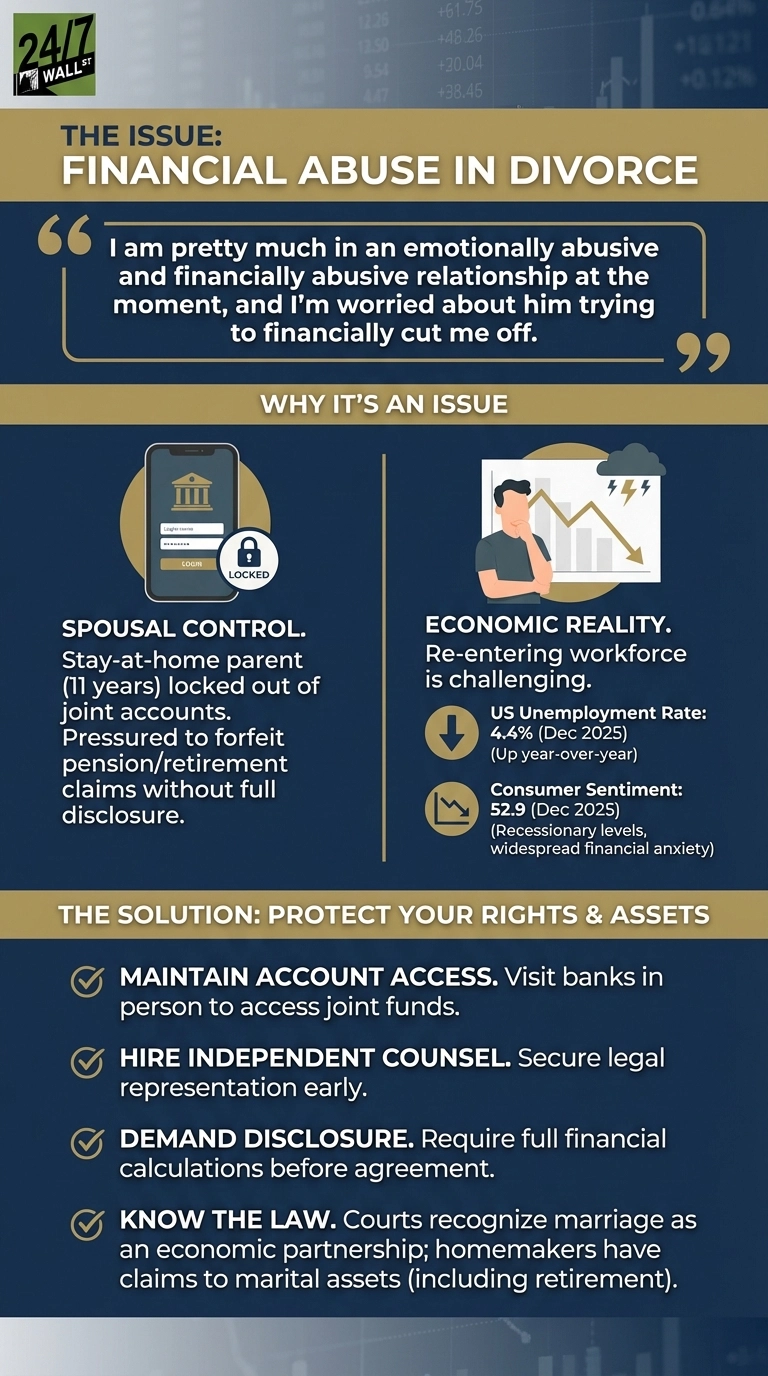
Courts enforce equitable division regardless of which spouse earned the paycheck. In most states, assets accumulated during marriage belong to both partners. A pension or 401k built over 11 years of marriage represents marital property, not individual wealth. Giving up these assets without proper valuation and legal advice could cost hundreds of thousands in retirement security.
Re-entering the workforce after an 11-year absence creates significant challenges, particularly in today’s economic climate where households face widespread financial anxiety. Without recent work experience, finding stable employment becomes harder precisely when it matters most. This reality explains why proper alimony and asset division are critical—they compensate for the career momentum lost during years spent raising children while peers advanced professionally.
Proper legal representation ensures homemakers receive the support and assets they deserve. Advice to “just agree” or “move on quickly” sounds appealing when emotions run high, but individual circumstances require individual solutions backed by complete financial information.














 Top Gaining Stocks
 Top Losing Stocks