



Most U.S.-focused portfolios carry a structural blind spot: the roughly half of global market capitalization that sits outside American borders. For investors looking to close that gap without paying for active management, BNY Mellon International Equity ETF (NYSEARCA:BKIE) offers one of the cheapest entry points available, at just 4 basis points annually.
What BKIE Is Built to Do
BKIE is a passive, broad developed-market international equity fund. Its return engine is straightforward: long-term capital appreciation and dividend income from large-cap companies domiciled primarily in Europe and Asia-Pacific. The fund holds 500+ positions with no single holding exceeding 2.17% (ASML Holding), giving investors wide geographic diversification across Switzerland, the UK, Germany, France, Japan, and Australia. With 9% annual portfolio turnover, this is a genuine buy-and-hold vehicle, not a tactical rotation product.
Does It Deliver?
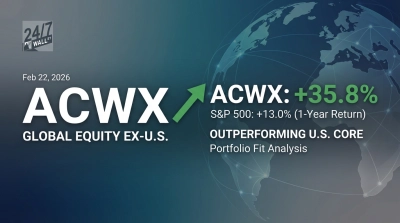
Against the most common benchmark for this category, iShares MSCI EAFE ETF (NYSEARCA:EFA | EFA Price Prediction), BKIE has tracked closely and edged ahead over both short and long horizons. Over the past year, BKIE returned 34% versus EFA’s 32.8% — a gap that reflects BKIE’s lower cost drag compounding over time. That effect becomes more visible over five years, with BKIE gaining 73% compared to EFA’s 66.8%, suggesting the fee savings translate directly into better net returns for patient investors. That modest outperformance, combined with the cost advantage, represents a lower-cost option for the same exposure.
On income, the picture is more nuanced. The fund’s 2.41% dividend yield trails the current 10-year Treasury yield of 4.05% by 164 basis points, meaning income-only investors can find better risk-free alternatives. BKIE’s dividend appeal is secondary to its growth role.
The Tradeoffs
The most significant constraint is currency risk. Returns in BKIE are denominated in U.S. dollars, but the underlying companies report in euros, yen, pounds, and francs. A strengthening dollar can meaningfully erode returns that look attractive in local terms. This is not a hedged fund.
Second, the heavy financials concentration across European and Asia-Pacific banks means BKIE carries more sensitivity to regional credit cycles than a pure market-cap-weighted index might suggest. In a European banking stress scenario, the portfolio would feel it.
Finally, while short interest in BKIE jumped 45.1% in December 2025, the days-to-cover ratio of just 1.0 suggests this reflects tactical positioning rather than fundamental concern about the fund itself.
BKIE is structured as a low-cost, passive developed-market international fund designed as a long-term diversifier for U.S.-heavy portfolios. The fund’s income profile and unhedged currency exposure are factors investors may want to weigh when evaluating its fit.












 Top Gaining Stocks
 Top Losing Stocks