



Mario Gabelli is looking at the defense sector and seeing a multi-year, capital-intensive buildout across the entire missile supply chain. He’s not just buying the obvious names.
“Anyone that’s producing missile rocket engines, seeker heads — Lockheed, RTX, Raytheon, Boeing all make the sort of the main parts of the missile. But there’s other parts for it as well, like the casings, the nose cones, all that. And we have a small company called Albany International. It’s a small aerospace and defense supplier. And they make these components on these weapons systems. There’s going to be a huge capex build for these primes, and we’re going to see that in their numbers.”
Defense primes have one customer, the Department of Defense, and they need contract assurance before committing to massive capital expansion. That assurance is now arriving, and the capex wave is coming.
The Primes Are Already Delivering
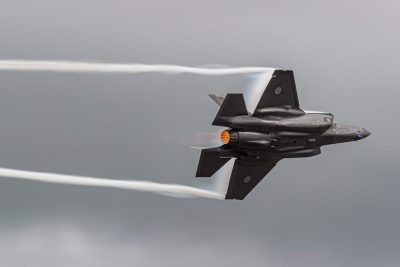
Lockheed Martin (NYSE:LMT | LMT Price Prediction) is the clearest proof point. The company posted a $194 billion record backlog at year-end 2025, with F-35 deliveries jumping to 191 in 2025 from 110 in 2024. Its Missiles and Fire Control segment swung from a $804 million operating loss in Q4 2024 to a $535 million profit in Q4 2025. CEO Jim Taiclet called out “unprecedented demand” and guided 2026 revenue to $77.5 to $80 billion. The stock is up 38% year-to-date and trades at 22x forward earnings, with a $194 billion backlog providing multi-year revenue visibility.
RTX (NYSE:RTX) is equally compelling. Its record $268 billion backlog includes $107 billion in defense. Pratt & Whitney military revenues grew 30% in Q4 on F135 production. CEO Chris Calio said “We enter 2026 with great momentum.” RTX is up 65% over the past year.
Boeing (NYSE:BA) is the recovery story of the group. Still burning cash with a negative operating margin, it carries a $682 billion total backlog and is ramping the 737 back toward 42 per month. It’s a longer-duration bet on operational normalization.
The Name You Haven’t Heard Of
Gabelli’s most interesting call is Albany International (NYSE:AIN). Its Engineered Composites division makes structural components — think casings and nose cones — for the F-35, LEAP engine, and missile applications. In Q4 2025, AEC revenue surged 45% year-over-year to $143.7 million, with LEAP volumes up roughly 27%. Albany is also developing ceramic matrix composites for hypersonic missile applications, with announcements expected in spring 2026.
CEO Gunnar Kleveland described the moat plainly: “Albany is built around industrial weaving technology and material science that are deeply embedded in our customers’ products. These capabilities have been developed over decades and are not easily replicated.”
AIN trades around $59, up 16% year-to-date but still below its 52-week high of $73.85. Analysts have a consensus target of $56.25, which the stock has already exceeded as the defense narrative takes hold.
Gabelli’s point: when a capex supercycle arrives in defense, it doesn’t just lift the primes. It flows through the entire supply chain, down to companies making parts most investors have never considered. That’s the thesis Gabelli is betting on with his focus on under-the-radar suppliers like Albany International.












 Top Gaining Stocks
 Top Losing Stocks