$200 Oil And A Ruined US Economy

Photo of Douglas A. McIntyre
By Douglas A. McIntyre Published

Quick Read

  • Preditions of $100 Oil Are Already In The Market

  • The Middle East Problems Are Worse Than They Seem

  • A CPI Above 10% Is The Road To Ruin

This post may contain links from our sponsors and affiliates, and Flywheel Publishing may receive compensation for actions taken through them.
$200 Oil And A Ruined US Economy

© departmentofenergy / Flickr

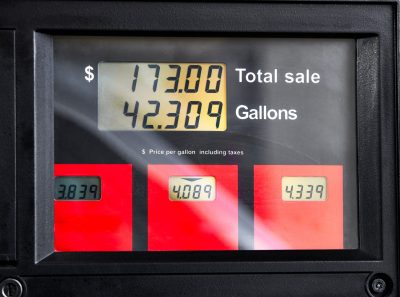
Forecasts that oil will hit $100 barrel happen regularly now because of the war in the Middle East and the shuttering of the Strait of Hormuz through which 20% of the world’s oil flows by ship. If 2022, after the start of the Ukraine war, is any indication, $100 brings $5 gas. People forget that the CPI rose 9.1% in June of that year, which caused panic among some economists.

A headline in the FT today read, “Why oil at $200 a barrel is no longer unthinkable.” The author continued, noting that Stifel’s analysis reminded readers that crude oil reached a peak of $147.27 per barrel on July 14, 2008. The analysis showed that this would translate into $222 in today’s money. The reason for the high rate was not complicated. Supply and demand were at the heart of the problem. However, so was the volatility of crude, according to commodity traders.

Qatar shut down its gas liquidation operations today and said it would take weeks to reopen. It supplies 20% of the world’s LNG. Ships may not transit the Strait of Hormuz for weeks, if not longer. Iran has the chance to attack oil fields and production facilities. France24 recently reported that, in Saudi Arabia, “One of the world’s largest refineries, with a capacity of over half a million barrels of crude oil a day, was temporarily shut down as a precaution.”

$200 oil does not immediately cause $10 gasoline. It certainly takes the price much, much higher than $5. The CPI carries a heavy weight of oil and gas, which were the primary components of the June 2022 number.

How much will the US economy bleed if the CPI goes to 12%, 13%, of 14%. That answer is that it would partially wreck consumer spending and the financial health of some businesses and industries. Consumer spending is 70% or more of GDP. Gas prices are about 4% of household spending today. That figure could rise toward 8%

American consumers say their budgets are already stretched and that the statements from The White House about inflation are wrong. They could get much wronger.


Photo of Douglas A. McIntyre
About the Author Douglas A. McIntyre →

Douglas A. McIntyre is the co-founder, chief executive officer and editor in chief of 24/7 Wall St. and 24/7 Tempo. He has held these jobs since 2006.

McIntyre has written thousands of articles for 24/7 Wall St. He is an expert on corporate finance, the automotive industry, media companies and international finance. He has edited articles on national demographics, sports, personal income and travel.

His work has been quoted or mentioned in The New York Times, The Wall Street Journal, Los Angeles Times, The Washington Post, NBC News, Time, The New Yorker, HuffPost USA Today, Business Insider, Yahoo, AOL, MarketWatch, The Atlantic, Bloomberg, New York Post, Chicago Tribune, Forbes, The Guardian and many other major publications. McIntyre has been a guest on CNBC, the BBC and television and radio stations across the country.

A magna cum laude graduate of Harvard College, McIntyre also was president of The Harvard Advocate. Founded in 1866, the Advocate is the oldest college publication in the United States.

TheStreet.com, Comps.com and Edgar Online are some of the public companies for which McIntyre served on the board of directors. He was a Vicinity Corporation board member when the company was sold to Microsoft in 2002. He served on the audit committees of some of these companies.

McIntyre has been the CEO of FutureSource, a provider of trading terminals and news to commodities and futures traders. He was president of Switchboard, the online phone directory company. He served as chairman and CEO of On2 Technologies, the video compression company that provided video compression software for Adobe’s Flash. Google bought On2 in 2009.

Featured Reads

Our top personal finance-related articles today. Your wallet will thank you later.

Continue Reading

Top Gaining Stocks

WAT Vol: 2,131,048
INTC Vol: 198,362,091
AKAM Vol: 8,677,900
MU Vol: 64,268,462
QCOM Vol: 34,272,223

Top Losing Stocks

HII Vol: 1,746,810
POOL Vol: 2,311,870
APTV Vol: 10,166,405
LDOS Vol: 2,252,442
PYPL Vol: 39,099,369