


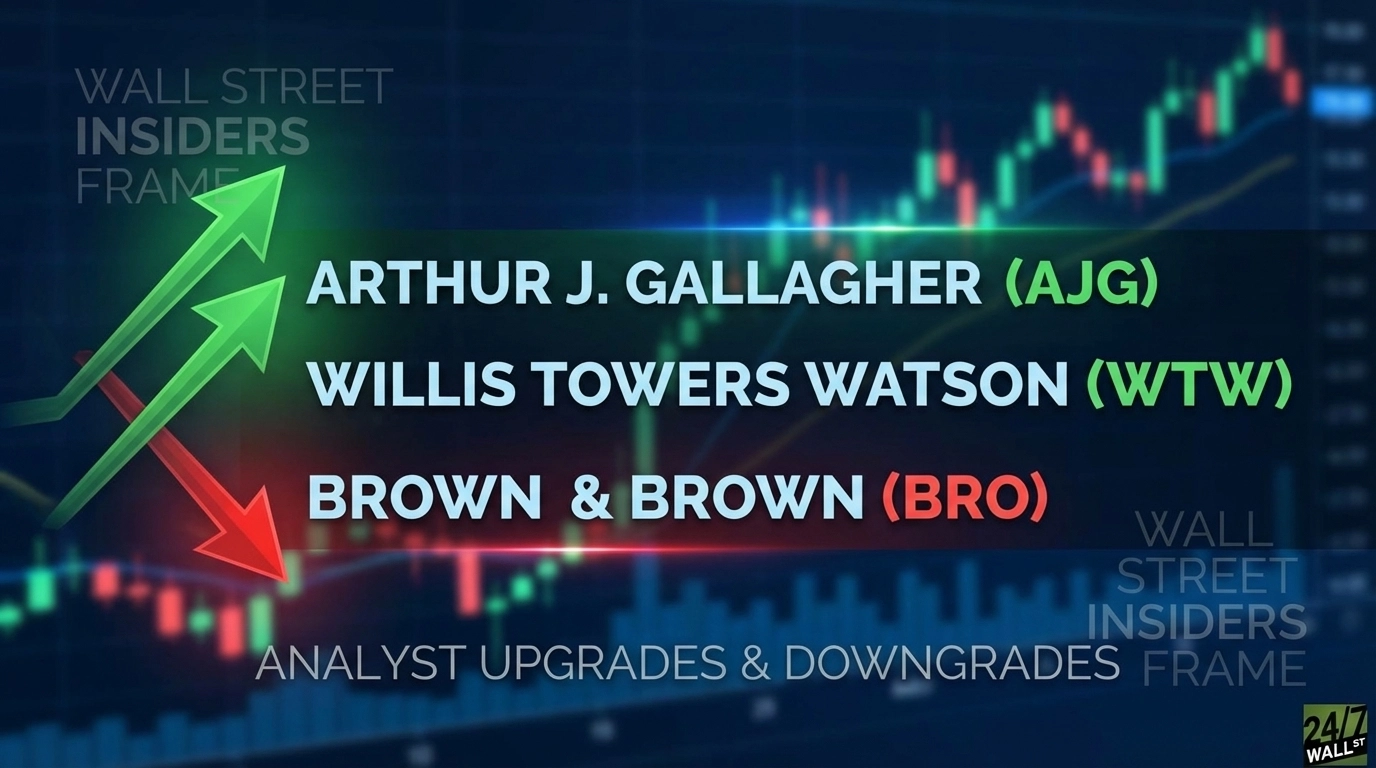
Barclays is pushing back against the narrative that artificial intelligence poses an existential threat to insurance brokers, upgrading two of the sector’s largest names while trimming its price target on a third. The bank upgraded Arthur J. Gallagher & Co. (NYSE:AJG | AJG Price Prediction) to Overweight from Underweight and Willis Towers Watson PLC (NASDAQ:WTW) to Equal Weight from Underweight, while analyst Alex Scott lowered his price target on Brown & Brown, Inc. (NYSE:BRO) to $80 from $82, maintaining an Equal Weight rating. The common thread: the insurance broker group has “derated sharply on fears of AI-driven disruption,” and Barclays believes the market has overreacted.
| Ticker | Company | Firm | Old → New Rating | New Price Target | One-Line Takeaway |
|---|---|---|---|---|---|
| AJG | Arthur J. Gallagher & Co. | Barclays | Underweight → Overweight | $262 (from $247) | Top defensive pick in the sector; AI fears seen as overdone |
| WTW | Willis Towers Watson PLC | Barclays | Underweight → Equal Weight | $341 (from $318) | Specialty strategy proving durable; valuation now reflects risks |
| BRO | Brown & Brown, Inc. | Barclays | Equal Weight (maintained) | $80 (from $82) | Price target trimmed; organic softness and integration costs weigh |
The Analyst’s Case
Barclays believes current share multiples now “more than discount” slower growth while overlooking the durability of the broker business model and AI’s potential to support productivity and margins. Rather than viewing AI as a disruptive threat, the analyst frames it as a “productivity enabler” for the brokers, one that could actually help margins expand rather than compress them.
For Arthur J. Gallagher specifically, Barclays calls the stock “one of the best ways to play defense in this environment,” citing the company’s scale and consistent execution. The upgrade to Overweight, a two-notch move from Underweight, represents a meaningful conviction shift. The revised price target of $262, up from $247, implies meaningful upside from the stock’s current trading level.
On WTW, Barclays notes the company’s specialty strategy is proving more durable than expected, warranting a move off the Underweight designation. The new price target of $341, raised from $318, reflects improved confidence in the firm’s earnings trajectory even as near-term headwinds persist.
Brown & Brown’s rating stays at Equal Weight, but the modest price target trim to $80 from $82 signals some caution. Q4 organic revenue declined 2.8% after three quarters of positive organic growth, and the integration of the Accession acquisition is still generating elevated amortization and costs, factors that likely tempered Barclays’ enthusiasm relative to the other two names.
Company Snapshot & Recent Performance
All three stocks have been caught in the same sector-wide selloff. Arthur J. Gallagher has fallen 17.94% year-to-date and is down 33.56% over the past year, trading at $211.72 as of March 10, well below its 52-week high of $347.79. WTW has lost 11.97% year-to-date, trading at $289.26 against a 52-week high of $351.81. Brown & Brown has declined 13.76% year-to-date and is down 42.26% over the past year, sitting at $68.58 versus a 52-week high of $124.76.
The underlying fundamentals, however, have held up better than the price action suggests. Arthur J. Gallagher posted Q4 2025 revenue of $3.59 billion, beating estimates by 4.83%, with revenue up 32% year-over-year — its 20th consecutive quarter of double-digit top-line growth. WTW delivered Q4 2025 organic revenue growth of 6% with adjusted operating margin expanding 80 basis points to 36.9%. Brown & Brown grew full-year revenue 25.44% in 2025 and generated free cash flow of $1.382 billion, though the Q4 organic dip was a notable soft spot.
Why the Move Matters Now
The selloff has compressed valuations across the group to levels that Barclays views as disconnected from the underlying earnings power. Arthur J. Gallagher now trades at a forward P/E of 16x, down sharply from where the stock commanded premium multiples, while the broader analyst consensus still carries an average price target of $281.94. WTW trades at a forward P/E of roughly 15x with a consensus target of $369.42, implying the market is pricing in a deterioration that the numbers simply have not yet shown.
The AI disruption thesis, that automated platforms could disintermediate traditional brokers, has been the dominant narrative driving the derating. Barclays is effectively arguing that thesis is premature at best and backwards at worst: the same AI tools that some fear will replace brokers are more likely to make them more efficient, supporting margin expansion rather than threatening revenue. Arthur J. Gallagher’s own results offer some evidence, as the company has maintained 5-9% organic growth across all four quarters of 2025 with no sign of AI-driven client attrition.
Brown & Brown’s situation is more nuanced. The company announced a $250 million accelerated share repurchase with Bank of America in February 2026 as part of a broader $1.5 billion board-approved buyback authorization from October 2025, signaling management confidence in the stock at current levels. But the Q4 organic revenue decline and a $15.1 billion goodwill balance from the Accession acquisition keep the risk profile elevated relative to peers.
The Broader Picture
Barclays’ note reframes a sector that has been treated as a casualty of the AI revolution into something closer to a potential beneficiary, or at minimum, a group that has been oversold. The two-notch upgrade on Arthur J. Gallagher is the most aggressive call here, and the company’s consistent execution, large-scale acquisition integration, and 20-quarter streak of double-digit revenue growth provide a credible fundamental foundation for that view.
WTW’s upgrade is more measured, but the raised price target and acknowledgment that the specialty strategy is working suggest the risk/reward has shifted. WTW’s $1.65 billion in 2025 share repurchases and guidance for $1 billion or more in buybacks in 2026 add a capital return component that Barclays cites as part of its upgrade rationale.
Brown & Brown remains a show-me story. The rating hold and modest price target trim suggest Barclays wants to see organic growth return before getting more constructive. The integration overhang and organic softness are real considerations that Barclays flags as factors to watch over the coming quarters.











 Top Gaining Stocks
 Top Losing Stocks