


Costco (NASDAQ:COST | COST Price Prediction) shares have been enjoying an outstanding bounce back this year, with just north of 16% gains in the books for 2026 so far. Still, the warehouse retailer has seemingly hit a wall at around $1,000 per share. Even if the stock hasn’t done as much (at least compared to the S&P) in the past year, the valuation remains a tad on the steep side at over 51.0 times trailing price-to-earnings (P/E).
As the firm finds itself in a sweet spot between a multitude of tailwinds, though, while continuing to enjoy global membership renewal rates in the ballpark of 90%, perhaps it’s worth paying the big, fat premium. After all, there aren’t many steady defensive stocks that are also capable of steady growth.
With members sticking around for the excellent value proposition as well as the $1.50 hot dog combo, it’s clear that Costco has pretty much perfected the in-store experience at this point.
The 90% renewal rate might just be the floor
As the firm opens new stores across the globe while doubling down on e-commerce, perhaps there’s room to bump up that renewal rate further. Indeed, the ultimate goal may very well be to convince members that they can’t afford to have a Costco membership. As a main beneficiary of “invisible AI,” or AI that works hard behind the curtains, there’s potential for the well-run retail juggernaut to pass even more savings onto its members.
Given Costco’s member-first approach, I certainly wouldn’t bet against the firm as it goes out of its way to give more back to members, even if it means foregoing a few basis points of margin. Any way you look at it, all things seem to suggest margins and membership renewal rates are poised to go up over time.
Competition in big retail is fierce, and it’s about to get even more fierce as physical AI starts doing more of the work behind the scenes. Whether we’re talking about using robots to stock the massive shelves over at the local Costco or algorithms to go into ensuring the bakery section is running smoothly, the Costco experience seems to be on the ascent.
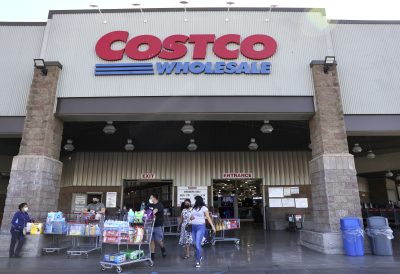
The only big question, at least in my view, is what the firm can do to control those massive crowds. If you’ve tried to find parking at the local Costco, you’ll know how difficult and time-intensive it can be. Perhaps the experience is so good that the only solution is for there to just be more Costcos.
Expansion and e-commerce are compelling growth drivers worth “flooring it” on
As the company explores new concepts, like multi-use properties (think apartments with Costcos at the base), perhaps there are ways to tap into that urban market, which may be even more successful than the big warehouses located way out in the suburbs.
It’s a good problem for Costco to have, especially as it looks to open up new warehouses in the coming years. Still, it seems like Costco can’t open new stores fast enough. And that’s where e-commerce could help step in. The e-commerce business is starting to really take off, with sales growing close to 23% in the last quarter.
For such a digital latecomer, Costco may very well have what it takes to level up its growth rate while reducing the huge crowds at its hottest stores. As agentic shopping and autonomous fulfillment and delivery come into their own while Costco continues making the most of its digital sales momentum, I think the firm might be the single best defensive growth company in the S&P right now.
While management operates with prudence, I do think the expansion plan could use a big shot in the arm. Perhaps the only thing more needed than a data center buildout is a Costco buildout, especially in China and Europe, markets where Costco is also a massive deal. As it turns out, the desire to save big money isn’t unique to the U.S. And with that, I wouldn’t sleep on Costco while shares are still going for the three figures.








 Top Gaining Stocks
 Top Losing Stocks