


Two vehicle manufacturer stocks sit at opposite ends of the story spectrum. One is a global automotive giant navigating a painful EV retreat while its motorcycles quietly carry the load. The other is a specialty vehicle maker that doubled in a year before disappearing into a larger company. Here is what you need to know about both.
2. Honda Motor
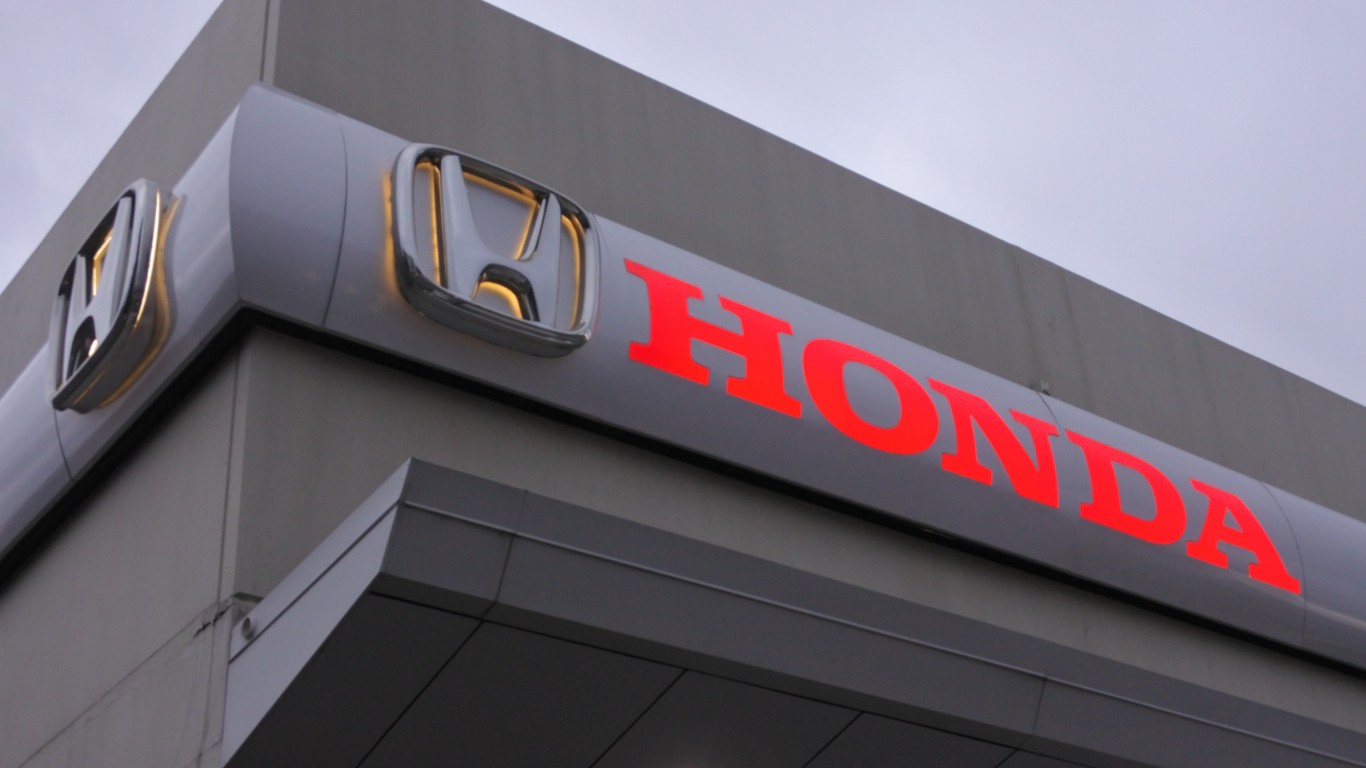
Honda Motor (NYSE:HMC | HMC Price Prediction) manufactures motorcycles, automobiles, and power products. Most Americans know Honda through its cars and trucks, but the motorcycle business is quietly the most important segment right now.
The headline numbers for the nine months through December 2025 are rough. Sales revenue came in at $100.39 billion, down 2.2% year-over-year. More striking, operating profit fell 48.1% to $3.72 billion, and the automobile segment swung from a $2.53 billion profit to a $1.05 billion operating loss.
The culprit is a messy EV unwind. Honda took $1.76 billion in EV-related charges during the nine-month period, covering impairments on cancelled models and onerous contract provisions tied to an alliance agreement. The company has now cut its 2030 global EV sales ratio target from 30% to 20%, a significant strategic retreat driven by slowing EV demand in North America and Europe, the end of U.S. EV tax incentives, and brutal competition from Chinese manufacturers.
Full-year FY2026 guidance tells the rest of the story. Honda now expects operating profit to fall 54.7% year-over-year and net profit to owners to drop 64.1%. Full-year EPS is guided at approximately $0.47, below the analyst consensus of $0.52.
The bright spot is motorcycles. The motorcycle segment generated $18.44 billion in revenue over nine months with growing profitability. Honda is the world’s largest motorcycle manufacturer by volume, with real pricing power in emerging markets where two-wheelers are essential transportation.
On capital returns, Honda is not sitting still. The board resolved to cancel 747 million shares, representing 14.1% of issued shares, a meaningful buyback that compresses the share count aggressively. The stock trades at a forward P/E of roughly 8x, which prices in a lot of bad news. Shares are down 11.5% year-to-date and off 16.4% over the past month, sitting at $26.09 as of March 12, 2026.
Morgan Stanley recently downgraded Honda to Equalweight on March 11, 2026, citing rising raw material costs and geopolitical pressures. The analyst consensus sits at Hold with an average price target of $32.63. The EV charges are real and the automobile business is struggling, but Honda’s motorcycle dominance, aggressive buybacks, and discounted valuation are factors analysts point to when assessing the stock’s outlook.
1. REV Group
REV Group (NYSE:REVG) designs and manufactures specialty vehicles including fire apparatus, ambulances, and recreational vehicles. Its products are the ones communities depend on when something goes wrong.
REV Group earns the top spot because of a remarkable operational turnaround. Full-year FY2025 revenue reached $2.46 billion, with operating income recovering to $192.8 million after years of thin margins. Gross margins expanded to 15% in FY2025, up from 12% in FY2023. The company achieved its fiscal 2027 margin targets ahead of schedule.
Q4 FY2025 EPS came in at $0.83, beating the consensus estimate of $0.78, with revenue up 11.1% year-over-year. That consistent beat pattern, combined with a 53.9% year-over-year increase in cash flow, attracted significant institutional accumulation throughout 2025.
The stock reflected all of it. REVG gained 107.27% over the past year, going from $30.83 to $63.90.
Then came the deal. Terex Corporation completed its acquisition of REV Group on February 4, 2026, with shareholders receiving $8.71 in cash plus 0.9809 Terex shares per REV share. REV Group shareholders approved the deal with over 99% support. REV Group is now a wholly-owned Terex subsidiary and no longer trades independently on the NYSE.
Terex CEO Simon Meester called it a “defining milestone” for Terex, creating a “leading specialty equipment manufacturer” with expected synergies of $75 million by 2028.
The Takeaway
These two manufacturers illustrate how different “vehicle manufacturer” can mean. Honda is a century-old global giant absorbing billions in EV write-downs while its motorcycle business quietly outperforms. REV Group was a specialty niche player that executed a textbook operational turnaround, rewarded shareholders with a double in twelve months, and then got absorbed into a larger platform. Honda remains a publicly traded company trading at a forward P/E of roughly 8x amid ongoing financial pressure. REV Group’s story, at least as a standalone stock, is closed.











 Top Gaining Stocks
 Top Losing Stocks