


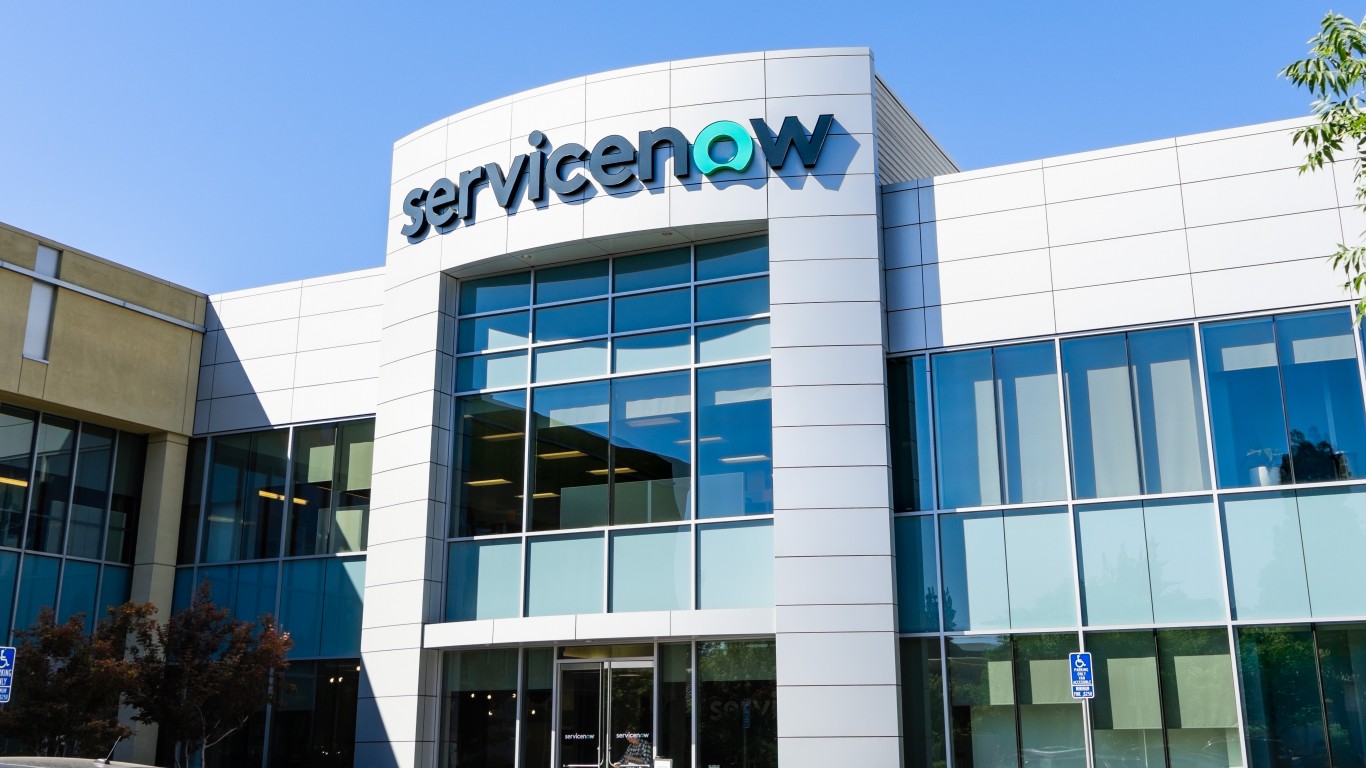
ServiceNow (NYSE:NOW | NOW Price Prediction) has found itself caught in the crosshairs of Wall Street’s deepest fears: that generative AI will render entire software-as-a-service empires obsolete overnight. Shares have plunged roughly 25% year-to-date amid the so-called SaaS-pocalypse, as investors fret that large language models could automate away the very business processes that power today’s enterprise software giants.
Yet in a recent CNBC “Squawk on the Street” interview, CEO Bill McDermott pushed back hard. The market, he argued, is missing the bigger picture. AI has a fatal flaw — and ServiceNow is perfectly positioned to exploit it.
Crushed by the SaaS-Pocalypse
The selloff has been brutal and broad. Software stocks across the board — Salesforce (NYSE:CRM), Adobe (NASDAQ:ADBE), Workday (NASDAQ:WDAY), and others — have been dragged lower on concerns that AI agents could soon handle everything from customer support tickets to IT incident resolution without needing costly platforms. For ServiceNow specifically, the fear is that its core value proposition — automating complex enterprise workflows — could evaporate if AI simply writes the code or resolves issues on its own. The result is a sharp valuation reset as investors question whether legacy SaaS models still deserve premium multiples in an agentic AI world.
Workflow Is the Action Layer
ServiceNow is the cloud platform that powers digital workflows for the world’s largest organizations. It connects disparate legacy systems and automates everything from IT service management and HR onboarding to customer service and security operations, creating seamless “systems of action” across the enterprise.
In the CNBC interview, McDermott delivered a high-level thesis that says AI excels at identifying problems and offering advice — “great advice,” in his words — but it cannot execute the fix. It spots the fire but cannot grab the extinguisher. ServiceNow, by contrast, owns the “last-mile” execution layer.
The company already orchestrates more than 80 billion enterprise workflows annually, sitting atop legacy infrastructure where pure AI models struggle to act reliably. McDermott framed the agentic era this way: AI provides intelligence; ServiceNow provides the reliable system of action that actually gets work done. The market, he believes, is undervaluing that distinction and overestimating how quickly raw AI can replace orchestrated enterprise platforms.
JPMorgan Sees Resilience
Wall Street’s sharpest analysts appear to agree with the broader view. In February, JPMorgan explicitly flagged ServiceNow as one of a select group of “AI-resilient” software names after the sector’s brutal selloff. The bank’s strategists argued that extreme price action had created a buying opportunity in high-quality franchises less vulnerable to disruption.
For ServiceNow, the reasoning centers on its role as the connective tissue: it doesn’t compete with large language models but instead integrates and extends them. Its platform turns AI insights into automated, auditable actions across complex, regulated enterprise environments — something standalone AI agents still cannot replicate at scale.
JPMorgan views this orchestration capability, combined with ServiceNow’s deep entrenchment in Fortune 500 workflows, as a durable edge.
Key Takeaway
ServiceNow says it has been unfairly lumped in with the rest of the software pack and punished accordingly. It does possess a genuine moat — decades of embedded workflows, massive data sets, and mission-critical integrations that competitors cannot simply code around overnight. McDermott’s argument that AI needs a reliable execution layer holds water today and likely for the immediate future.
Yet the pace of AI advancement remains breathtaking. What looks like an unbridgeable gap in execution capability could shrink dramatically in the next 12 to 24 months as agentic systems grow more autonomous and reliable. The thesis may be correct right now, but investors should remember: in technology, “resilient today” can become “disrupted tomorrow” faster than anyone expects. ServiceNow may beat AI in the short run — but the long game is still very much in flux.










 Top Gaining Stocks
 Top Losing Stocks