Is Hess Midstream’s Capital Return Program a Strength or a Warning Sign?

Photo of David Beren
By David Beren Published

Quick Read

  • Hess Midstream (HESM) executed a $60 million equity repurchase in March and carries a 7.49% dividend yield backed by nine consecutive years of uninterrupted quarterly distributions, though its payout ratio sits at a concerning 105% with 2026 EPS forecast declining to $2.56 from $2.86 in 2025. Chevron (CVX) reduced its Bakken rig count from 4 to 3 starting Q4 2025, targeting a 200,000 barrels per day plateau, which prompted UBS to cut HESM’s price target from $36 to $34 due to anticipated volume declines.

  • Hess Midstream’s capital spending is collapsing 40% to $150 million in 2026 and below $75 million annually in 2027-2028, creating a free cash flow unlock that supports buybacks and distributions even as Chevron’s upstream production plateaus, with 95% of 2026 revenues protected by minimum volume commitments.

This post may contain links from our sponsors and affiliates, and Flywheel Publishing may receive compensation for actions taken through them.
Is Hess Midstream’s Capital Return Program a Strength or a Warning Sign?

© Public Domain / Wikimedia Commons

Hess Midstream LP  (NYSE:HESM | HESM Price Prediction), the fee-based, growth-oriented midstream energy company, announced a $60 million equity repurchase on March 3, 2026, the latest move in a capital return program that has returned hundreds of millions to shareholders annually. The question is whether these buybacks reflect genuine confidence or are engineered to prop up per-share metrics as upstream growth stalls.

The Yield That Demands Scrutiny

HESM currently trades near $39.66 and carries a 7.49% dividend yield, backed by nine consecutive years of uninterrupted quarterly distributions. The most recent quarterly payout was $0.7641 per Class A share, up from $0.2703 at inception in August 2017. Management has committed to at least 5% annual distribution growth through 2028.

The dividend payout ratio relative to earnings sits at a concerning 105%, and analysts have flagged a 2026 EPS forecast of $2.56, a step down from the $2.86 earned in 2025. Free cash flow coverage tells a more reassuring story at 36%, though that metric tightened in 2025 when total shareholder returns of $750.2 million consumed 96% of the $728.2 million in free cash flow generated.
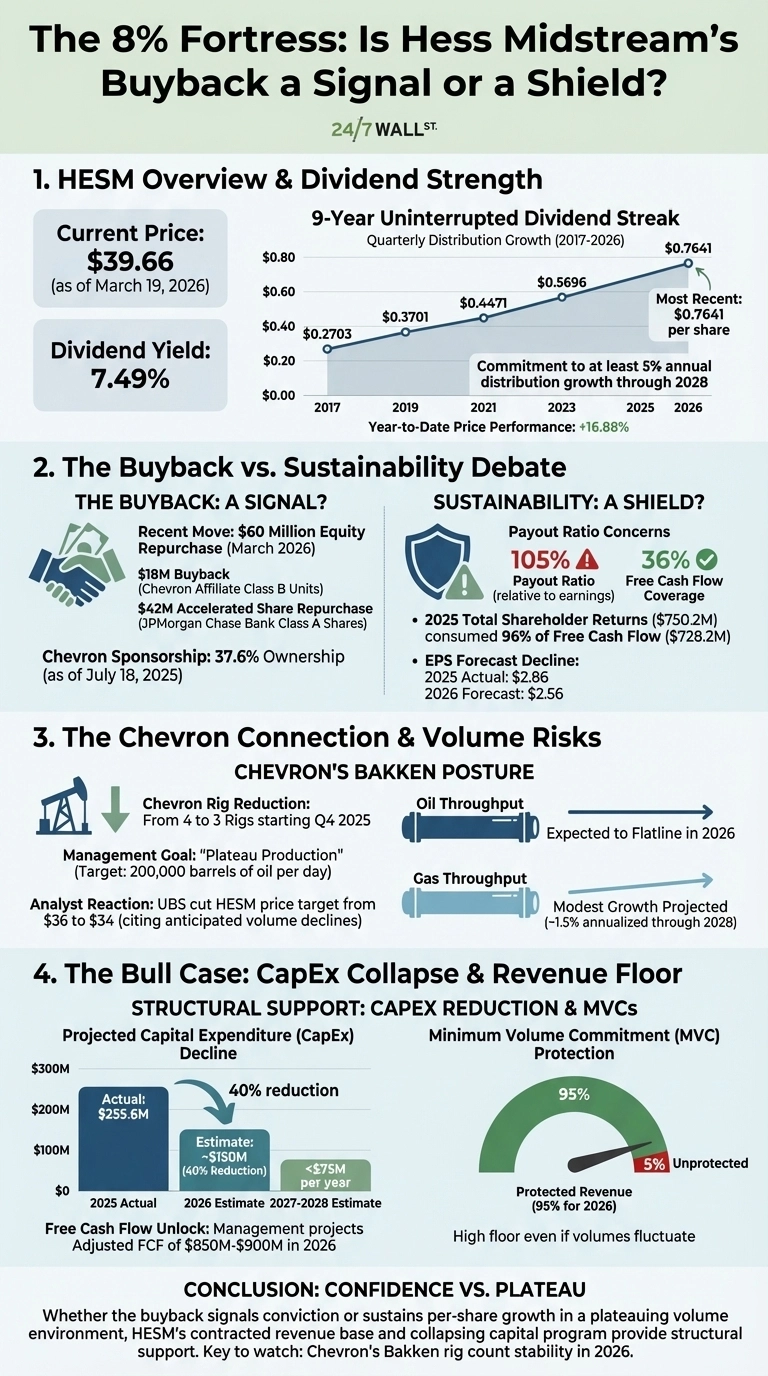
An infographic titled 'The 8% Fortress: Is Hess Midstream’s Buyback a Signal or a Shield?' from 24/7 Wall St. The graphic is divided into five sections. Section 1, 'HESM Overview & Dividend Strength,' shows a current price of $39.66 (as of March 19, 2026) and a dividend yield of 7.49%. A line chart titled '9-Year Uninterrupted Dividend Streak (2017-2026)' displays quarterly distribution growth from $0.2703 in 2017 to $0.7641 in 2026. Section 2, 'The Buyback vs. Sustainability Debate,' details a $60 million equity repurchase and $18 million Chevron affiliate buyback. Sustainability concerns include a 105% payout ratio and 36% Free Cash Flow Coverage, with an EPS forecast decline to $2.56 in 2026. Section 3, 'The Chevron Connection & Volume Risks,' indicates Chevron rig reduction from 4 to 3 starting Q4 2025 and a management goal of 200,000 barrels of oil per day. Oil throughput is expected to flatline in 2026, while gas throughput projects modest growth (-1.5% annualized through 2028). Section 4, 'The Bull Case: CapEx Collapse & Revenue Floor,' shows a bar chart of projected capital expenditure decline from an actual $255.6 million in 2025 to an estimated ~$150 million in 2026 and <$75 million per year for 2027-2028. A dial chart indicates 95% protected revenue for 2026. Section 5 is a conclusion titled 'Confidence vs. Plateau.'
24/7 Wall St.
This infographic dissects Hess Midstream’s (HESM) recent buyback, evaluating its dividend strength, sustainability concerns, the impact of Chevron’s Bakken operations, and projected capital expenditure reductions. It explores whether the buyback signifies confidence or is a shield against plateauing volumes.

The Buyback Mechanics

The March repurchase included an $18 million buyback of 455,811 Class B units from a Chevron affiliate and a $42 million accelerated share repurchase with JPMorgan Chase Bank. Chevron became HESM’s sponsor on July 18, 2025, and its ownership now sits at 37.6% following prior repurchases.

CFO Michael Chadwick was direct on the Q4 2025 earnings call: “We’re also funding incremental shareholder returns for free cash flow after distributions, rather than leverage buybacks. And so it’s just a bit more of a conservative approach that we’re following that is in line with our profile and Chevron’s target of 200,000 barrels of oil per day plateau production in the Bakken.”

That phrase, “plateau production,” is the crux of the concern. Chevron reduced its Bakken rig count from 4 to 3 rigs starting Q4 2025, and UBS responded by cutting its HESM price target from $36 to $34, citing anticipated volume declines. Oil throughput is expected to flatline in 2026.

The Bull Case: CapEx Collapse and MVC Protection

CEO Jonathan Stein framed the lower-growth environment as a free cash flow unlock: “In 2026, we expect to spend approximately $150 million, a 40% reduction in capital spending relative to 2025. We expect our capital spend to decrease even further in 2027 and 2028 to less than $75 million per year.”

With approximately 95% of 2026 revenues protected by minimum volume commitments, the floor is high even if Chevron pulls back further. Management projects adjusted free cash flow of $850 to $900 million in 2026.

Whether the buyback signals conviction or sustains per-share growth in a plateauing volume environment, HESM’s contracted revenue base and collapsing capital program provide more structural support than a simple yield-chasing story. Investors will want to track whether Chevron’s Bakken rig count holds or slips further in 2026, with the stock up 16.88% year-to-date.


Photo of David Beren
About the Author David Beren →

David Beren has been a Flywheel Publishing contributor since 2022. Writing for 24/7 Wall St. since 2023, David loves to write about topics of all shapes and sizes. As a technology expert, David focuses heavily on consumer electronics brands, automobiles, and general technology. He has previously written for LifeWire, formerly About.com. As a part-time freelance writer, David’s “day job” has been working on and leading social media for multiple Fortune 100 brands. David loves the flexibility of this field and its ability to reach customers exactly where they like to spend their time. Additionally, David previously published his own blog, TmoNews.com, which reached 3 million readers in its first year. In addition to freelance and social media work, David loves to spend time with his family and children and relive the glory days of video game consoles by playing any retro game console he can get his hands on.

Featured Reads

Our top personal finance-related articles today. Your wallet will thank you later.

Continue Reading

Top Gaining Stocks

CBOE Vol: 1,568,143
PSKY Vol: 12,285,993
STX Vol: 7,378,346
ORCL Vol: 26,317,675
DDOG Vol: 6,247,779

Top Losing Stocks

LKQ
LKQ Vol: 4,367,433
CLX Vol: 13,260,523
SYK Vol: 4,519,455
MHK Vol: 1,859,865
AMGN Vol: 3,818,618