


Three high yield income stocks are paying between 10.7% and 19.7% right now, and most retail investors have never heard of any of them. The reasons Wall Street stays quiet on names like these are sometimes the most important part of the story.
What These Three Actually Are
PennantPark Investment (NYSE:PNNT), Gladstone Capital (NASDAQ:GLAD), and Kimbell Royalty Partners (NYSE:KRP) all generate income differently. PennantPark and Gladstone are Business Development Companies that lend money to mid-sized private companies and pass the interest income to shareholders. Kimbell collects oil and gas royalties across U.S. basins and pays out a share of whatever the wells produce. No drilling costs, no operational headaches. Just a cut of revenue every quarter.
That structural difference matters enormously for how you evaluate the safety of each payout.
PennantPark: A 19.7% Yield With a Real Problem
PennantPark’s yield looks extraordinary on paper. The stock has fallen 18% year-to-date to around $4.65, and that price collapse is what makes the yield look so extraordinary — the $0.08 per month monthly payment annualizes to $0.96 per share, producing a verified yield of 19.7% only because the denominator has shrunk. But the yield is inflated precisely because the price has collapsed, and the price has collapsed for a reason.
The problem is that earnings are not covering the payout. Net investment income came in at $0.11 per share in the most recent quarter against a $0.24 quarterly distribution rate. Management restructured the dividend into a $0.04 base plus $0.04 supplemental component, but the gap is currently being bridged by spillover income estimated at $0.73 per share — a finite buffer that cannot last forever.
That spillover income is the only thing standing between the current distribution and a cut. Once it is exhausted, a reduction becomes difficult to avoid unless net investment income recovers meaningfully — something that looks unlikely given the ongoing rate environment and declining portfolio yields. The yield on new loans has dropped from 11.4% to 9.3% as rates have fallen, and revenue is down 20% year-over-year. PennantPark’s yield is high because the market is pricing in a cut. The data supports that concern.
Gladstone Capital: Coverage Intact, Compression Ongoing
Gladstone is a more defensible income story. The company pays $0.15 per month and has maintained uninterrupted monthly payments for over 24 years. Net investment income of $0.50 per share last quarter covered the $0.45 quarterly distribution covers the distribution with room to spare.
The risk is not an imminent cut. The risk is slow erosion. Portfolio yields have compressed from 13.9% a year ago to 12.2% today as the Fed has cut rates. The Fed Funds rate now sits at 3.75%, down 75 basis points from its peak. If cuts continue, Gladstone’s variable-rate portfolio will feel it. The dividend is safe today, but whether coverage holds through another rate cycle is the real question.
Kimbell: The Royalty Model Changes the Risk Profile
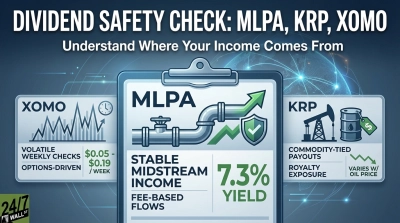
Kimbell owns royalty interests in oil and gas wells across the U.S. and collects revenue without bearing any drilling or operating costs. The 75% payout ratio is explicit policy, with the remaining 25% going to debt repayment. That conservatism paid down roughly $57 million in debt during 2025.
Distributions have historically swung dramatically with oil prices — during the pandemic, payouts collapsed before recovering as crude rebounded. With WTI crude recently at $94.65 per barrel and production guidance steady for 2026, the near-term distribution environment looks favorable.
The Verdict
KRP’s royalty structure insulates it from credit risk, though distributions fluctuate with commodity prices. Gladstone’s dividend coverage remains intact, though portfolio yield compression is ongoing as rates fall. PennantPark’s dividend restructuring and finite spillover buffer make a distribution cut the most likely near-term outcome if net investment income does not recover. Each structure carries distinct risks that investors may want to research further before drawing conclusions.











 Top Gaining Stocks
 Top Losing Stocks