



PennantPark Investment Corporation (NYSE:PNNT) has been paying investors $0.08 per share every month, yielding around 20% annually at the current share price. That kind of yield grabs attention. What matters more is who is actually funding it.
How PennantPark Generates Its Income
PennantPark is a Business Development Company, or BDC: a publicly traded lender to mid-sized private businesses too small for traditional capital markets. The company earns income by making loans and equity investments, collecting interest, and distributing most of that income to shareholders. By law, BDCs must distribute at least 90% of taxable income to maintain their tax-advantaged structure, which is why yields run high.
The portfolio is 89% variable-rate, meaning the interest income PNNT collects floats with benchmark rates like SOFR. When rates were higher, that was a significant advantage. Now it is the core problem.
The Supplemental Split and What It Signals
Starting in April 2026, management restructured the monthly $0.08 ($0.24 quarterly) payment into two components: a $0.04 base dividend and a $0.04 supplemental dividend. The base is supported by ongoing earnings, while the supplemental is explicitly funded by spillover income, undistributed taxable income accumulated over prior years. Management has indicated that the supplemental is anticipated only through December 2026.
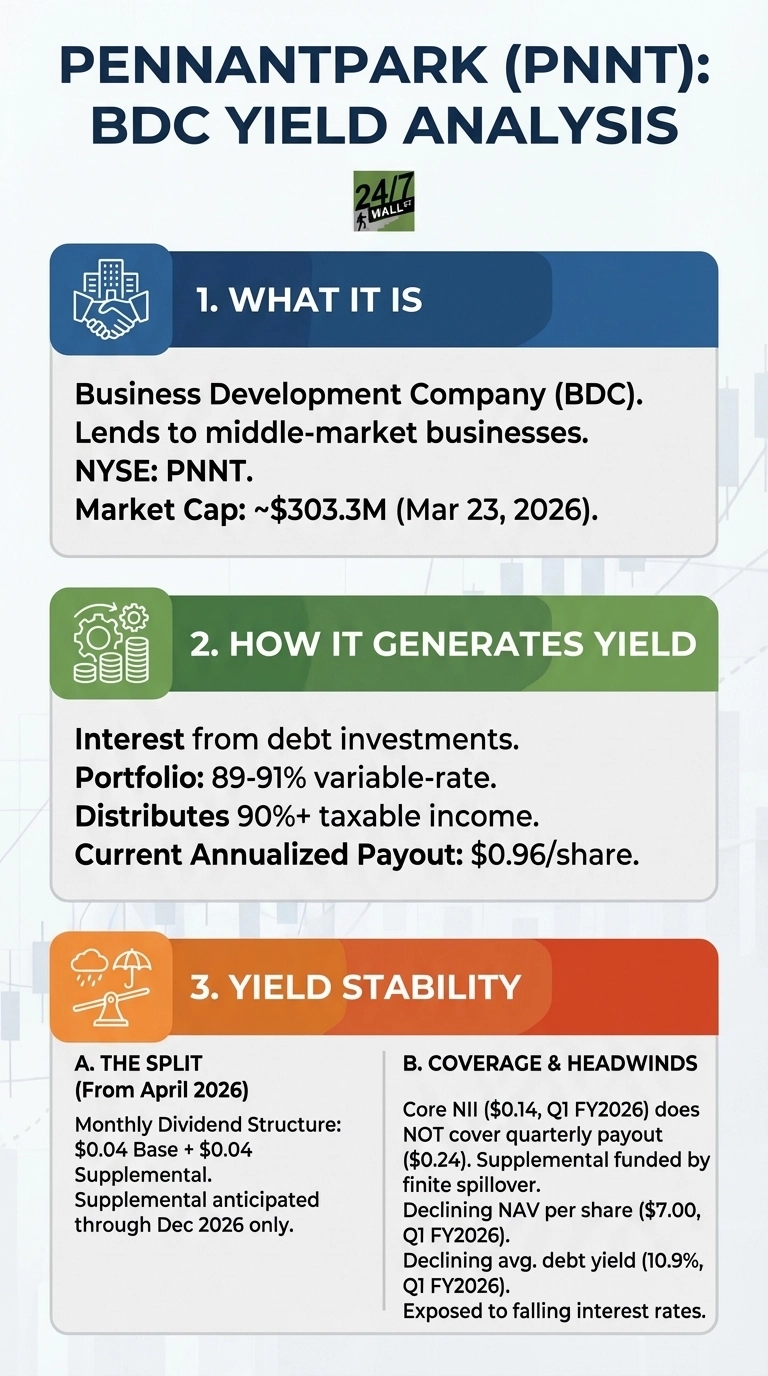
This restructuring acknowledges that current earnings cannot cover the full payout. Core net investment income (NII) came in at $0.14 per share in Q1 FY2026, which is below the $0.24 quarterly distribution rate. The supplemental is being funded by drawing down a finite reserve, not by generating new income.
A Shrinking Income Engine
The coverage gap has been widening for over a year, as NII per share has missed analyst estimates in four consecutive quarters and revenue has fallen by more than 20% year over year in the most recent quarter. The weighted average yield on debt investments has compressed steadily, from 12.0% in Q2 FY2025 to 10.9% by Q1 FY2026, as the Fed cut rates and new loans came in at lower yields.
The Fed has cut rates 75 basis points since mid-December 2025, with the federal funds rate now ranging between 3.50% and 3.75%. With nearly 89% of the portfolio tied to floating rates, each cut directly reduces interest income. Any further easing would pressure the base dividend, not just the supplemental.
The Spillover Cushion Is Real but Finite
Management estimated spillover income of $0.73 per share as of Q4 FY2025, providing a meaningful runway to fund the $0.04 monthly supplemental through the end of 2026, as guided. CEO Art Penn has been transparent about the strategy. On the Q3 FY2025 earnings call, he stated: “We will continue to utilize the significant balance of spillover income to cover any shortfall between core net investment income and the dividend as we execute on the plan.”
The plan centers on rotating out of equity positions and redeploying proceeds into higher-yielding debt. The $67.5 million realization of the JF Intermediate equity stake in Q1 FY2026 is an example of this working. But equity realizations are lumpy and unpredictable, and NAV has declined in each of the past five quarters, falling from $7.56 to $7.00 per share, a steady erosion that reflects both the income shortfall and the challenges of the equity rotation strategy.
Total Return Context
The market has responded to PNNT’s deteriorating fundamentals with a sustained selloff, with shares down about 21% year-to-date and roughly 33% over the past year. Even after accounting for dividends paid, investors who bought at higher prices are sitting on a net loss. The stock trading at roughly 0.64 times book value signals that the market broadly doubts NAV can stabilize, a reasonable concern given five consecutive quarters of NAV erosion.
One positive signal: PNNT’s CFO purchased 15,000 shares at $4.88 on March, 11, 2026, doubling his direct ownership. Insider buying at depressed prices is encouraging, but it does not change the earnings coverage math.
Verdict
The $0.04 base dividend is reasonably safe in the near term, and the $0.04 supplemental is a bridge mechanism funded by a reserve that will eventually run out. Management has been clear: the supplemental is expected through December 2026, not beyond. If the equity rotation strategy does not rebuild NII by then, the total payout will likely drop to what earnings can actually support. At current core NII levels, that is roughly half the current monthly payment. The full $0.08 monthly rate has an expiration date unless fundamentals improve, and investors should weigh that timeline carefully against the yield on offer today.












 Top Gaining Stocks
 Top Losing Stocks