


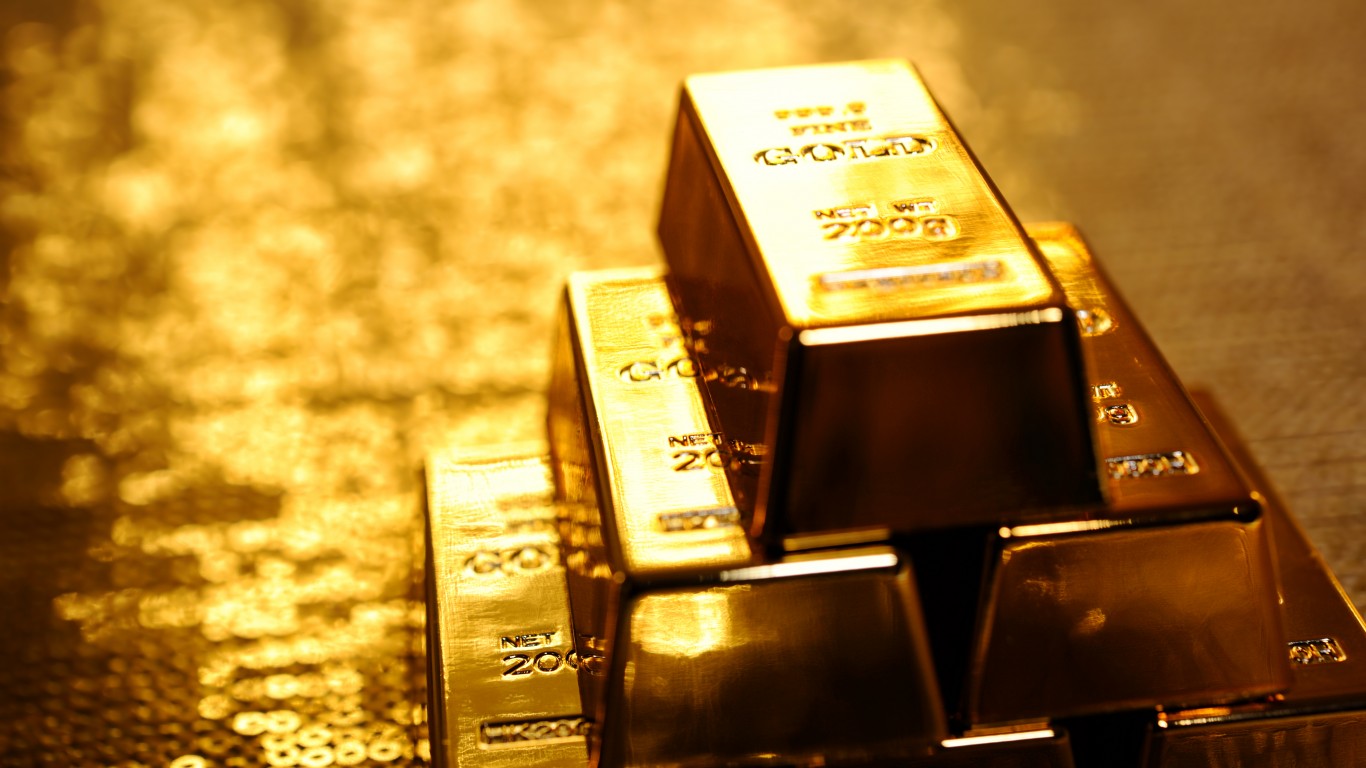
The debasement trade have produced quite a few winners. One of the most obvious is the SPDR Gold Shares ETF (NYSEMKT: GLD). In mid-March 2026, the fund crossed a massive $180 billion in assets under management, fueled in part by roughly $15 billion in net inflows in the first quarter alone.
Confidence in the U.S. dollar has been fading. Persistent deficits, elevated interest rate volatility, and ongoing monetary expansion have all contributed to concerns about long-term purchasing power. At the same time, geopolitical tensions have continued to escalate. The Russia-Ukraine war, the Israel-Hamas conflict, and now rising tensions involving the U.S. and Iran have all reinforced demand for perceived safe-haven assets.
Gold sits at the center of that trade. In 2026, gold prices surged past $5,000 per ounce and held those levels for much of March before pulling back toward $4,500. Unsurprisingly, it’s been a strong environment for gold-backed ETFs. As of February 28, 2026, GLD delivered an 83.53% return over the trailing one-year period based on net asset value.
But it wasn’t actually the best-performing way to play gold. Over that same period, gold mining ETFs delivered significantly higher returns. The VanEck Gold Miners ETF (NYSEMKT: GDX) returned 192.31%, while the more speculative VanEck Junior Gold Miners ETF (NYSEMKT: GDXJ) surged 225.3%.
That’s a massive difference. Bu before you rush to chase those higher returns, though, there are important nuances to understand. The same factors that amplified gains for mining stocks can just as easily work in reverse. Here’s what you need to know.
Why GDX and GDXJ Beat GLD
The first thing to understand is that these are fundamentally different products.
GLD holds physical gold bullion. It sits in a vault, and each share represents fractional ownership of that gold. Your returns are almost entirely driven by the spot price of gold, minus fees.
GDX and GDXJ, on the other hand, don’t hold any gold at all. They own shares of companies that explore for, extract, and sell gold. That distinction changes everything.
With GLD, your performance closely tracks the price of gold itself. With GDX and GDXJ, returns depend on both gold prices and how well these companies operate. That includes how efficiently they find reserves, how cheaply they can extract them, and how profitably they can sell their output.
This is where a key concept comes into play: all-in sustaining cost, or AISC. AISC measures the total cost required to produce an ounce of gold, including operating expenses, sustaining capital, and overhead. It’s essentially the breakeven level for a mining company.
If a miner has an AISC of $1,500 per ounce and gold is trading at $2,000, it earns a $500 margin. If gold rises to $2,500, that margin doubles to $1,000. The price of gold only increased by 25%, but profits increased by 100%. That’s operating leverage.
During a strong gold bull market, that leverage can lead to outsized gains for mining stocks. Higher margins drive earnings growth, which feeds into higher earnings per share and, ultimately, higher stock prices.
But the same dynamic works in reverse. When gold prices fall, margins compress quickly. Profits can disappear altogether, and share prices tend to fall much harder than gold itself.
That’s why you’ll notice different levels of “torque” across these ETFs. GDX amplifies gold price movements more than GLD, but GDXJ takes that even further. The reason comes down to what each fund holds.
GDX focuses on larger, more established mining companies. GDXJ, by contrast, holds smaller “junior” miners. These companies are often still in the exploration phase, may not yet be profitable, and frequently rely on issuing new shares to fund operations. That makes them higher risk and higher reward.
Why the Long-Term Results Tell a Different Story
Over short periods, especially during a gold bull market, it’s easy to assume that if GLD is doing well, GDX and GDXJ must be even better. But a longer-term perspective tells a different story.
According to testfolio.io, over a 16.36-year period from November 2009 to March 2026, GLD delivered an 8.3% annualized return. GDX lagged at 4.17%, while GDXJ did even worse at just 2.62%.
Gold and gold miners go through boom and bust periods. During downturns, mining stocks can experience deep drawdowns, and the math of compounding works against them. A 10% loss requires an 11% gain to recover, and the deeper the loss, the harder it is to climb back.
Mining ETFs have had to dig out of much deeper holes. At their worst, GLD declined about 19.62%. GDX fell 45.84%, and GDXJ dropped as much as 61.56%. That level of volatility makes long-term compounding much more difficult.
This doesn’t mean GDX or GDXJ are bad investments. But they are cyclical, high-volatility tools that require careful position sizing and an understanding of the broader gold cycle. If you’re looking for leveraged exposure to gold, they can make sense. Just recognize the trade-offs.







 Top Gaining Stocks
 Top Losing Stocks