



Private equity (PE) firms have deployed trillions of dollars buying public companies, taking them private, restructuring operations, and selling at a profit. Understanding the leveraged buyout (LBO) playbook can help investors spot potential targets before a deal is announced.
What Private Equity Looks For in an LBO Target
The ideal LBO candidate checks five boxes: predictable cash flow to service acquisition debt, a depressed valuation that creates entry-point value, an underleveraged or rationalizable balance sheet, clear operational improvement levers, and a manageable size that fits a PE fund’s deployment capacity. Cash flow is paramount because buyouts are financed with significant debt serviced from the target’s own operations. Valuation matters because PE sponsors need to buy at a price that leaves room for equity returns after debt paydown. The rest is execution: can management cut costs, expand margins, or accelerate growth under private ownership?
With the federal funds rate at 3.6% as of April 1, 2026, after 75 basis points of cuts since September 2025, financing conditions have improved meaningfully from peak levels. Meanwhile, the CBOE Volatility Index (VIX) at 30.61 signals elevated market stress, which historically compresses valuations and creates attractive LBO entry points. Here are four stocks that fit the profile right now.
Bath & Body Works
Bath & Body Works (NYSE: BBWI | BBWI Price Prediction) is the most compelling pure cash-flow LBO story in this group. The stock trades at a trailing P/E of 6x and an EV/EBITDA of 5x, with EBITDA of $1.55 billion on $7.29 billion in revenue. Free cash flow reached $865 million in the most recent fiscal year, up sharply from prior periods. CEO Daniel Heaf’s transformation plan targets $250 million in cost savings over two years and includes an Amazon distribution expansion, giving a buyer clear value-creation levers.
The stock has fallen 38.4% over the past year, landing at $18.67, against an analyst consensus target of $27.62. The key risk is that the specialty retailer already carries $3.612 billion in long-term debt and negative shareholders’ equity of −$1.279 billion, meaning any acquirer must refinance a complex capital structure. A sponsor like Sycamore Partners, with deep specialty retail experience, would be a plausible buyer.
GitLab
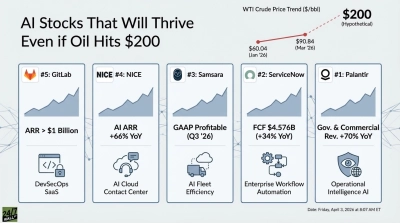
GAAP losses at GitLab (NASDAQ: GTLB) obscure a rapidly maturing cash engine. Operating cash flow hit $232.9 million in FY2026, up from −$64 million in FY2025, driven by $214.9M in non-cash stock-based compensation that inflates accounting losses but does not affect cash. Annual recurring revenue (ARR) crossed $1 billion, dollar-based net retention sits at 118%, and gross margins approach 87%. Those are classic SaaS characteristics that PE firms prize.
The stock has dropped 42.3% year-to-date to $21.64, well below analyst targets of $34.20. Polymarket assigns a 23.5% probability that GitLab is acquired before the end of 2026. A strategic acquirer like IBM or a large-cap PE firm with software expertise would be logical buyers.
ESAB
ESAB (NYSE: ESAB) is the industrial compounder PE loves: consistent margins, low capital intensity, and a proven M&A playbook. Core adjusted EBITDA margins reached 20.0% in FY2025, up 30 basis points year-over-year, on $2.84B in revenue. Capex was only $47 million against $2.84 billion in revenue, underscoring minimal reinvestment requirements.
The stock has fallen 23.4% in the past month to $96.66, creating a potential entry point relative to the analyst consensus of $148. With positive book value of $35.67 per share and a disciplined acquisition strategy, ESAB fits the industrial platform roll-up thesis favored by sponsors like Danaher or private equity firms building diversified manufacturing portfolios.
Alignment Healthcare
Alignment Healthcare (NASDAQ: ALHC) is an earlier-stage LBO candidate with strong growth credentials. Revenue rose 46.1% in FY2025 to $3.95 billion, and the company achieved its first-ever positive full-year free cash flow with operating cash flow of $139.9 million, up 302% year-over-year. Operating income turned positive at $14.75 million, versus −$101.6 million in 2024.
The stock trades at 0.87x revenue despite 44.4% quarterly revenue growth and a FY2026 revenue guidance of $5.135 billion to $5.190 billion. Regulatory risk around Medicare Advantage funding is real, but a healthcare-focused PE firm or large managed-care operator seeking a technology-differentiated platform would find the AVA platform and 100% four-star membership rating compelling.
What Happens to Shareholders When a Buyout Hits
When a PE firm or strategic acquirer announces a buyout, shareholders typically receive a cash premium of 20% to 40% above the undisturbed stock price. Shares immediately trade up toward the deal price, locking in that gain. Shareholders vote on the transaction and, if approved, receive cash at closing while the stock is delisted. The upside is certain and immediate; the downside is forfeiting long-term appreciation if the acquirer later relists at a higher valuation. For investors, the key takeaway is that holding a stock with strong LBO characteristics (low valuation, strong cash flow, clear improvement potential) provides both organic upside and the possibility of a buyout premium that accelerates those returns.









 Top Gaining Stocks
 Top Losing Stocks