


The Broadcom/Google deal announced this week signals a structural shift in AI infrastructure competition.
Here’s Bloomberg’s Neil Campling:
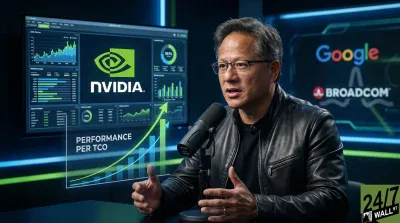
“The key factor is this is a five-year long-term agreement between Broadcom and Google. This is a technology that is rivaling Nvidia AI and in combination with Samsung earnings we had earlier today as well it is quite clear the AI demand trade is still alive and well and its appetite for these solutions.”
What the Five-Year Deal Actually Means
Broadcom (NASDAQ:AVGO | AVGO Price Prediction) and Alphabet (NASDAQ:GOOGL) have signed a long-term TPU and networking supply agreement running through 2031. For Broadcom investors, the five-year duration provides revenue visibility that quarterly earnings beats cannot match. A locked-in Google relationship through 2031 makes growth targets considerably less speculative.
Broadcom’s AI chip revenue already came in at $8.4 billion in Q1 FY2026, up 106% year-over-year. CEO Hock Tan has set a target of exceeding $100 billion in AI sales by 2027, with Q2 guidance calling for AI semiconductor revenue of $10.7 billion. Broadcom rose 12% over the past week, closing at $350.63. Alphabet gained 7% over the same period.
Custom Silicon vs. Nvidia’s Dominance
Nvidia (NASDAQ:NVDA) posted data center revenue of $62.31 billion in Q4 FY2026, up 75% year-over-year. That scale is formidable. But the Google deal illustrates something critical: hyperscalers are building a second lane. Google’s TPUs, designed with Broadcom, are purpose-built for specific AI workloads where custom silicon outperforms general-purpose GPUs on performance and cost per inference.
Campling’s read is that AI infrastructure demand is large enough to sustain multiple winners simultaneously.
Three Data Points, One Thesis
Campling combined three signals. First, the Broadcom-Google five-year deal. Second, Samsung’s earnings reported the same morning, validating memory and chip demand broadly. Third, Anthropic reported that over 1,000 companies are now spending more than $1 million annually on its AI solutions, a figure that doubled from February in just six weeks. Broadcom also confirmed plans to work with Anthropic to help power its operations.
Super Micro Computer (NASDAQ:SMCI), which assembles AI servers using chips from Broadcom and Nvidia, reported Q2 FY2026 revenue of $12.68 billion, up 123% year-over-year, with full-year guidance of at least $40 billion. The infrastructure build-out is accelerating across the entire stack.
If enterprise AI adoption is still in early innings, the Broadcom-Google deal validates the thesis. A five-year commitment from Google, combined with Anthropic’s customer growth and Samsung’s demand signal, suggests the AI infrastructure trade has considerably more runway than skeptics are pricing in.








 Top Gaining Stocks
 Top Losing Stocks