



The Roundhill AMZN WeeklyPay ETF pays investors every week, but the weekly check may be coming straight out of their own pocket. Roundhill AMZN WeeklyPay ETF (BATS:AMZW) is built around the premise that Amazon investors shouldn’t have to pick one. It delivers a weekly paycheck tied directly to how Amazon trades, with a twist that amplifies both the upside and the risk.
What AMZW Is Actually Trying to Do
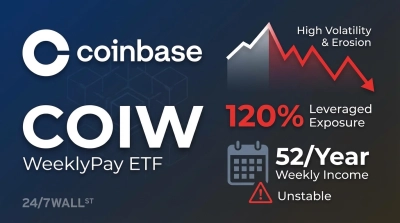
AMZW is an actively managed ETF designed to provide weekly distributions and calendar week returns equal to 1.2 times (120%) the calendar week total return of Amazon common shares. That means if Amazon rises 5% in a given week, AMZW is targeting roughly 6%. If Amazon falls 5%, AMZW is targeting roughly a 6% decline. The leverage cuts both ways, every week, without reset.
The return engine is a total return swap structure. It is a contract where the fund receives the full economic return of Amazon shares (price gains plus dividends) from a counterparty without directly holding all of those shares. Rather than simply buying Amazon shares outright, the fund holds Amazon shares at roughly a 20% weight alongside a government money market position, with swap contracts providing the leveraged exposure to Amazon’s weekly performance. The weekly distributions are funded through a proprietary formula that draws on that swap structure, and the fund has disclosed that recent distributions are estimated to be 100% return of capital, meaning they are not generated from investment income but from the fund’s own assets.
This is a critical distinction. Return of capital distributions reduces your cost basis rather than representing earnings, which changes both the tax treatment and the long-term math considerably.
The Weekly Paycheck in Practice
The distributions do arrive, and they can be sizable. On April 10, 2026, AMZW declared a weekly distribution of $0.3305 per share, a roughly 60% increase from the prior week’s distribution of $0.2069. That kind of week-to-week swing reflects how directly the payout is tied to Amazon’s price action rather than any stable income stream.
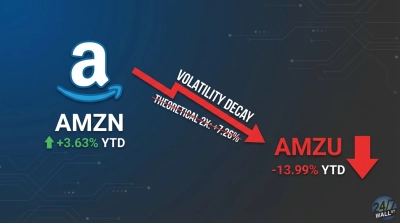
The fund has $34.9 million in total net assets and launched in June 2025, making it a young product with a limited track record. Since its inception, AMZW has returned roughly 10%. Over the same period, Amazon itself has gained about 32% over the past year. The gap between those numbers is the cost of the income sleeve and the drag from distributions classified as return of capital rather than appreciation.
The recent volatility has been sharp. AMZW gained 16% in a single week ending April 10, 2026, mirroring Amazon’s own 14% one-week gain with the 1.2x multiplier doing its job. That kind of upside is compelling, but the same math applies to a bad week for Amazon.
Three Tradeoffs Investors Need to Understand
- Distributions can be returns of capital, not income: When a weekly payment is classified as a return of capital, it is essentially the fund returning your own money. If Amazon trades sideways or lower for an extended period, distributions erode the fund’s net asset value rather than supplement it. Investors chasing yield can mistake capital return for earned income.
- Leverage amplifies losses symmetrically: The 1.2x structure works against holders in down weeks just as powerfully as it works for them in up weeks. Amazon is a volatile stock, and a sustained drawdown compounds faster at 1.2x than a buy-and-hold position would. The fund has no downside buffer or options collar to soften losses.
- Tax complexity is real: Return of capital distributions reduces your cost basis over time, which can create a larger taxable gain when shares are eventually sold. This fund is poorly suited for taxable accounts where investors are not actively tracking basis adjustments.
AMZW makes sense as a small income sleeve for investors who are already bullish on Amazon and want weekly cash flow from that conviction. Anyone expecting it to outperform a simple Amazon position on total return, or treat the weekly checks as risk-free income, is misreading what this fund actually delivers.









 Top Gaining Stocks
 Top Losing Stocks