


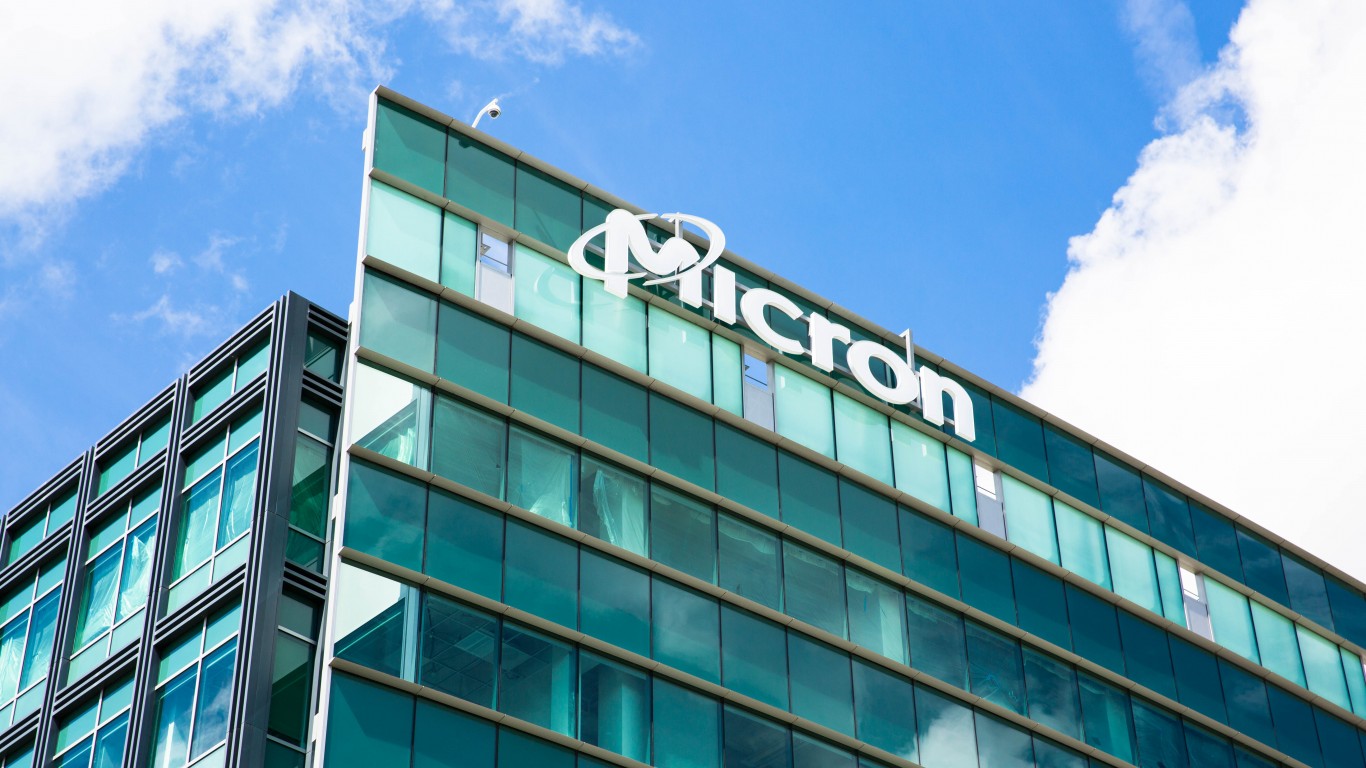
One year ago, Micron Technology was trading at roughly $70 a share. Today, Micron Technology (NASDAQ:MU | MU Price Prediction) sits at $450.49, a gain of 557% over the past twelve months. The skeptics who doubted the setup have been proven wrong in spectacular fashion.
The Original Thesis
On the Barron’s Streetwise podcast episode “The Cheapest Stocks in America,” Jack Hough laid out a straightforward case. “Memory, of course, is in fierce demand for AI data centers, and that’s led to shortages and soaring prices,” he explained. The core of the argument was an earnings explosion. Hough noted that Micron “never earned more than $12 a share,” with its highest year at “$11 and change” back in 2018. The AI supercycle was pushing the company into territory it had never seen before.
Hough also identified the valuation paradox at work. “You can get a low P/E ratio by having either a low P or a high E or both at the same time. But you can also have a rising P with an E that’s just rising a whole lot faster.” That dynamic, he argued, was exactly what was unfolding at Micron.
Why the Skeptics Had a Point
The doubters had reasonable grounds for caution. Semiconductor booms have a long history of ending badly, and Hough acknowledged that investors were taking a “my eyes deceive me” approach, having “seen enough semiconductor booms in the past that fizzled.” Co-host Jackson Cantrell remained skeptical about whether the momentum would continue. Hough’s own expectation was measured: “the stock stays at 4 times earnings, but then gradually investors come around and the stock keeps climbing.”
The earnings data has since removed most of the ambiguity. Micron’s fiscal Q1 2026 results showed revenue of $13.64 billion, a 57% year-over-year increase, with non-GAAP EPS of $4.78, exceeding the consensus estimate of $3.94. The Cloud Memory Business Unit alone generated $5.28 billion in revenue at a 66% gross margin. For the full fiscal year 2025, net income grew 998% year-over-year.
Where Analysts Stand Now
The analyst community has followed the data. Of 43 analysts covering the stock, 10 rate it Strong Buy and 28 rate it Buy, with just 5 Hold ratings and zero Sells. The consensus price target sits at $533.73, implying meaningful upside from the current price. KeyBanc sees another 40% upside from recent levels.
The forward P/E tells its own story. Micron currently trades at 7x forward earnings, a figure that looks historically low for a company generating this kind of operating leverage. The lesson Hough outlined has played out: when the fundamental demand driving an earnings explosion is structural rather than cyclical, the market eventually prices it in. The question now is how much of the AI memory supercycle remains ahead.








 Top Gaining Stocks
 Top Losing Stocks