


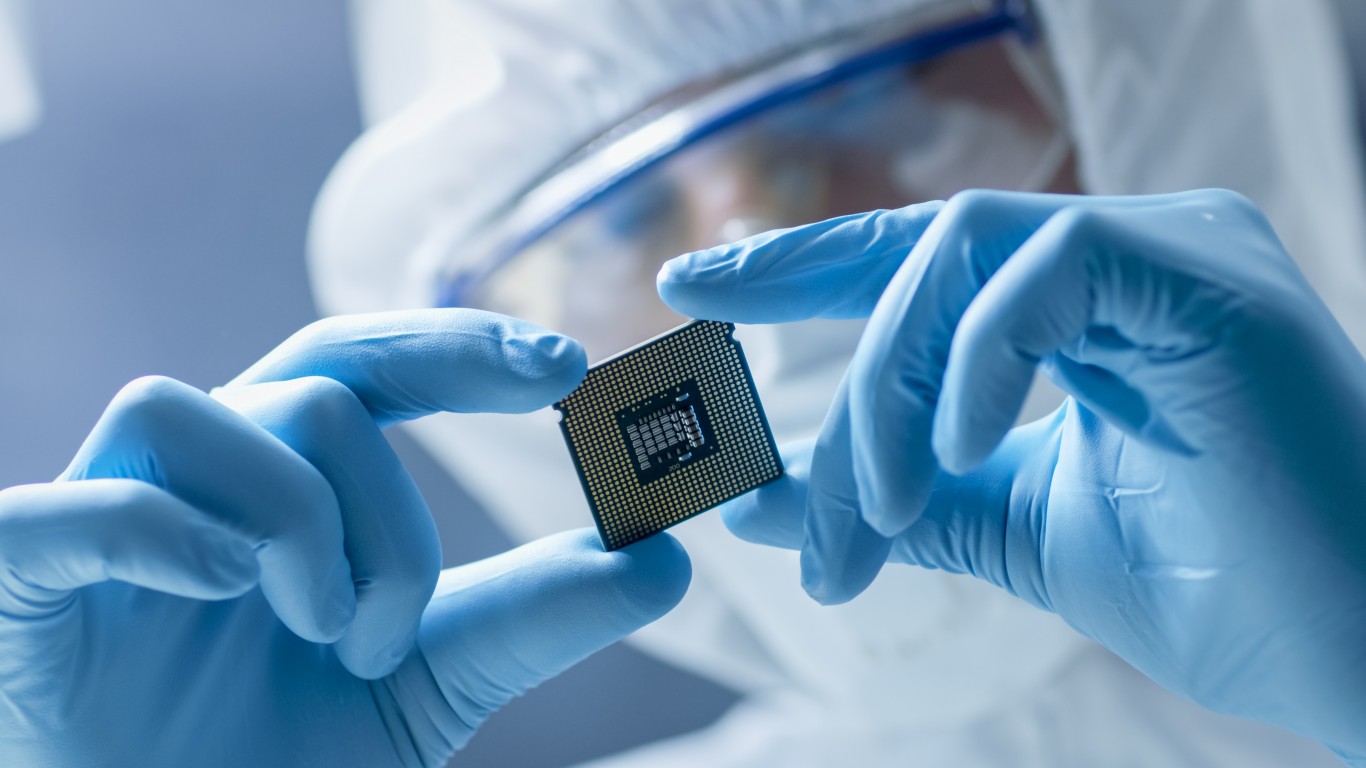
Taiwan Semiconductor Manufacturing (NYSE:TSM | TSM Price Prediction) makes the chips inside nearly every advanced device on earth, from iPhones to AI accelerators. Its dominance is so complete that even competitors depend on it. YieldMax TSM Option Income Strategy ETF (NYSE:TSMY) offers a way to collect weekly income from this critical company without owning it outright.
How the covered call strategy works
TSMY does not hold TSM shares directly. Instead, it uses a synthetic covered call strategy, gaining indirect exposure to TSM while simultaneously selling call options on that position. When you sell a call option, you collect a premium upfront in exchange for capping your upside if the stock rises past the strike price. That premium becomes the income TSMY distributes to shareholders, paid out weekly.
The trade-off is explicit: the fund’s strategy will cap its potential gains if TSM shares increase in value, while remaining subject to all potential losses if TSM shares decrease in value, which may not be offset by income received by the fund. You get the income. You absorb the downside. You forfeit much of the upside.
The yield is mostly return of capital
As of mid-April 2026, TSMY carries a distribution rate of about 58%, annualizing the most recent weekly payment. But that figure requires context that changes its meaning dramatically.
The most recent distribution disclosed that 96% of the payment was classified as return of capital, with only 4% representing actual income. Return of capital is not income generated by the strategy. It is the fund returning a portion of your own investment to you. Over time, this erodes the NAV and reduces the cost basis of your shares, creating a deferred tax liability. A 58% “yield” built almost entirely on return of capital is not a yield in any traditional sense.
Weekly distributions in 2026 have ranged from roughly $0.10 to $0.24 per share, totaling roughly $2.19 per share year-to-date across 15 payments. That is real cash in hand, but its source matters enormously for sustainability.
The cost of capped upside
TSM has delivered outsized returns relative to most large-cap peers over the past year. Over the past year, TSM shares have risen 147%, while TSMY has gained 109% over the same period. The gap illustrates exactly what the covered call structure costs: a meaningful portion of TSM’s price appreciation was surrendered to option buyers.
Year-to-date in 2026, TSM has gained 22%, while TSMY has gained 19%. The closer tracking in a calmer market reflects how covered call strategies work: when the underlying stock grinds higher steadily rather than surging sharply, the cap bites less.
The underlying business is exceptional
The sustainability of any covered call income strategy depends on the underlying stock’s volatility and trajectory. TSM’s fundamentals are hard to argue with. In its most recent quarter, TSM reported revenue of $35.9 billion, up 35% year over year, with a gross margin of 66.2% and a net profit margin of 50.5%. Those margins are extraordinary for a capital-intensive manufacturing business.
Advanced nodes are driving growth: 3nm and 5nm chips combined represented 61% of wafer revenue, and the high-performance computing platform powering AI workloads accounted for 61% of total revenue.. For Q2 2026, management guided for revenue of $39 to $40.2 billion, with full-year growth of above 30% in USD terms. TSM’s free cash flow grew 18%, and the company holds NT$3.38 trillion in cash and equivalents. The business financing TSMY’s option premiums is not fragile.
Geopolitical risk cannot be modeled away
Every analysis of TSM-linked investments must acknowledge the geopolitical dimension. 100% of TSMY’s exposure is concentrated in Taiwan,, and the cross-strait risk between China and Taiwan is not theoretical. A conflict scenario would be catastrophic for both TSM and TSMY regardless of option income collected.
Who should own TSMY
The income from TSMY will continue as long as the fund operates and TSM maintains volatility. What changes is how much of each distribution is genuine option income versus return of capital, and that ratio has recently tilted heavily toward the latter.
For income investors who understand the structure, TSMY functions as a satellite position where the weekly cash flow and upside cap are both explicit trade-offs. For investors expecting a 58% yield backed by earnings, the reality is different: the fund is largely returning their own capital while providing partial participation in one of the most important companies in technology. Investors who want full exposure to TSM’s AI-driven growth will find the covered call structure limits that participation.











 Top Gaining Stocks
 Top Losing Stocks