


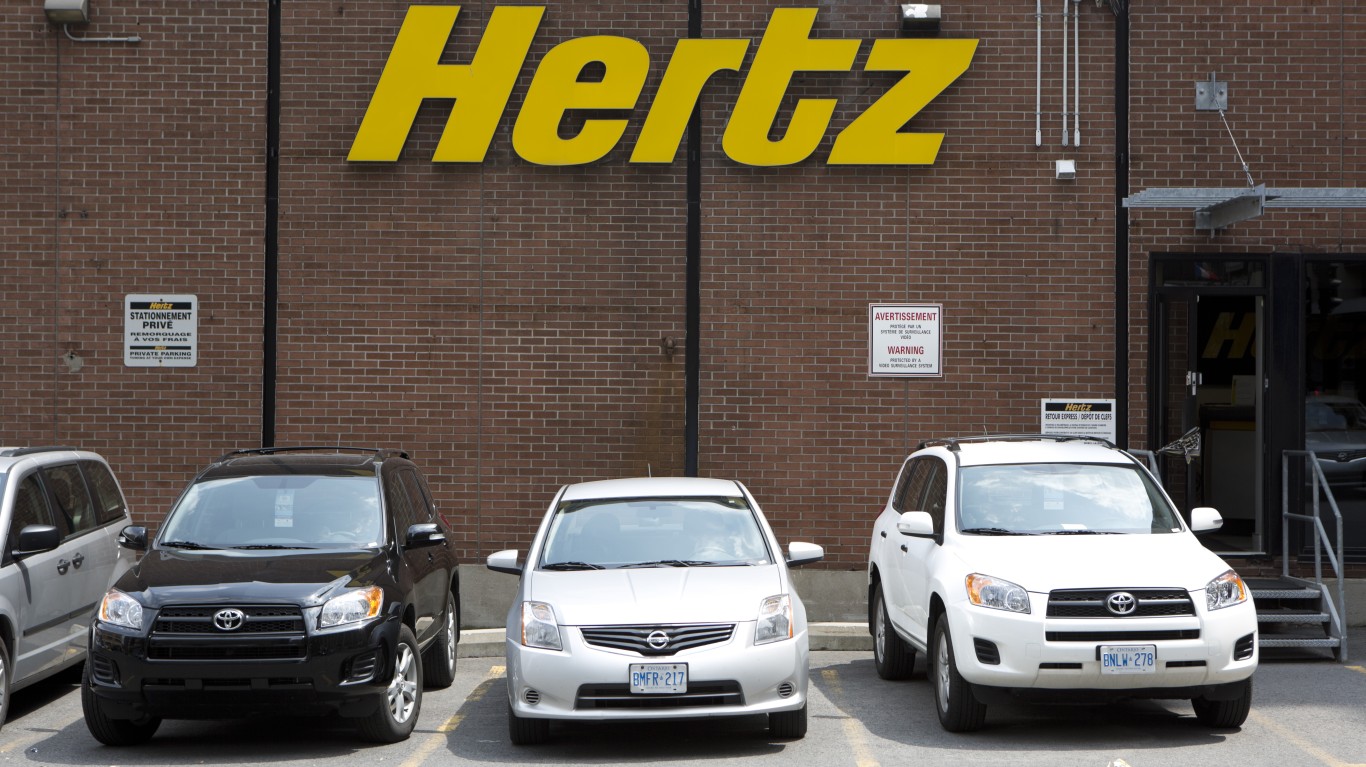
Hertz Global Holdings (NASDAQ:HTZ) stock is down 9% in midday trading on Tuesday, sliding from $7.81 to $7.11. That’s a painful single-session reversal for a stock that had nearly doubled over the prior month.
The short answer: nothing broke fundamentally. Profit-takers are stepping in after a parabolic run, and a Barclays downgrade of rental car peer Avis Budget Group (NASDAQ:CAR | CAR Price Prediction) is adding sector-wide unease. The irony is that Avis stock is actually up on the day despite receiving that downgrade.
Hertz hasn’t issued any negative news today. There’s no earnings miss, no guidance cut, no analyst action directly targeting HTZ stock. What’s happening is a classic case of a stock that ran too far, too fast, meeting profit-taking gravity.
A Rally That Nearly Doubled the Stock in Weeks
Hertz stock has surged 76% over the past month and is still up 35% year-to-date even after today’s selloff. That kind of move in a low-priced, heavily shorted name creates a specific dynamic: some investors sitting on substantial gains are watching the exit signs.
Hertz stock had been accelerating into this week, with momentum building across multiple timeframes. When a name that’s nearly doubled keeps pushing higher, profit-taking isn’t a question of whether it arrives. It’s when. Today appears to be that moment.
The longer-term picture for Hertz remains complicated. The stock is down 11% over the past year and 68% over five years. The recent monthly surge was a sharp departure from a long downtrend, which makes the profit-taking pressure even more understandable.
Barclays Downgrade on Avis Jolts the Sector
Barclays issued an “Underweight” rating on Avis stock today, adding fuel to the rental car sector’s volatility. Institutional downgrades on a sector peer have a well-documented spillover effect, particularly when both stocks have been caught up in the same short squeeze narrative. Traders who rode the rental car trade broadly are reassessing risk.
The downgrade matters for Hertz because the two companies have been moving in tandem during this squeeze cycle. When a major bank formally says a sector peer is overvalued, it signals that the institutional community thinks the move has gone too far. That sentiment doesn’t stop at the ticker that received the downgrade.
The Sector Divergence Worth Watching
Here’s where it gets interesting. Avis is up approximately 3% today despite receiving the Barclays “Underweight” downgrade. Meanwhile, Hertz is down 9%. That’s a sharp intraday divergence between two stocks that had been moving together.
One r/options post from Tuesday morning captured the short squeeze dynamics well, noting “there are simply no natural sellers in the market” for Avis. The author flagged Hertz directly as a correlated play, writing “Check out HTZ too, that is a lower risk play because these tickers are correlated. CAR goes 20% and HTZ does 5%.” That correlation appears to be running in reverse today. You can read more about the Avis dynamics in our earlier coverage of the Barclays downgrade.
The divergence suggests money may be rotating within the rental car trade rather than exiting entirely. Traders appear to be concentrating squeeze positioning in Avis while trimming Hertz exposure. That’s a meaningful distinction for anyone reading the next move.
What’s Next: May 7 Earnings as the Catalyst Reset
Hertz’s Q1 2026 earnings are scheduled for May 7, confirmed by the company and just 16 days away. That report will be the next real fundamental test for the turnaround story. Hertz’s “back-to-basics” strategy delivered a return to GAAP profitability in Q3 2025 for the first time in two years, and the company guided for mid-single digit revenue growth in Q1 2026. Whether that guidance holds will matter far more than today’s technical noise.
The fundamental turnaround narrative hasn’t changed today. Hertz’s depreciation per unit improved 44% year-over-year to $330 per month in Q4 2025, and full-year 2025 net loss narrowed to $747 million from $2.86 billion in 2024. Those are real operational improvements, even if the balance sheet still carries approximately $17 billion in total debt.
The open question heading into May 7 is whether today’s drop is healthy mean reversion in a name that ran nearly 98% in a month, or the start of a broader unwind of the rental car squeeze trade. Watch for whether Hertz stock holds above the $7 level into the close. If it does, the bulls still have a case. However, if it breaks below $7 with conviction, the profit-taking wave may have further to run before earnings give the stock a fresh narrative.









 Top Gaining Stocks
 Top Losing Stocks