



The idea of a $1.5 trillion U.S. defense budget sounds abstract until you translate it into procurement lines, contract awards, and long-cycle government spending that quietly reshapes entire industries. That’s where things get interesting for investors. Because when the Pentagon expands its wallet, it doesn’t just buy more of the same — it reallocates toward intelligence-driven warfare, autonomous systems, and software-defined defense.
That shift is already visible in recent Department of Defense budget justification documents and congressional appropriations drafts for FY2026. While legacy contractors like Lockheed Martin (NYSE:LMT | LMT Price Prediction) and Northrop Grumman (NYSE:NOC) still dominate the top line, a growing slice of incremental spending is flowing toward data platforms, autonomous drones, and battlefield software. And when all is said and done, three names consistently sit closest to that growth curve: Palantir Technologies (NYSE:PLTR), AeroVironment (NASDAQ:AVAV), and Kratos Defense & Security Solutions (NASDAQ:KTOS).
Let’s break down why.
Palantir Technologies (PLTR)
Palantir Technologies is arguably the most direct beneficiary of the Pentagon’s pivot from hardware-first to data-first defense. U.S. government revenue reached roughly $1.86 billion, growing at more than 20% year over year, driven largely by expansion of its Gotham and Foundry platforms across military and intelligence agencies.
Here’s what the numbers tell us: defense spending is increasingly software-allocated, not platform-allocated. A $1.5 trillion defense budget doesn’t just mean more tanks — it means more real-time battlefield intelligence, AI-enabled targeting, and logistics optimization. Palantir’s role sits squarely in that layer.
- U.S. Army Vantage program expansion: multi-year contract reportedly exceeding $618 million cumulative value.
- Commercial and government combined revenue growth: 70% YoY in FY2025.
- Operating margin: now trending positive at over 50% adjusted.
Surprisingly, Palantir doesn’t need defense spending to “buy more Palantir.” It needs defense spending to restructure how decisions are made. That’s a much larger opportunity.
AeroVironment (AVAV)
If Palantir is the brain, AeroVironment is increasingly becoming the eyes and strike capability at the tactical edge.
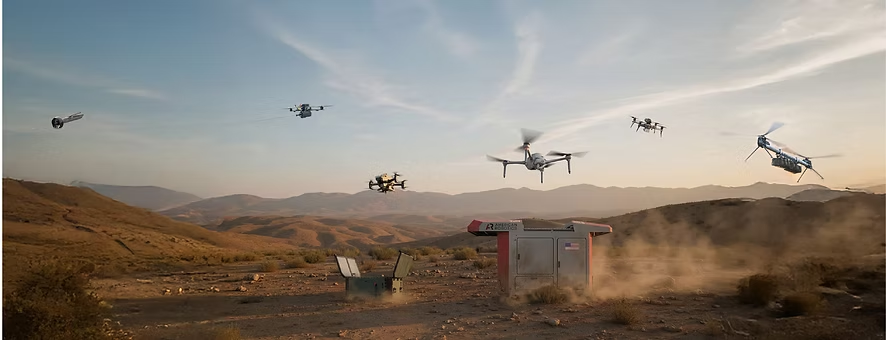
AeroVironment generated approximately $820 million in revenue, with defense-related unmanned systems accounting for more than 75% of total sales. That concentration matters in a world where the Pentagon is scaling unmanned aerial systems (UAS) procurement across infantry, reconnaissance, and low-cost strike missions.
The $1.5 trillion budget narrative accelerates that shift in three ways:
- Small drone procurement expansion under Army and Marine Corps modernization programs.
- Loitering munitions demand, especially after Ukraine validated their battlefield effectiveness.
- Border and surveillance integration programs, increasingly tied to autonomous systems.
Put differently, every additional billion in defense spending now includes a higher probability of drone allocation than it did five years ago. AeroVironment’s backlog stood at roughly $1,1 billion, giving it near-term visibility into demand that is already baked into federal procurement pipelines.
That said, investors should not ignore execution risk. Margins remain volatile, hovering in the high single digits to low teens, depending on mix. But in a rising-budget environment, scale often matters more than precision.
Kratos Defense & Security Solutions
Kratos Defense & Security Solutions is the least flashy of the three, but arguably one of the most structurally aligned with where defense spending is heading. Its FY2025 results showed revenue of approximately $1.35 billion, with strong growth in unmanned systems and hypersonic-related platforms.
Here’s the key shift: the Pentagon is increasingly funding “attritable systems” — low-cost, expendable drones and missiles designed for high-volume deployment. Kratos specializes in exactly that.
- Target drone and unmanned systems segment: growing at low-teens percentage rates
- Gross margin: approximately 23%, modest but stable for defense hardware
- DoD-funded development contracts: steadily increasing under Air Force and DARPA programs
That last point matters. DARPA’s autonomous systems initiatives, combined with Air Force “Collaborative Combat Aircraft” programs, are effectively redefining aerial warfare economics — fewer manned jets, more distributed unmanned fleets.
Kratos sits in that transition zone. In short, it’s not trying to replace Lockheed Martin. It’s trying to redefine the cost structure of air dominance.
Key Takeaway
When investors hear “defense budget increase,” they often default to broad ETFs or legacy primes. But this $1.5 trillion framework — based on early congressional budget projections and Department of Defense modernization outlines — does something more specific: it reallocates incremental dollars toward software, autonomy, and distributed systems.
That’s why these three names matter more than the broader sector beta. They sit at the intersection of:
- AI-driven command systems (Palantir Technologies)
- Autonomous battlefield hardware (AeroVironment)
- Low-cost, scalable strike systems (Kratos)
When all is said and done, the winners of a defense super-cycle are rarely the biggest contractors by revenue. They’re the ones aligned with where marginal dollars flow next. And right now, that flow is unmistakably shifting toward intelligence, autonomy, and attributable systems.










 Top Gaining Stocks
 Top Losing Stocks