



When Boeing (NYSE: BA | BA Price Prediction) and GE Aerospace (NYSE: GE) reported Q1 2026 results this week, both beat on the headline, but the market drew opposite conclusions: Boeing traded up roughly 5% intraday while GE traded down roughly 3%. So which one belongs in a retirement-focused portfolio right now? After reading both filings, the answer is clearer than the price action suggests.
1. Income and Cash Flow. GE Wins Decisively
Retirement portfolios live on cash returned to shareholders. GE Aerospace generated free cash flow of $1.658 billion in Q1, up 27.44% year over year, and full-year 2025 FCF of $7.69 billion. Management reaffirmed a 2026 free cash flow target of $8.0 billion to $8.4 billion and has committed to returning roughly $24 billion to shareholders between 2024 and 2026, with at least 70% of free cash flow flowing back via dividends and buybacks beyond 2026.
Boeing, meanwhile, posted Q1 free cash flow of negative $1.454 billion, pays no common dividend, and is still accumulating mandatory convertible preferred stock dividends ($86 million this quarter alone) that will dilute common shareholders on conversion. For anyone living off portfolio income, GE wins outright.
2. Balance Sheet and Risk. GE Wins Again
Boeing carries $47.2 billion in debt, down from $54.1 billion after $6.95 billion of repayments this quarter, against shareholders’ equity of just $5.987 billion. The Commercial Airplanes segment ran a $563 million operating loss on $9.203 billion of revenue, a negative 6.1% margin. Layer on Spirit AeroSystems integration risk, fixed-price defense contract exposure, and the 777X first delivery slipping to 2027, and the risk stack is substantial.
GE operates a services-heavy model with a commercial services backlog of $170 billion and 75% share of the narrowbody cycle and 55% of widebody cycles, giving it recurring, high-margin revenue that compounds regardless of the delivery cycle. CEO Larry Culp told investors the company is “well positioned to navigate cycles, with our backlog providing resilience through changes in air traffic.” That’s the kind of reassurance retirees should want to hear.
3. Momentum and Forward Setup. Boeing Wins
Credit where due: Boeing narrowed its core loss per share to −$0.20 from −$0.49 a year earlier, grew revenue 14% to $22.217 billion, delivered 143 aircraft (up from 130), and logged a record $695 billion backlog. The stock is up 42.3% over the past year and 18.5% in the past month, and sentiment has turned bullish: the composite score moved to 60.38.
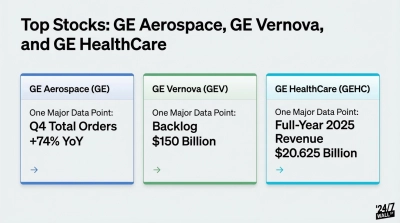
GE, despite a 16.31% EPS beat and 87% order growth to $23.0 billion, fell because management cut the full-year departures outlook from mid-single-digit growth to flat to low single-digit growth on Middle East disruption. Culp admitted, “if it were not for current events, we would be talking about an increase in the guide this morning.” Boeing is accelerating; GE is absorbing macro friction. Near-term momentum belongs to Boeing.
The Verdict
For a retirement-focused investor prioritizing income, capital preservation, and predictable cash generation, GE Aerospace is the clear choice. It pays shareholders, earns its keep on real free cash flow, and sits on a services backlog that insulates multi-year results. The current weakness (a stock down 12.0% in the past week and 10.3% year to date despite beating estimates) reflects macro caution instead of a broken business.
Boeing belongs in a different portfolio: a long-horizon investor willing to accept zero income, dilution risk from preferred conversion, and ongoing execution risk in exchange for turnaround upside if the 737-7 and 737-10 certifications land in 2026 and first deliveries arrive in 2027. That is a recovery trade rather than a retirement holding. Retirees will stick with the compounder while speculators pursue the turnaround.












 Top Gaining Stocks
 Top Losing Stocks