



Ripple (CRYPTO: XRP) just signed a partnership with Kbank, South Korea’s first internet-only bank and the sole banking partner of Upbit, to test blockchain cross-border remittances. The April 27 deal already has the bank testing remittance flows to the UAE and Thailand using Ripple’s Palisade digital wallet. It’s the second Ripple deal in South Korea this month, following the Kyobo Life Insurance partnership earlier.
We broke down what Kbank and Ripple are actually testing, how the blockchain remittance model works, and the most important question—if the partnership uses XRP, and how it could impact the XRP price?
Inside the Kbank and Ripple Partnership: What’s Being Tested?

Kbank CEO Choi Woo-hyung and Ripple’s Asia-Pacific Managing Director Fiona Murray met for the signing. The deal is structured as a multi-phase proof-of-concept (PoC) rather than a live commercial product, so Kbank customers can’t actually send money through Ripple’s network yet. Kbank wants to verify whether Ripple’s blockchain infrastructure can move money across borders faster, cheaper, and with more transparency than the systems it uses now.
The first phase of the test has already been completed using a separate test app with Kbank’s in-house wallet, which proved the basic remittance structure works. Phase 2 is now underway, with Kbank virtually linking customer accounts to its internal banking systems and testing on-chain transfer stability across two specific corridors—Korea to the UAE and Korea to Thailand.
The bank has also swapped its in-house wallet for Ripple’s Palisade, a software-as-a-service digital wallet Ripple acquired in November 2025 that’s already set up to handle bank-grade security and compliance.
So why does Kbank matter here? Every Korean trader who buys or sells crypto on Upbit—the country’s largest exchange—has to move their money through a Kbank account first. That makes Kbank the gateway between Korean fiat and the local crypto market, which gives this Ripple partnership more weight than a typical bank PoC.
How the Blockchain Remittance Model Actually Works
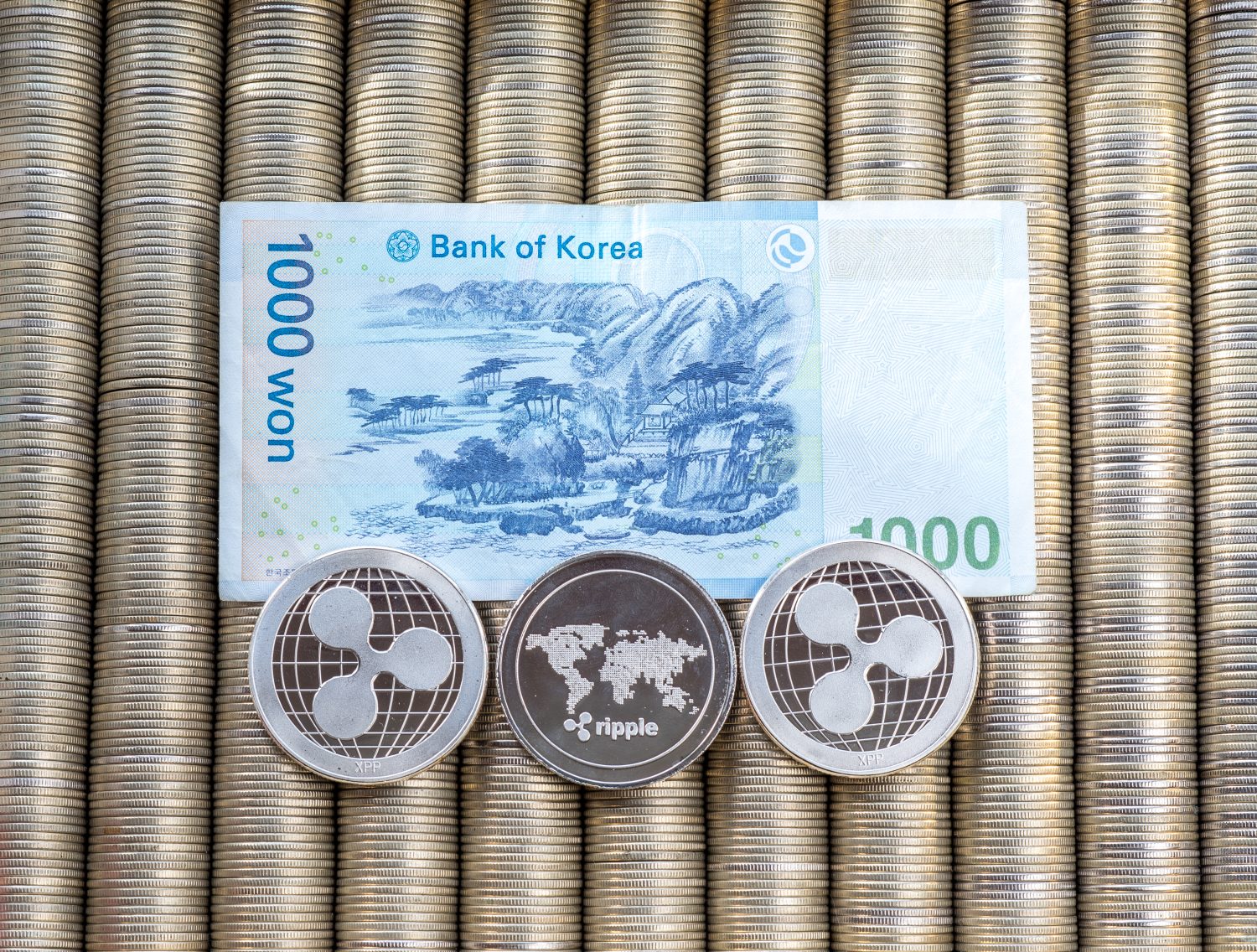
The setup looks like a typical money transfer process from the customer’s side. A Kbank user opening the app will see their balance in Korean won, and then choose to send money to a recipient in either the UAE or Thailand.
Behind that simple screen, the bank’s plan is to convert the won into a stablecoin in the background, send it across Ripple’s blockchain network, and convert it back into local currency on the other end—a typical cross-border transfer process, but with crypto in the mix. The customer will never touch crypto or stablecoin, and won’t even know one is involved—they’ll just see their won leave and the recipient’s local currency arrive.
There are key reasons why Kbank is testing this process via the Thailand and UAE corridors. Korea hosts more than 180,000 Thai nationals who regularly send money home, which makes the Korea-Thailand route a real test of demand. Kbank also signed an agreement back in January with UAE-based digital asset firm Changer.ae and Korean blockchain company BPMG, to build won-to-dirham stablecoin remittance rails.
So the Ripple PoC isn’t a cold start, but plugging into corridors Kbank has already been preparing. Then, speed and cost are what’s actually pulling Kbank toward this model. Sending money through traditional correspondent banks takes 1-3 business days and costs roughly 5-8% on Asia-to-Asia routes. Stablecoin transfers settle in seconds and cost cents on the blockchain side, leaving most of the savings in the hands of customers and the bank.
However, that only holds if the model survives compliance checks, currency conversion at both ends, and the transaction monitoring rules Korean and foreign regulators require—which is exactly what Phase 2 is testing.
Does the Deal Use XRP, and Will It Impact the XRP Price?

The Kbank and Ripple PoC doesn’t use XRP. In these corridors, the settlement asset is a stablecoin, the wallet is Ripple’s Palisade, and XRP plays no role in the conversion or transfer process. That means the deal creates no direct buying or selling pressure on XRP and won’t move the price. XRP is still trading around $1.41-$1.43, with whales accumulating but the wider market waiting for a key catalyst—like the CLARITY Act.
The reason XRP isn’t in the deal is that banks running compliance-heavy pilots want predictable settlement value, and XRP is too volatile for the job. A token that could drop by 5% during a transaction creates a regulatory headache no bank wants. Stablecoins like RLUSD fix that problem because they hold their value through the transfer. That’s why the major Ripple bank deals in 2026—Deutsche Bank, Convera, Kyobo Life—have all gone the same route.
That said, this is still Phase 2 of a multi-phase test, and the path to XRP demand from this partnership isn’t closed. If Kbank eventually turns on Ripple’s On-Demand Liquidity service—where XRP is the bridge between Korean won and dirham or baht—every transaction would create real XRP buying and selling activity.
That switch has been the missing piece for XRP in almost every Ripple partnership for years. And it’s why the CLARITY Act is a major catalyst that would make XRP a permanent digital commodity. For now, the Kbank deal is one more pipe being laid—and whether it ever carries XRP is a question for Phase 3 and beyond.
How Significant Is the Kbank and Ripple Partnership?
The Kbank and Ripple partnership matters for Ripple’s Korea strategy, but it won’t have any direct impact on the XRP price. South Korea’s ruling Democratic Party formally proposed the Digital Asset Basic Act on April 8, and President Lee Jae Myung has made a Korean won-backed stablecoin a national priority to push back against U.S. dollar stablecoin dominance.
So Kbank is not only testing a remittance model but also positioning itself for a legislative framework that’s actively being written. What will turn this PoC into a real product depends on the licensing structure that ensues from the Digital Asset Basic Act passing.
If the bank-led 51% consortium model wins, Kbank would move from the test phase to a competitive position issuing won-pegged stablecoins. But if the framework opens up to fintech firms, Korea’s competitive landscape would get messier and the Ripple-Kbank pipeline could lose some of its first-mover edge. What comes next depends on how the Digital Asset Basic Act passes in Seoul.












 Top Gaining Stocks
 Top Losing Stocks