


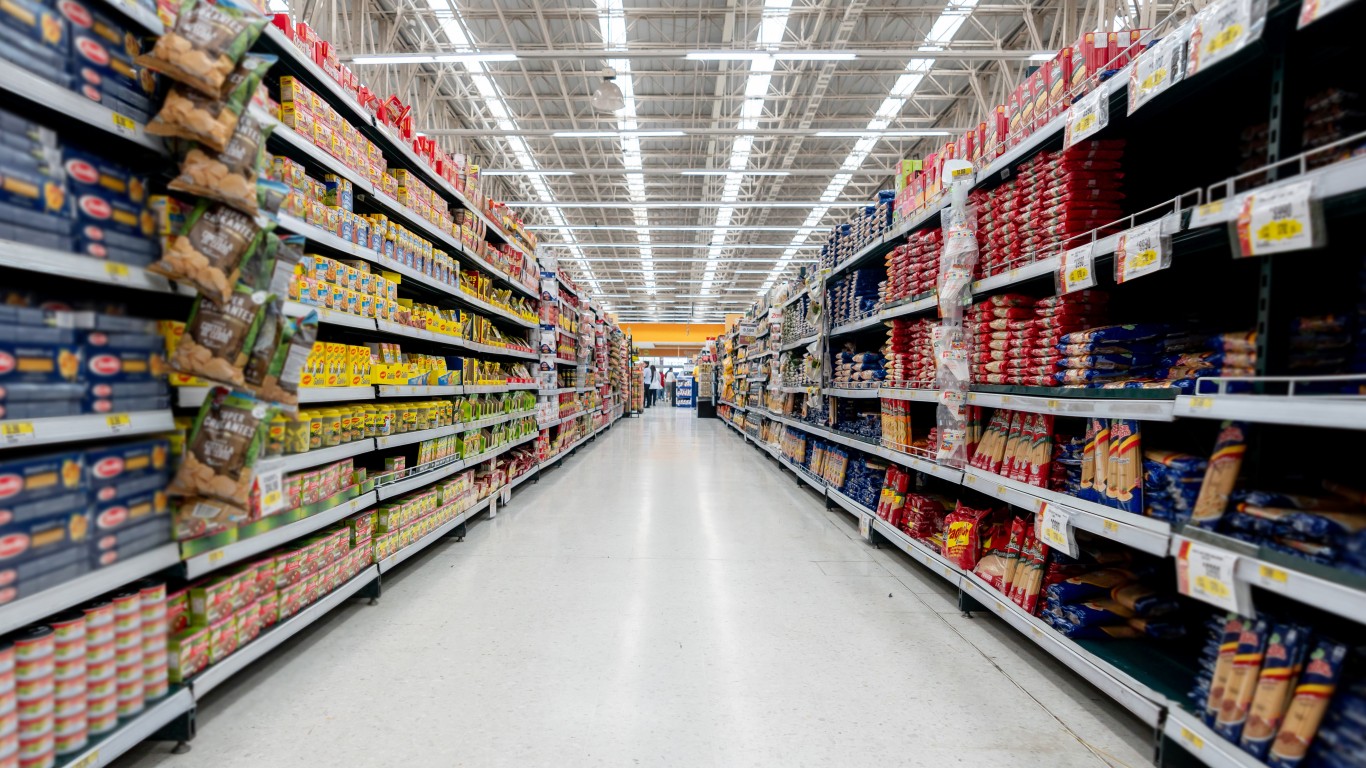
Consumer sentiment sits at 53.3 in March 2026, deep in the pessimistic zone, while retail sales just hit a fresh high of $752.1 billion. That gap between how Americans feel and how much they spend is the entire reason a fund like the Consumer Staples Select Sector SPDR Fund (NYSEARCA:XLP | XLP Price Prediction) exists. People grumble, then they buy toilet paper, soda, and a rotisserie chicken anyway.
XLP holds the companies that capture those routine reflex purchases.
What XLP Is Actually Built To Do
XLP launched on December 16, 1998 and tracks the Consumer Staples Select Sector Index, which carves the staples slice out of the S&P 500. The expense ratio is microscopic and the dividend yield runs 2.8%, paid quarterly from a basket that is 100% U.S.-listed.
The portfolio role is straightforward. You hold XLP because you want exposure to demand that does not flinch when the cycle turns. Consumer Staples Distribution & Retail makes up 33.64% of the fund, Beverages 19.25%, Food Products 17.15%, Household Products 16.27%, Tobacco 10.23%, and Personal Care 3.45%. There is no tech, no banks, no airlines. The return engine is mundane and durable, repeat-purchase cash flows compounded by pricing power and dividends.
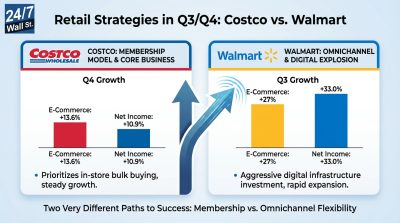
The businesses inside back that up. Walmart (NYSE:WMT) closed FY26 with $713 billion in revenue, 5% growth, and a 23% return on equity, and just authorized a $30 billion buyback in February 2026. Costco (NASDAQ:COST) renewed 89.7% of its 82.1 million paid memberships last quarter, a recurring revenue stream most software companies would envy. Procter & Gamble (NYSE:PG) just raised its payout for the 70th consecutive year on a dividend streak that started in 1890, and runs 23.1% operating margins.
The Defensive Math
XLP is up 8% year-to-date and 5% over the past year, against SPY’s 26.7% one-year and 5.3% YTD. Stretch the lens and the gap widens. XLP returned 37% over five years and 105% over ten, while SPY returned 73% and 249%. A retiree who parked $100,000 in XLP a decade ago has roughly $200,000. The same dollars in SPY became closer to $350,000.
That is the staples tax. You are buying a smoother ride and a bigger yield in exchange for missing the AI rally, the cloud rally, and whatever rally comes next.
Holdings tell the same story. Walmart returned 33% over the past year, but P&G is down 8% and Costco managed only 1%. The fund delivers averages.
Three Tradeoffs Worth Naming
- Valuation creep at the top. Walmart now trades at a P/E of 48x and Costco at 53x. Reddit users in r/wallstreetbets are openly asking why Walmart sits at 47x earnings. Defensive does not mean cheap.
- Tariff and input cost exposure. P&G is absorbing roughly $400 million in after-tax tariff costs and another $150 million in commodity headwinds in FY26, which is why the company guided toward the lower end of its $6.83 to $7.09 core EPS range.
- Concentration risk. The top five holdings carry roughly 41% of the fund. If Walmart or Costco stumbles, the “diversified” staples ETF stumbles too.
XLP fits best as a 5-15% defensive sleeve for investors who want yield, lower volatility, and exposure to brands that print cash through pessimism cycles. Anyone benchmarking against the S&P 500 in a growth-led market will find the underperformance hard to stomach.









 Top Gaining Stocks
 Top Losing Stocks