


For months, investors have been trapped in a market roiled by the Iran war that could swing wildly in a single afternoon based on one Truth Social post by President Trump or one missile strike in the Middle East. Oil traders were pricing in supply disruptions. Airlines were bracing for higher jet fuel costs. Consumers were already paying more at the pump.
The question hanging over Wall Street wasn’t just whether the U.S. and Iran were headed toward a broader conflict — it was whether the global economy could absorb another inflation shock without tipping into recession. Now investors finally have a reason to exhale.
Trump announced he was pausing “Project Freedom” operations escorting tankers through the Strait of Hormuz for “a short period” to allow negotiations with Iran to continue. The blockade of Iranian ports remains in effect, but the move marked the first meaningful de-escalation in weeks. And the prediction markets reacted immediately.
Recession Odds Just Collapsed
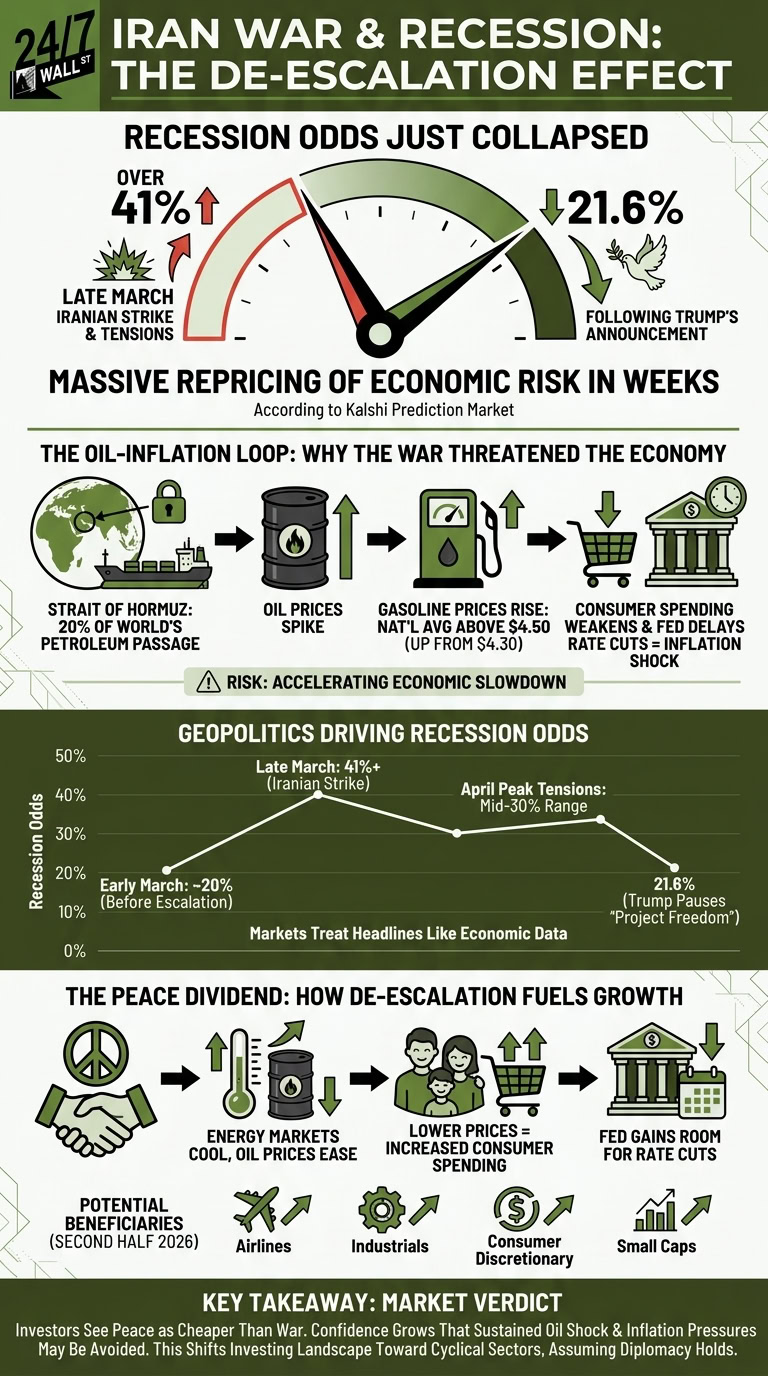
According to the Kalshi prediction market, the odds of a U.S. recession in 2026 fell to 21.6% following Trump’s announcement — down more than 10 percentage points in just one day and the lowest level since early March.
That matters because the same market showed recession odds surging above 41% in late March after an Iranian strike injured 12 U.S. troops stationed at Prince Sultan Air Base in Saudi Arabia. Traders feared the incident would spiral into a wider regional war involving oil infrastructure and shipping lanes.
Since then, recession expectations have swung wildly depending on Trump’s rhetoric.
When the administration intensified naval operations near the Strait of Hormuz, recession fears climbed. When Trump floated negotiations or hinted at restraint, the odds narrowed. Surprisingly, markets have treated geopolitical headlines almost like economic data releases.
Here’s what the numbers tell us:
| Event | Kalshi Recession Odds |
| Early March before escalation | ~20% |
| Late March Iranian strike | 41%+ |
| Peak military tensions in April | Mid-30% range |
| Trump pauses Project Freedom | 21.6% |
That’s a massive repricing of economic risk in a matter of weeks.
Why the Iran War Threatened the Economy
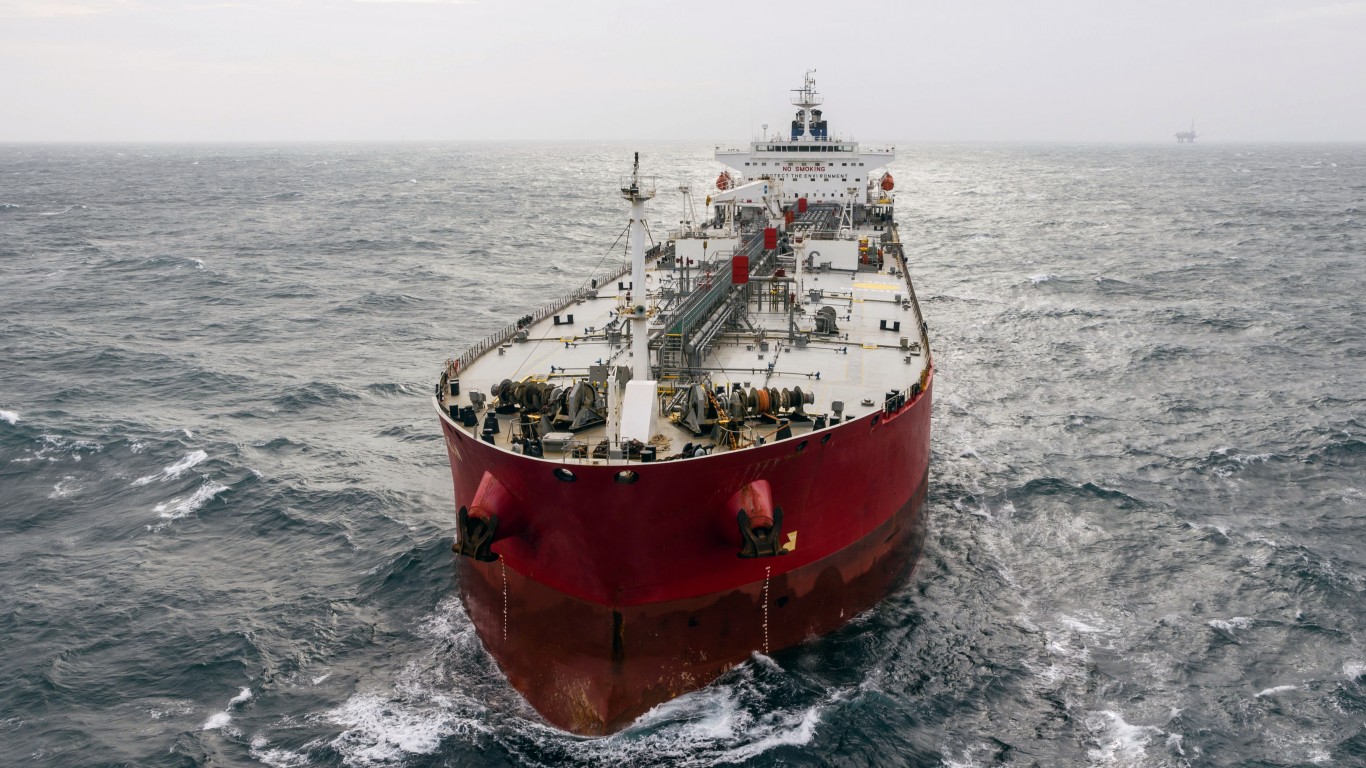
The economic danger was never just about military spending. It was about oil. Roughly 20% of the world’s petroleum liquids pass through the Strait of Hormuz, according to the U.S. Energy Information Administration. That shows how the global economy still runs through one narrow shipping corridor.
If tankers stop moving safely through the region, oil prices spike. And when oil spikes, inflation usually follows. That creates a brutal chain reaction:
- Gasoline prices rise
- Shipping costs expand
- Airline profits narrow
- Consumer spending weakens
- The Federal Reserve delays rate cuts
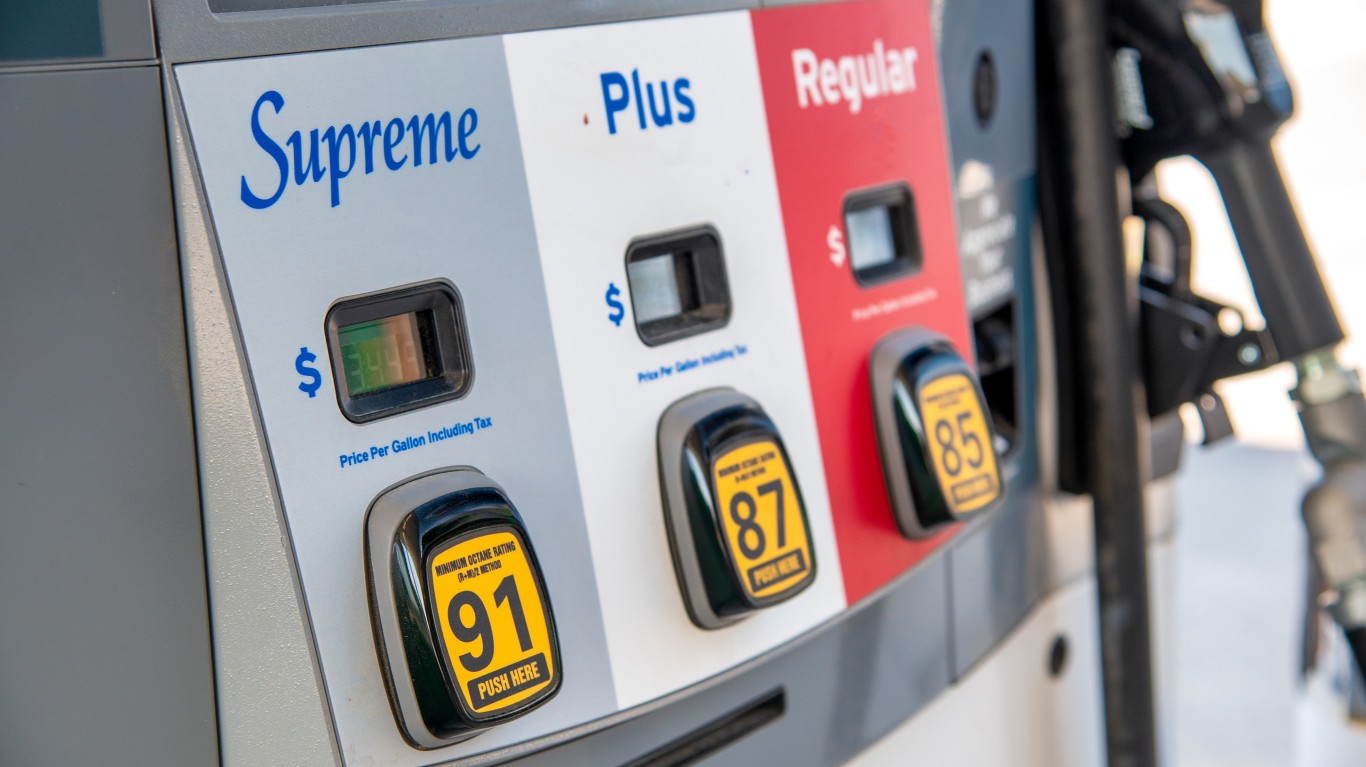
Investors are getting a taste of that now. AAA data shows national average gas prices that jumped to $4.30 per gallon after tanker rerouting intensified in the Gulf region have risen above $4.50 today. That increase acts like a tax on consumers.
Granted, higher gas prices alone don’t automatically cause recessions. But they can accelerate slowdowns already forming underneath the surface. That was the real concern facing Wall Street.
The Conference Board’s Leading Economic Index has been signaling slower growth for months. Manufacturing surveys from the Institute for Supply Management have remained uneven. Credit card delinquencies tracked by the Federal Reserve Bank of New York also climbed during the first quarter.
Adding a sustained oil shock into that mix could have pushed the economy over the edge.
Why a Peace Deal Could Fuel Growth Again
Now the opposite scenario is coming into focus. If negotiations hold and tanker traffic stabilizes, energy markets could cool quickly. Crude oil prices already eased after Trump’s announcement as traders reduced worst-case-war assumptions.
Lower oil prices ripple through the economy faster than many investors realize. Consumers spend less filling their tanks. Businesses pay less for transporting goods. Airlines regain pricing flexibility. Inflation pressure cools. Suddenly the Federal Reserve has more room to consider interest-rate cuts later this year. That’s why recession odds fell so sharply in a single session.
Markets aren’t just reacting to diplomacy. They’re recalculating the probability of an inflation resurgence. And when all is said and done, inflation has been the biggest obstacle preventing stronger economic growth since 2022.
That said, risks remain. Trump only paused Project Freedom “for a short period,” and the blockade of Iranian ports continues. One failed negotiation or one attack on shipping infrastructure could send oil prices surging again overnight. In any case, investors finally have evidence that de-escalation is possible.
Key Takeaway
In short, the market just delivered a clear verdict: investors believe a cooling Iran conflict sharply lowers recession risk. A drop from more than 41% recession odds to 21.6% is not noise. It reflects growing confidence that oil markets may avoid a sustained supply shock and that inflation pressures could ease instead of intensify.
It also changes the investing landscape. If diplomacy continues gaining traction, economically sensitive sectors like airlines, industrials, consumer discretionary stocks, and small caps could regain momentum during the second half of 2026. If tensions flare again, expect oil and defensive sectors to rebound quickly.
For now, though, Wall Street is betting peace is cheaper than war — and investors are responding accordingly.












 Top Gaining Stocks
 Top Losing Stocks