


The case for Apple (NASDAQ:AAPL | AAPL Price Prediction) gets easier to articulate every quarter. The pitch is simple. While Big Tech is in a capex arms race that will run past $725 billion in AI spending this year across Google (NASDAQ:GOOG), Microsoft (NASDAQ:MSFT), Meta (NASDAQ:META) and Amazon (NASDAQ:AMZN), Apple is sitting on enormous free cash flow, raising prices, raising dividends, and quietly letting 2.5 billion active devices do the compounding for it.
Apple’s job is to be the place customers eventually use the AI that everyone else is paying to build. So far, the receipts agree.
The cash flow keeps compounding
Start with the most recent quarter. Apple reported $111.184 billion in revenue, up 16.6% year over year, with diluted EPS of $2.01 against a $1.94 consensus. That is the eighth consecutive quarter of beating EPS estimates, a streak that only happens when the underlying business is structurally underpromising.
iPhone did $56.994 billion, a March-quarter record. Services did $30.976 billion, an all-time record, at a 76.7% gross margin. Every geographic segment grew double digits, including Greater China up 28% in the March quarter and 33% in the first half. Tim Cook called it “our best March quarter ever”, and the segment data backs the framing.
Apple turns those dollars back to shareholders with discipline almost no other company can match. The board raised the dividend 4% to $0.27 per share and authorized another $100 billion in buybacks. In fiscal 2025 alone, Apple repurchased $90.71 billion of its own stock. Over the program’s life, Cook noted more than $1 trillion has been returned to shareholders, with over $850 billion of that through repurchases. The yield is small at 0.38%, but the share count shrinks every quarter, which is a dividend by another name.
All that buyback money may have gone down a money pit if Apple tried training AI models and building data centers without having a strong foundation in the sector.
The returns the business itself earns on capital are striking. Return on equity of 121%, return on invested capital of 38%, operating margin of 32%. For a company with $371 billion in total assets, those figures describe a business that has turned its installed base into a private utility.
Why “do nothing” is the strategy
The bears get one thing right. Polymarket has Apple at 7.75% to be the largest company in the world by year-end, with NVIDIA at 51.5% and Alphabet at 37.5%. The market is telling you the AI builders are winning the headline race, and Apple is the one big platform that has not bet the balance sheet on the pick-and-shovel side.
What I need from Apple is to be the device on which the AI is consumed. Cook’s framing on the call was the entire investment case in one sentence. “What truly sets Apple Inc. apart is how Apple Intelligence is woven into the core of our platforms, powered by Apple silicon and designed from the ground up to deliver intelligence that is fast, personal, and private.” While Alphabet and Microsoft burn cash on training runs, Apple ships A19 Pro chips and lets the customer pay for the hardware that runs the inference. The cost structure is enviable.
Apple is also quietly using its pricing power. The cheapest Mac mini went from $599 to $799, and demand is so strong management said on the call “the Mac mini and the Mac Studio may take several months to reach supply-demand balance.” A company raising prices into a supply-constrained product line is signaling strength.
The risk that matters
The risk that actually matters here is the supply chain and the political weather around it. Apple still relies on third-party manufacturing concentrated in geographies subject to trade disputes and geopolitical tensions, and memory costs are expected to drive an increasing impact on the business beyond the June quarter.
I take that seriously. I also note that Apple is committing $600 billion to its U.S. supply chain, with Mac mini production moving to Houston later in 2026 and well over 100 million advanced chips being purchased from TSMC Arizona. The hedge is being built in real time.
What you are paying for at 36x
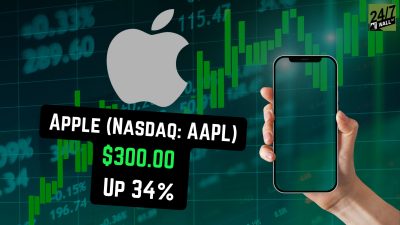
The stock is up 35.39% over the last year and 1,210.37% over the last decade, and trades at a P/E around 36x. Not cheap. But I am paying for an installed base of 2.5 billion devices, a Services business compounding at 16% with a 76.7% gross margin, and a management team that guided next quarter to 14% to 17% revenue growth while everyone else is guiding to higher capex.
Apple’s posture this cycle is to do nothing on AI capex, keep buying back stock, and let the rest of Big Tech finance the infrastructure its customers will eventually use.










 Top Gaining Stocks
 Top Losing Stocks