


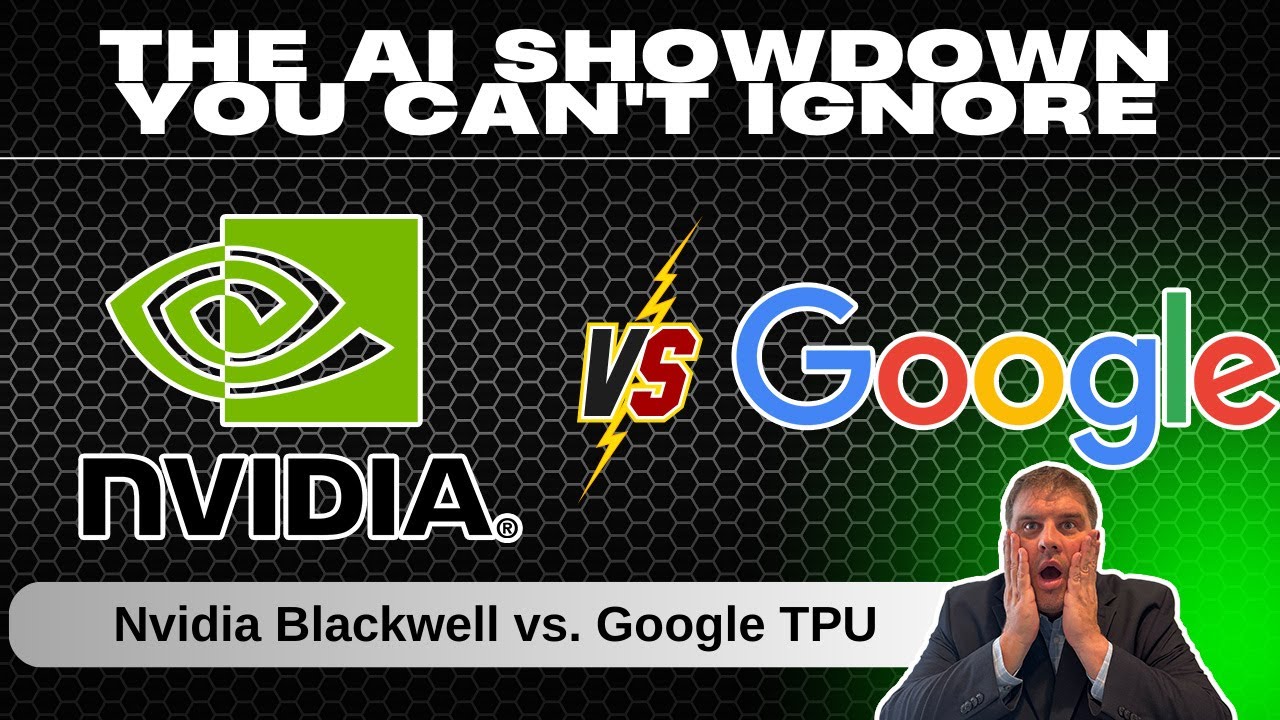
The question for retirement-focused investors right now is simple: own Alphabet (NASDAQ:GOOGL | GOOGL Price Prediction) or NVIDIA (NASDAQ:NVDA)? Google’s decision to sell its Tensor Processing Units (TPUs) directly to enterprise customers reframes the AI compute race, and it changes the risk math on the most crowded trade in the market. One of these stocks belongs in a retirement portfolio today. The other belongs in a growth sleeve with a stomach for volatility.
Here is how the two stack up on the dimensions that actually matter for retirees: valuation, yield and growth durability.
Valuation: Alphabet Wins, And It Isn’t Close
Alphabet trades at a P/E of 17 with a free cash flow yield of 3% and an earnings yield near 6%. For a business compounding earnings at the rate Google just printed, that is an unusually reasonable multiple for a mega-cap. NVIDIA, by contrast, carries a P/E ratio of 41 on a $4.82 trillion market cap. Paying roughly twice the multiple for a business with concentrated end-market exposure is the opposite of what a retirement investor wants. Winner: Alphabet.
Yield and Income: Alphabet Pays, NVIDIA Doesn’t
This dimension is binary. Alphabet pays a 22-cent quarterly dividend for a yield under 1%, and management raised the payout 5% alongside the latest report. The yield is modest, but the dividend is real, growing, and backed by $73.27 billion of full-year free cash flow. NVIDIA pays a token 1-cent quarterly dividend and runs its capital return through buybacks, with $58.5 billion remaining on its repurchase authorization and $41.1 billion returned in FY2026. Buybacks help, but they do not pay grocery bills. For an income-oriented retiree, Alphabet is the only one of the two that even shows up. Winner: Alphabet.
Growth Trajectory: NVIDIA Wins on Pace, Alphabet Wins on Durability
The headline numbers favor NVIDIA. Q4 FY2026 revenue rose 73% year over year to $68.13 billion, with Data Center revenue up 75% to $62.31 billion and Networking revenue up 263%. Full-year FY2026 revenue grew 65% to $215.94 billion. Jensen Huang says “Blackwell sales are off the charts, and cloud GPUs are sold out.”
Alphabet’s pace is slower, but more diversified. Q1 revenue rose 22% to $109.90 billion, Google Cloud grew 63% to $20.03 billion, and the cloud backlog nearly doubled quarter over quarter to over $460 billion. EPS came in at $5.11 versus $2.63 expected. NVIDIA has the faster top line right now. Winner on raw growth: NVIDIA.
However, durability cuts the other way. NVIDIA’s Q1 FY2027 guide of roughly $78 billion explicitly excludes any China Data Center compute, and $95.2 billion in supply commitments assume the AI capex cycle keeps compounding. Google now selling TPUs directly is a structural challenge to that assumption. Reddit’s most-discussed NVDA thread of the past week, “Is there a good answer for how do TPUs not pose a threat to GPU?”, captures exactly the question hyperscaler CFOs are now asking.
The Verdict
For a retirement-focused investor, Alphabet wins outright. Cheaper multiple, a real and growing dividend, a diversified cash flow base across Search, YouTube, Cloud, and a Gemini App with 350 million paid subscriptions, and a credible second leg of compute monetization via TPU. The market is already voting: GOOGL is up 23% year to date and 134% over one year, while NVDA is up just 6% YTD and down 8% over the past week.
NVIDIA still belongs in aggressive growth portfolios. The Blackwell ramp is real, the analyst consensus target of $269.17 implies meaningful upside, and 57 of 60 covering analysts rate it Buy. But a 40x multiple on a business facing its largest customers building competing silicon is a growth-investor trade that sits awkwardly in a retirement sleeve. For retirement-focused positioning, Alphabet screens as the more appropriate of the two here.












 Top Gaining Stocks
 Top Losing Stocks