



516 days ago, a Queens-born Manhattan real estate developer decided to run for President, and in the process convinced roughly 60 million Americans to exercise a 240-year-old right to appoint him as their leader. Most of America, including the popular vote, national pollsters, independent polling organizations, Republicans, and even some members of Trump’s own campaign thought he would lose. And then he won.
Two weeks ago, we covered how Mr. Trump’s presidential bid hurt his business and, with the election finally over, we certainly thought he was going to pursue a television network or some form of media outlet to either offset his losses or create a platform for his political ideology.
Trump TV has rumored to be in the works for months and, given that half his campaign staff was made up of an all-star lineup of Fox News and alt-right media alums, the formation of such a network or digital platform should have no problem converting a passionate electorate into a paying subscriber base.
Utilizing PrivCo’s Private Company Financial Database and a number of publicly-reported data points, we tabulated not only what a Trump TV network would look like, but also what its value would be, and how much revenue Trump could realistically expect to generate from the creation of such an enterprise.
The Viewer Base:
60.3 million people voted for Mr. Trump this year. That doesn’t mean all of them are ready and willing to tune in to a Trump TV nightly broadcast, as apparently many voters just didn’t like the other candidate that much — news to us. Votes do not equate to views though, just ask the 51 million who voted for Gore in 2000 for their thoughts on Current TV.
But even with just a fraction of his voter base, a real life version of a Trump network has a credible path to bringing on perhaps millions of subscribers.
The potential platform could go the traditional media route, broadcasting on an existing cable network as Vice Media did in partnership with A+E Networks.
If it goes digital only — a route that an entrepreneurial group of teenagers in Macedonia has figured out – the entity would be in good company and have a speedier time-to-launch.
Below are some compelling figures to promote why a digital version of his network could take off with a passionate and consistent viewer base.
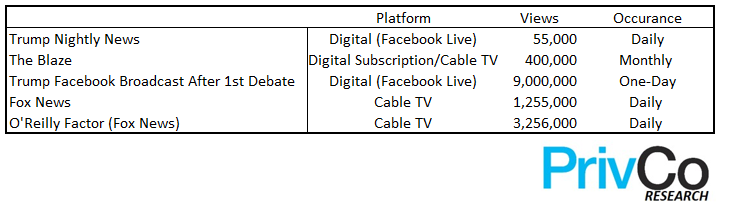
Glenn Beck’s Blaze Media is obviously the best proxy for Trump TV, and it is safe to assume that Trump can bring in more than Beck’s reported 400,000 monthly subscribers. To compare some major TV network views, Bill O’Reilly pulls in 3.26 million daily viewers. Fox News pulls in on average 1.25 million viewers per day. Rush Limbaugh in his prime in the mid-1990s had 20 million listeners per week. For greater context on the digital enthusiasm of Trump’s supporters, one story on just one of those fake Macedonian News sites received 480,000 unique shares on social media within one week. Trump is averaging roughly 55,000 views on Facebook Live each night for “Trump Nightly News” and garnered 9 million views on Facebook Live the night of the first debate.
For argument’s sake, we will assume Trump won’t explore a site that only generates revenue through advertising, but will explore a subscription model (as we will explain below, however, the valuation multiples for new media are significantly higher than traditional ones).
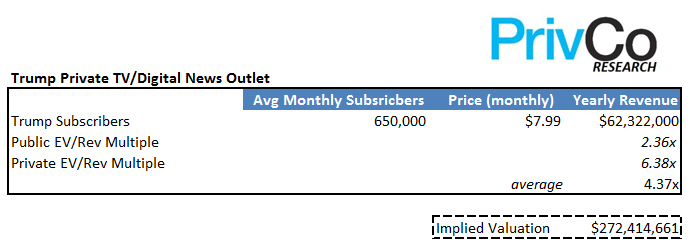
Let’s put Trump TV’s core subscribers at 650,000/month (1.07% of his electorate), each paying $7.99/month. Higher subscribers, but a lower price point that Glenn Beck’s Blaze.
Market Comps:
To get a fair market valuation of a potential Trump TV/digital outlet, we took a look at a number of public and private comp tables to see what a new media company would look like in today’s market. Unfortunately, there aren’t many publicly traded, independent networks anymore as most have been gobbled up by the likes of Comcast, Time Warner, and Viacom. Of those still independent and public, we looked at Hemisphere Media Group, News Corp, Starz, and AMC Networks. These companies were, on average, valued at a 2.36x TTM Revenue/EV multiple.
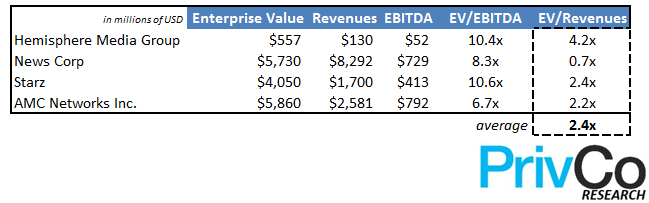
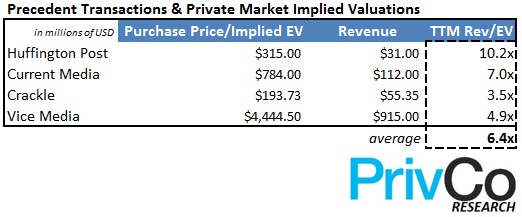
Utilizing PrivCo’s datasets, we were able to pull revenue multiples, valuation amounts, revenue figures, and unique viewership data to get appropriate current market averages for companies that more closely resemble what Trump TV would look like.
Based on these comp tables and precedent transactions we were able to come up with an appropriate valuation shown below:
Conclusion:
While the likelihood of a Trump TV or media outlet is fading by the day, there still are a few paths to seeing it come to light. The blind trust Trump is supposed to set up for the Trump Organization could get very difficult given his children’s prominent roles in the business. Having direct heirs of the president in charge a multinational business could create a conflict of interest if the children are to remain after the business is put into a truly blind trust. Ivanka, Donald Jr. and Eric have all made appearances on The Apprentice, and Ivanka in particular has a number of more media-focused business lines that could prove useful if they wanted to fully divest themselves from the Trump Organization. Finally, one name that has not been mentioned for a cabinet or advisory role as of November 14th was Roger Ailes. Roger spent the better part of two decades running Fox News, was a trusted advisor to the Trump campaign, and may be interested in competing with Fox News with a new outlet that can encapsulate the rhetoric and passion that brought Trump to power in the first place.
[wallst_email_signup]
Special to 24/7 Wall St. From PrivCo









 Top Gaining Stocks
 Top Losing Stocks