



A Chinese proverb says, “the best time to plant a tree is 20 years ago; the second best time is now.” The same goes for planning for your retirement. The earlier you start putting away money the wealthier you will be at the end.
24/7 Wall St. Key Points:
- Starting your retirement savings plan early and making regular contributions over time is the best way to build a substantial nest egg to see you through your Golden Years.
- Take advantage of employer-sponsored retirement plans and any employer matching programs they offer to get off on the right foot.
- 401(k) plans are not the only investment vehicles available, and you should make full use of Roth IRAs and HSAs to maximize and supercharge your retirement savings efforts.
- Also: Is your 401(k) optimized for your retirement plans? (Sponsored)
If you are young and just starting a new job, you should begin putting money aside for retirement right away, preferably in a 401(k) plan or similar tax-advantaged program, a Roth IRA, or both. Even better is when your job offers an employer match program where for every dollar you contribute your employer matches it dollar-for-dollar or a percentage of it.
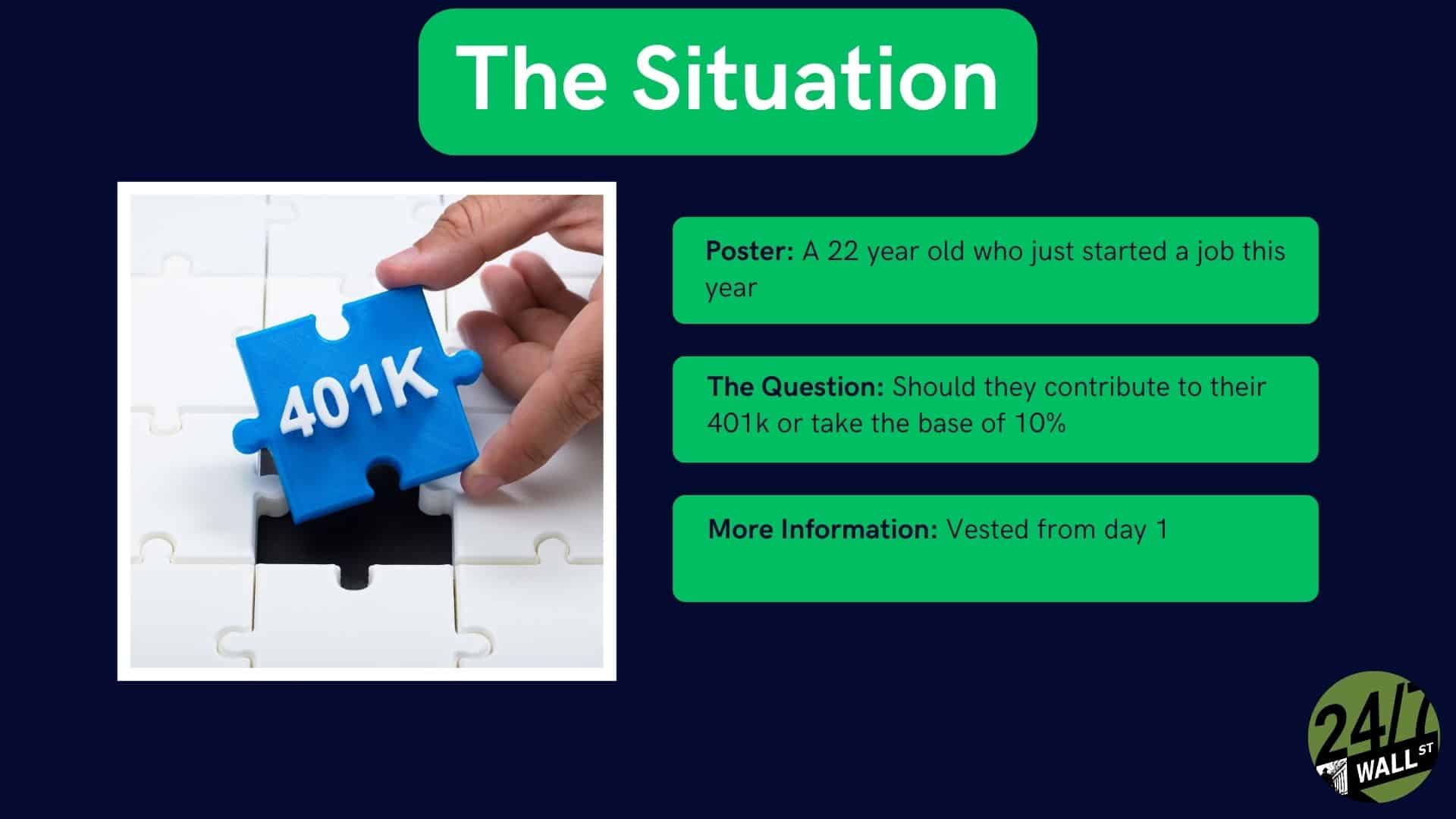
That’s the situation a Redditor on the r/personalfinance subreddit finds himself in. He is 22 years old and is essentially just starting out in the workforce. The job he landed offers a 401(k) program and the position is sweetened because his employer will contribute 10% of his salary to the retirement plan regardless of whether he contributes or not.
Although that is a relative rarity, it is a perk he should immediately take advantage of with his own contributions. There are a number of strategies you can employ, though, to leverage this opportunity and really supercharge your retirement savings.
Finding the right savings mix
Now I’m not a financial planner, so these are just my opinions, but the rule of thumb is to try and put aside at least 15% of your income towards retirement. You have a number of options available on how to divide the contributions.
Generally speaking, it is recommended to put into your 401(k) just enough to meet your employer match. These are pre-tax dollars, so you are lowering your income for when you file your taxes, but when you retire and begin withdrawing the gains you made you will pay taxes then. That could be a hefty bite of your retirement funds, although many expect to be in a lower tax bracket by then.
But don’t max out your 401(k) contributions just yet. Once you meet the employer match, then direct your contributions either to a Roth IRA, which in 2024 is up to $7,000, or to a Healthcare Savings Account (HSA), which has a maximum contribution of $4,150. Some would say to prioritize HSA contributions because they are triple tax-advantaged: contributions are pre-tax, earnings grow tax-free, and withdrawals for eligible medical expenses also incur no tax. And healthcare costs are going to be a large part of your expenses in retirement.
Roth IRAs are contributed on an after-tax basis, but because the earnings grow tax-free you get their full benefit when you retire.
Only after you have maxed out these contributions should you begin thinking about maxing out your 401(k) plan. You can contribute up to $23,500, but combined with employer contributions, the total can be as much as $70,000 beginning in 2025.
Key takeaways
No matter which option you choose, even if you just want to max out your 401(k), it is important to start early and make regular contributions. Both time and the magic of compound interest, which Albert Einstein called “the eighth wonder of the world,” will result in you generating fabulous wealth over your career.
You should work with a qualified financial advisor who can more accurately answer any financial questions. But even just putting your money into a plain vanilla S&P 500 fun like the Vanguard S&P 500 ETF Trust (NYSEARCA:VOO | VOO Price Prediction), one of the world’s most popular and widely held exchange-traded funds, will set you on the path to a comfortable retirement — and maybe even early retirement.












 Top Gaining Stocks
 Top Losing Stocks