



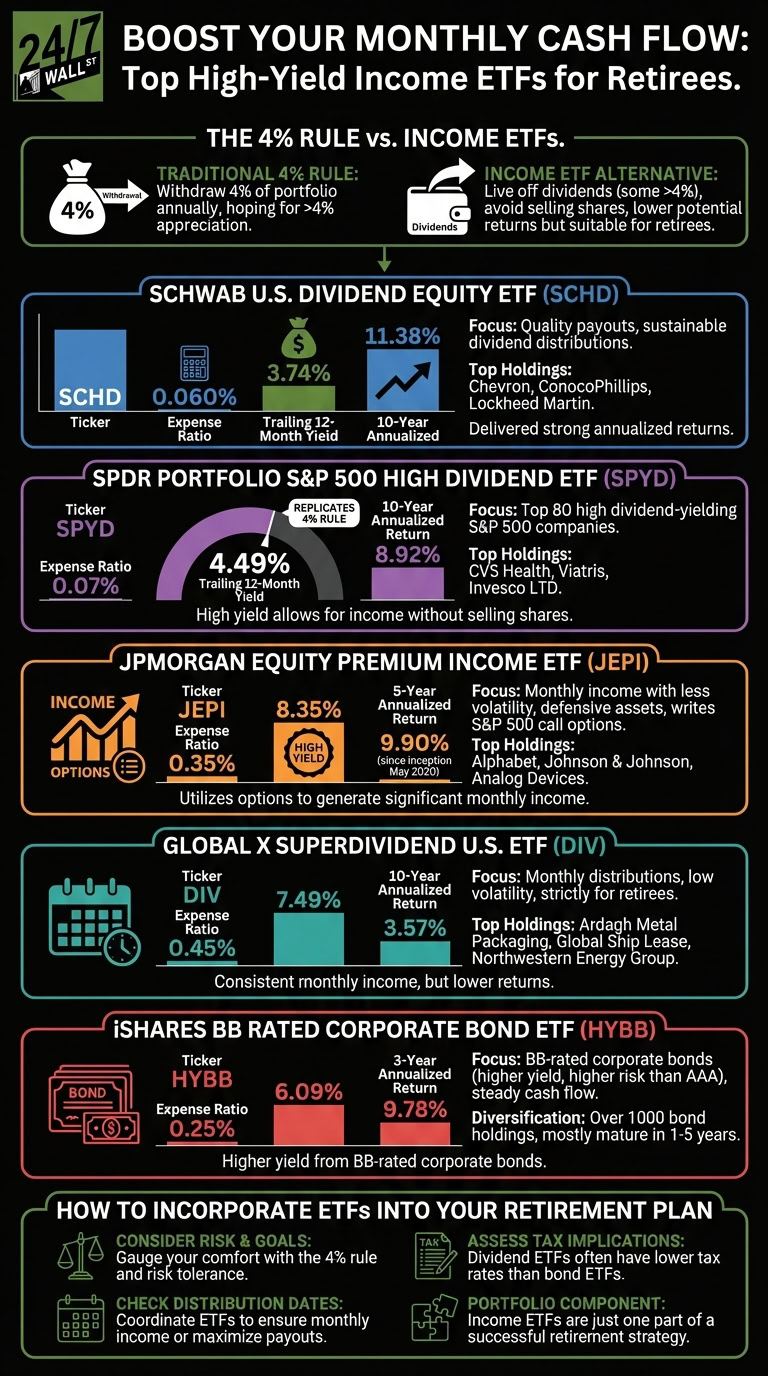
Many retirees follow a 4% withdrawal rule. Essentially, they withdraw 4% of their portfolio each year to cover expenses and hope that the portfolio appreciates by more than 4% in the same year.
There’s an alternative for investors who don’t want to withdraw from their portfolios. Income-generating ETFs come with high yields, some of them above 4.00%. Some investors can live off their dividends instead of selling shares in their portfolios. However, high yields come with lower potential returns, so they’re more suitable for retirees.
These are some of the top high-yield income-generating ETFs to consider if you want to boost your monthly cash flow.
Schwab U.S. Dividend Equity ETF (SCHD)

The Schwab U.S. Dividend Equity ETF (NYSEARCA:SCHD | SCHD Price Prediction) has a 0.060% expense ratio and a 3.74% yield over the past 12 months. The fund focuses on dividend stocks that offer quality payouts and have sustainable dividend distributions.
The fund allocates its $73.0 billion in total assets across 102 stocks. Chevron, ConocoPhillips, and Lockheed Martin are the top three holdings in the fund. SCHD has delivered an annualized 11.38% return over the past ten years.
SPDR Portfolio S&P 500 High Dividend ETF (SPYD)
The SPDR Portfolio S&P 500 High Dividend ETF (NYSEARCA:SPYD) gives investors exposure to the top 80 high dividend-yielding companies within the S&P 500 index. The fund has a 0.07% expense ratio and a trailing 12-month yield of 4.49%.
That’s a high enough yield to replicate the 4% rule without having to sell a single share. Its top three holdings are CVS Health, Viatris and Invesco LTD. The ETF has an annualized 8.92% return over the past ten years.
JPMorgan Equity Premium Income ETF (JEPI)
The JPMorgan Equity Premium Income ETF (NYSEARCA:JEPI) is one of the most well-known income-generating ETFs due to its 8.35% yield over the past 12 months. The fund has a 0.35% expense ratio and $41 billion in total assets.
JEPI’s goal is to deliver monthly income distributions with less volatility. The fund incorporates defensive assets and writes out-of-the-money S&P 500 index call options to generate monthly income. The fund’s top three positions are Alphabet, Johnson & Johnson and Analog Devices. The fund has an annualized 9.90% return over the past 5 years. The funds inception was in May 2020.
Global X SuperDividend U.S. ETF (DIV)
The Global X SuperDividend U.S. ETF (NYSEARCA:DIV) offers monthly distributions with a trailing 12-month yield of 7.49%. The fund has a 0.45% expense ratio. It also has $653 million in total assets spread across 50 holdings.
DIV is known for its low volatility, but its returns aren’t spectacular. The ETF has an annualized 3.57% return over the past decade. The dividend helps, but this fund is strictly for retirees. Its top three holdings are Ardagh Metal Packaging, Global Ship Lease and Northwestern Energy Group.
iShares BB Rated Corporate Bond ETF (HYBB)
The iShares BB Rated Corporate Bond ETF (NYSEARCA:HYBB) has a 0.25% expense ratio and a trailing 12-month yield of 6.09%. BB-rated corporate bonds are more risky than AAA bonds, but they come with higher yields. Most bonds get paid without any issue, resulting in steady cash flow.
Most of the fund’s bonds mature within the next 1-5 years. It’s well-diversified with over 1000 bond holdings. HYBB has generated an annualized 9.78% return over the past three years.
How to Incorporate ETFs into Your Retirement Plan
Income-generating ETFs can provide additional cash flow and help you live off your investments without having to sellshares. However, these ETFs are one piece of successful portfolios.
When constructing a portfolio, it’s important to consider your risk tolerance and long-term financial goals. Many people use the 4% withdrawal rule, and it’s good to gauge if you are ready to comfortably sustain that type of annual portfolio withdrawal.
You can also check when ETFs give out dividends. Knowing dividend distribution dates can help you ensure monthly dividends by picking ETFs with different distribution schedules. You can also choose ETFs that give out dividends during the same four months of the year to maximize how much you receive during those four months.
It’s also good to consider the tax implications of ETF distributions. Dividend ETFs have lower tax rates than bond ETFs since interest is treated as ordinary income. It’s good to assess your financial situation and objectives before adding income-generating ETFs to your portfolio.










 Top Gaining Stocks
 Top Losing Stocks