



A decade after college, Lily from New York City faces a financial dilemma that tests the boundary between legal obligation and moral commitment. She agreed to repay $150,000 in Parent PLUS loans her parents took out for her education. Now, watching them finance a $60,000 luxury vehicle while she struggles through debt repayment with just $1,000 in emergency savings – she’s questioning whether she should honor that agreement.
The Situation at a Glance
- Total Parent PLUS Debt: $150,000 (legally in parents’ names)
- Original Agreement: Lily would repay the loans
- Parents’ Recent Purchase: $60,000 vehicle financed
- Lily’s Financial Status: Working through Baby Step 2, $1,000 emergency fund, carrying her own student loans
- The Tension: Legal escape route vs. moral obligation
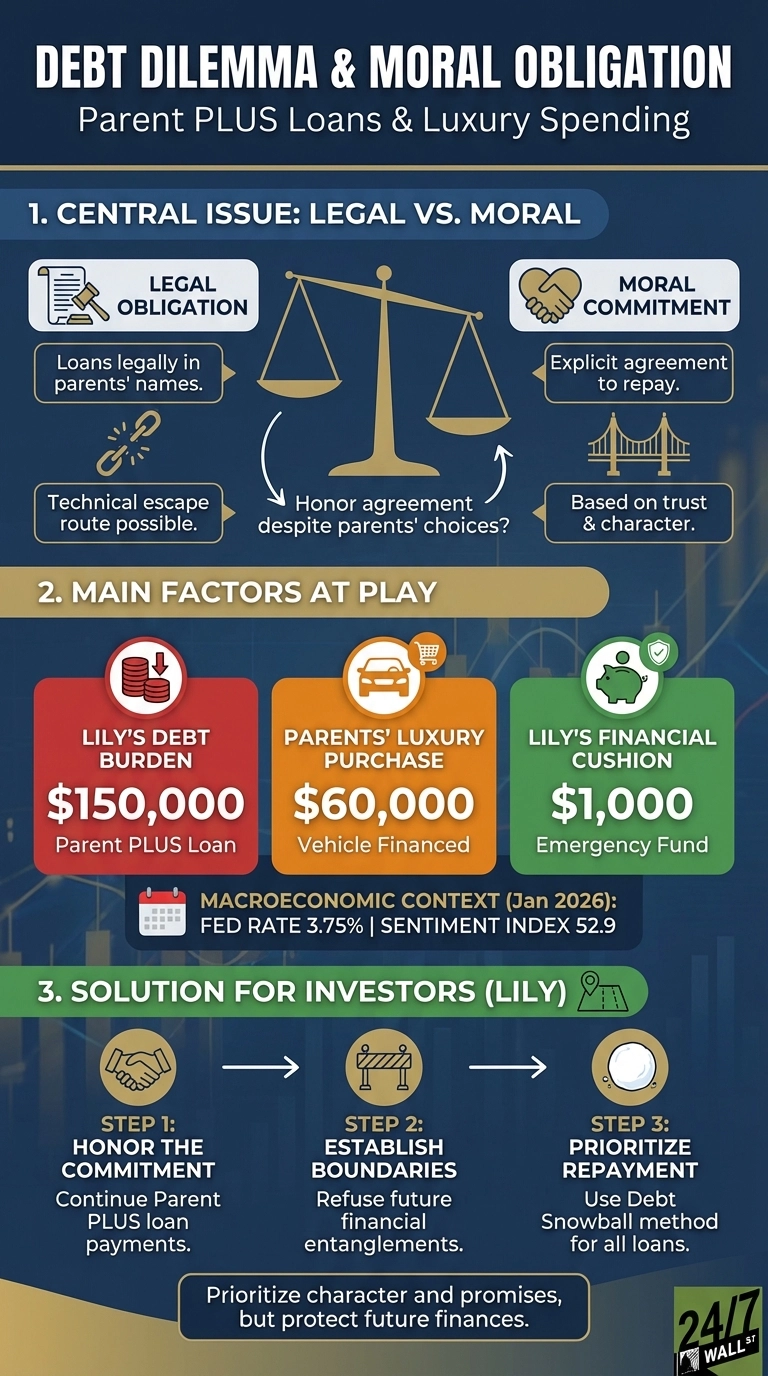
The visualization above illustrates the stark contrast between Lily’s debt burden and her parents’ discretionary spending, while highlighting her minimal financial cushion.
This scenario appears regularly on financial forums. On Reddit’s r/StudentLoans, one user described taking on $30,000 in Parent PLUS loans despite having no legal obligation, writing: “I know that legally, I have no obligation to pay her loans back, but they were taken out for me and she expects me to pay them back.” The moral weight of these agreements persists regardless of legal structure.
Why the Agreement Matters More Than the Paperwork
Parent PLUS loans create a unique moral hazard. The debt sits in the parents’ names, damaging their credit and retirement prospects if unpaid. But when an explicit agreement exists – the legal technicality becomes irrelevant to the ethical obligation. Current Parent PLUS loans carry an 8.94% fixed interest rate for the 2025-2026 academic year, making $150,000 in debt a substantial burden that compounds quickly.
The parents’ $60,000 car purchase is financially irresponsible and infuriating. But their poor decisions don’t void Lily’s commitment. She entered college understanding the terms: they would borrow, she would repay. Walking away might be legally possible, but it would permanently damage the relationship and establish that promises are negotiable when inconvenient.
Financial advisor Dave Ramsey addressed this scenario on his show: “You signing up for these loans is no different from you signing up for a credit card.” The agreement was made when Lily was an adult capable of understanding the obligation.
The Path Forward
Lily should honor her commitment while establishing firm boundaries. That means continuing Parent PLUS loan payments as agreed, but refusing any future financial entanglements with parents who demonstrate poor money management. She should prioritize these loans alongside her own debt using the debt snowball method, treating the $150,000 as her responsibility regardless of whose name appears on the paperwork.
The harder lesson: character is revealed when keeping promises becomes inconvenient. Her parents failed that test with their luxury purchase. Lily can choose differently.














 Top Gaining Stocks
 Top Losing Stocks