



Speculative assets have moved well past the fringe in 2026. Prediction markets, sports betting platforms, and cryptocurrencies are now part of how a meaningful share of Americans think about building wealth, and the Northwestern Mutual 2026 Planning & Progress Study puts a number on just how far that shift has gone. According to the report, roughly four in ten Americans are either investing in or actively considering these high-risk assets, a figure alone that is worth paying attention to. The motivation behind it is the part that tells the real story.
The 73% Figure
Among those, 39% say they are pursuing speculative assets because they feel financially behind and believe these investments offer a faster path to their goals than traditional methods. That is not a portfolio allocation decision. That is a distress signal dressed up as a strategy. The survey makes the framing explicit, and it matters because it places the majority of speculative investors inside a mindset that already accepts significant downside risk without fully accounting for what that risk actually costs when it goes wrong.
The economic backdrop helps explain the psychology. Inflation remains the single biggest obstacle to financial security for 42% of Americans, according to the same study, and 48% of households say their incomes are already growing more slowly than prices. When the gap between what things cost and what people earn keeps widening, the appeal of a faster solution does not feel irrational. It feels necessary, and that is exactly when the risk of a bad decision compounds the most.
Where the Behavior Concentrates
The generational split is sharp and worth understanding in full. Gen Z and Millennials represent the largest share of Americans engaging with speculative assets, and 80% of Gen Z respondents in that group say they are participating specifically because they feel behind on their goals. That is the cohort with the longest investment horizon in the entire workforce, and it is describing its primary investment strategy as a catch-up trade. The mismatch between the available time and the approach taken is one of the more consequential findings in the report.
The broader sentiment picture reinforces why this is happening. 45% of Americans expect the economy to weaken further in 2026, and more than half expect inflation to keep climbing. When households feel squeezed from multiple directions at once, patience stops feeling like a virtue and starts feeling like a liability. Speculative assets offer the appearance of speed, and speed is exactly what younger adults feel they need most right now.
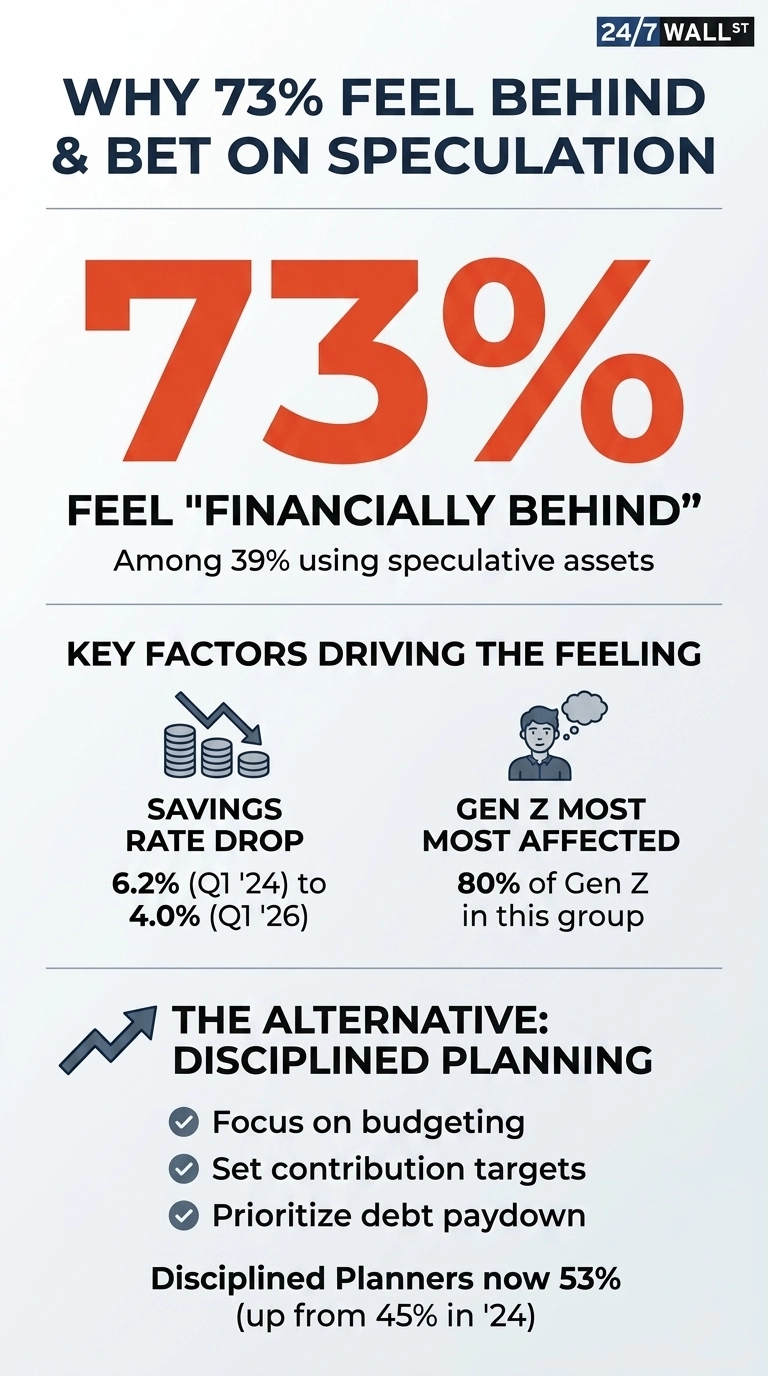
This infographic illustrates that 73% of Americans feel financially behind, leading many to speculative assets, while disciplined financial planning offers a more stable alternative.
The Income-Focused Alternative
The same study identifies a parallel trend moving in the opposite direction that deserves equal attention. The share of Americans who describe themselves as disciplined financial planners has climbed to 53% in 2026, recovering from a record low of 45% in 2024 and continuing a two-year upward trend. These are households that are budgeting, hitting contribution targets, paying down debt methodically, and building layers of protection into their financial lives. It is a slower path, and it is the one the data consistently shows producing better outcomes over time.
The two groups are not entirely separate, and the tension between them is evident in the numbers. 50% of Americans now feel financially secure, up from 44% in 2025, which is genuine progress. At the same time, 52% admit they are overemphasizing asset growth while underinvesting in protection, and 42% cite inflation as their top obstacle to getting ahead. Confidence and anxiety are sitting side by side in the same households, which is part of what makes the speculative impulse so understandable, even when the math behind it rarely works out.
What the Data Describes
Speculative assets are built around variance. The returns can be large and arrive quickly, and so can the losses. Income-focused strategies are built around something slower and harder to get excited about: compounding, consistency, and the kind of protection layers that do not show up in a portfolio balance until something goes wrong and they suddenly matter enormously. The Northwestern Mutual data shows both approaches gaining ground at the same time, with different generations gravitating toward each for reasons that make sense given where they sit in their financial lives.
The figure worth keeping in mind is not the 39% or even the 73%. It is the distance between where Gen Z believes it is financially and where a disciplined, income-focused approach could actually take them, given the time they still have. The generation most likely to describe its investment strategy as catch-up is also the one that needs it least, because no other cohort has more time for compounding to do the heavy lifting. The data documents the gap between what that time is worth and how it is currently being used.












 Top Gaining Stocks
 Top Losing Stocks