


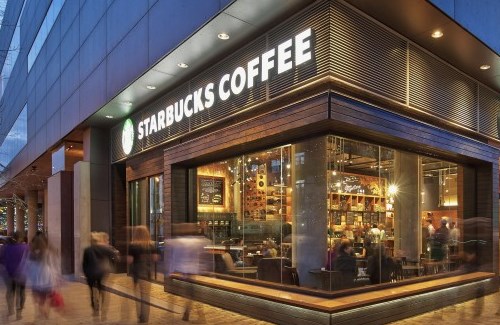
24/7 Wall St. wanted to see what these new Starbucks store formats and existing planned openings can ultimately mean to its future growth.
Starbucks opened its first Reserve Roastery and Tasting Room store back in 2011 in Tokyo. Reserve stores are upscale locations that deal in specialty blends and roasts that are sold at a premium. These stores specifically target fans of high-end and premium coffee — others have called these fans coffee snobs. The company expects its first new one to open in 2015 and plans another 100 locations strategically placed over the next five years. Starbucks said that it plans to use the actual Starbucks Reserve coffee line in 1,500 traditional stores.
READ ALSO: 6 High-Profile and Controversial Analyst Downgrades
Another concept store that is on the menu for Starbucks is the Express store. These stores are designed for the on-the-go commuter who doesn’t have time to wait in a traditional location. It turns out that some customers just want in and out rather than using the Wi-Fi for an alternative to a home office.
Starbucks decided on the Express store format after looking at its in-store performance, with drive-thru contributing massively: “Drive Thru stores accounting for more than 40% of U.S. company-operated stores and higher-than-average sales growth than non-Drive Thru locations …” These express store formats will look to integrate Starbucks digital payment platform and also were said to include mobile ordering to expedite speed of service in these locations.
So far, Starbucks competitors cannot keep pace with the coffee giant in terms of its expansion on these different fronts. McDonald’s Corp. (NYSE: MCD) likely does not pose a threat to Starbucks’ “premium-priced” experience. The recent expansion of Dunkin’ Brands Group Inc. (NASDAQ: DNKN) stores to the West Coast only signals how far behind this coffee retailer is compared to the scale of Starbucks. The company faces its main competition on the local level with big reputation coffee houses, but these competitors do not have the scale or brand appeal that Starbucks has gained on a national level.
So, how does all of this play out and what does it means to Starbucks investors ahead? The most recent Starbucks corporate earnings release indicated that Starbucks opened 344 net new stores globally in the most recent quarter, ending the period with 20,863 stores across 64 countries.
A simple guess would be that Starbucks has found yet another way (or two) to drive higher margins. Its smaller format express stores could make for nice niche locations in many locations throughout America and beyond. It would also seem to be a lower per-store investment than the grand premium locations, but we will have to await details before determining that with quantifiable data.
READ ALSO: Credit Suisse Releases New Top Investment Ideas
Starbucks closed at $77.95 last week, against a 52-week range of $67.93 to $82.50. Now we just have to keep in mind that Starbucks is valued at $58.5 billion in market capitalization.
Starbucks generated $14.89 billion in fiscal 2013 revenues, and Thomson Reuters has revenue estimates of $16.5 billion for fiscal 2014 and $18.29 billion for fiscal 2015. These store expansions should help the company meet those goals.










 Top Gaining Stocks
 Top Losing Stocks