


Despite growth in shipping and package volume and revenue, the real issue is that total volume and revenue from other products have declined. Total mail volume of 37.7 billion pieces was down by 420 million pieces from the 38.2 billion pieces counted for this same quarter last year. Shipping and package volume was up 14.4%, while First-Class Mail volume fell by 2.1% and Standard Mail volume fell by 1.1%.
The USPS has again said that its ongoing capital investments remain a priority. It is hard to consider government agencies, or government-oriented entities, on a non-GAAP basis like they are a public technology company, but the USPS did say:
Excluding a retiree health benefit prefunding expense, the net losses would have been $44 million and $447 million, respectively, for the quarters ended 2015 and 2014.
The USPS again states that it receives no tax dollars for operating expenses and relies on the sale of postage, products and services to fund its operations. Still, this vast endless pit of money comes from somewhere (Doesn’t it?). The USPS remains truly in a conundrum, and how it can get out from under it remains a mystery. How does an entity that has such deep roots in America operate with high retiree costs when its total volume from the core business of First Class Mail keeps declining year after year?
ALSO READ: Banks and States With the Most Branch Closings: The Rise of Mobile Banking
The lower operating expenses were shown to be driven in part by favorable trends in workers’ compensation expense. Still, the report said:
Excluding the decline in workers’ compensation expense for the quarter, operating expenses increased by $156 million, a reflection of higher compensation costs from growth in the labor-intensive shipping and package business, as well as higher retirement contribution rates mandated by the Office of Personnel Management.
Controllable income (net income ex-retiree health benefits and expenses for interest rate and other non-cash workers’ compensation expense) was shown to have risen by $52 million in the second quarter to $313 million, primarily attributable to efforts associated with continued cost-cutting initiatives and enhanced revenue from strong shipping and package volume.
The USPS showed that it ended the quarter with $6.1 billion in unrestricted cash. This represents 22 days of operating cash. Still, the release warns of continued operating expenses conundrum:
Considering that the Postal Service has reached its borrowing limit of $15 billion, the current level of available liquidity is not sufficient to support both operations and prefund retiree health benefits.
Postmaster General and Chief Executive Officer Megan Brennan said of the quarter:
We’re pleased with the increase in our controllable net income compared to the same period last year, which demonstrates that our cost containment and revenue strategies are delivering results. We also took significant steps during the quarter to improve our long-term operating model, which will help drive greater long-term efficiencies throughout our network.
Chief Financial Officer and Executive Vice President Joseph Corbett said:
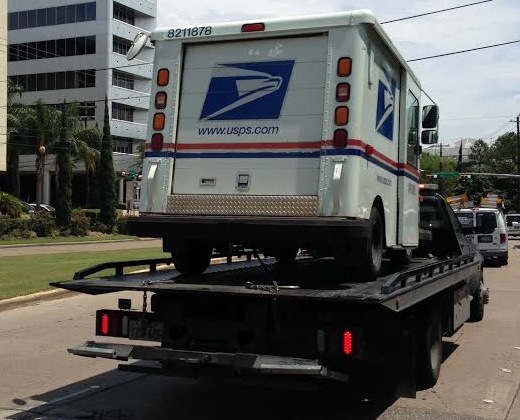
Shipping and Package Services are a key business driver, however, operating margins in this business are lower than in mailing services. And, while we’re pleased to see a small increase in controllable income, to improve our margins, we’ll need to make investments in our network infrastructure and delivery vehicles.
ALSO READ: Companies With the Best (and Worst) Reputations
If someone can figure out how to fix the USPS, without closing it down, the public would like to hear about it. Whether the public will want to hear about steep price hikes, and whether the USPS employees will want to hear about lower wages and lower retirement benefits without overspending on new equipment, that just makes this conundrum that much more complicated.








 Top Gaining Stocks
 Top Losing Stocks