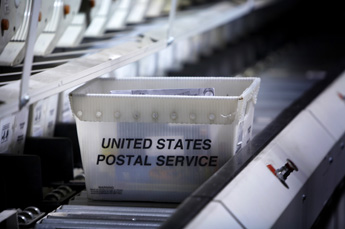
US Postal Service Loses Another $1.3 Billion

Photo of Douglas A. McIntyre
By Douglas A. McIntyre Published
This post may contain links from our sponsors and affiliates, and Flywheel Publishing may receive compensation for actions taken through them.

The sinkhole called the U.S. Postal Service (USPS) lost another $1.3 billion in the first quarter. Not only is the operation being overwhelmed by competition from United Parcel Service Inc. (NYSE: UPS) and FedEx Corp. (NYSE: FDX), but the rise of email and texting continues to make much of what the USPS does irrelevant. However, all those problems have existed for years. As they continue into the decades ahead, the USPS needs to begin cutting costs aggressively now.

Management announced:

The U.S. Postal Service ended the second quarter of fiscal 2015 (Jan. 1, 2015 – March 31, 2015) with an operating revenue increase of $223 million, or 1.3 percent, over the same period last year, and a net loss of $1.5 billion. The increase in operating revenue was driven by a 14.4 percent growth in shipping and package volume. The net loss for the quarter was $1.5 billion compared to a net loss of $1.9 billion for the same period last year. Excluding a retiree health benefit prefunding expense, the net losses would have been $44 million and $447 million, respectively, for the quarters ended 2015 and 2014.

ALSO READ: Banks and States With the Most Branch Closings: The Rise of Mobile Banking

“Health benefit prefunding expenses” are regularly given for the USPS’s problems, but these do not entirely explain the ongoing shortfall. However, management has tried to offset this huge expense, without much progress:

“We’re pleased with the increase in our controllable net income compared to the same period last year, which demonstrates that our cost containment and revenue strategies are delivering results,” said Postmaster General and Chief Executive Officer Megan Brennan. “We also took significant steps during the quarter to improve our long-term operating model, which will help drive greater long-term efficiencies throughout our network.”

The USPS’s description of its own operations speaks volumes. It has 31,662 Postal Service-managed retail offices. In addition, its operations include 486,822 career employees and 130,432 non-career employees. Its payroll and benefits payments every two weeks are $1.8 billion.

The future of the USPS is a political football. No member of Congress wants to face the closure of a large number of offices in his or her district. It is assumed that if delivery were cut to four or five days, most Americans would object. But, daily mail delivery is not as important as it was just two decades ago.

The solutions to the USPS’s problems are the same as they were two decades ago — layoffs and office shuttering.


ALSO READ: Companies With the Best (and Worst) Reputations

Photo of Douglas A. McIntyre
About the Author Douglas A. McIntyre →

Douglas A. McIntyre is the co-founder, chief executive officer and editor in chief of 24/7 Wall St. and 24/7 Tempo. He has held these jobs since 2006.

McIntyre has written thousands of articles for 24/7 Wall St. He is an expert on corporate finance, the automotive industry, media companies and international finance. He has edited articles on national demographics, sports, personal income and travel.

His work has been quoted or mentioned in The New York Times, The Wall Street Journal, Los Angeles Times, The Washington Post, NBC News, Time, The New Yorker, HuffPost USA Today, Business Insider, Yahoo, AOL, MarketWatch, The Atlantic, Bloomberg, New York Post, Chicago Tribune, Forbes, The Guardian and many other major publications. McIntyre has been a guest on CNBC, the BBC and television and radio stations across the country.

A magna cum laude graduate of Harvard College, McIntyre also was president of The Harvard Advocate. Founded in 1866, the Advocate is the oldest college publication in the United States.

TheStreet.com, Comps.com and Edgar Online are some of the public companies for which McIntyre served on the board of directors. He was a Vicinity Corporation board member when the company was sold to Microsoft in 2002. He served on the audit committees of some of these companies.

McIntyre has been the CEO of FutureSource, a provider of trading terminals and news to commodities and futures traders. He was president of Switchboard, the online phone directory company. He served as chairman and CEO of On2 Technologies, the video compression company that provided video compression software for Adobe’s Flash. Google bought On2 in 2009.

Featured Reads

Our top personal finance-related articles today. Your wallet will thank you later.

Continue Reading

Top Gaining Stocks

CBOE Vol: 1,568,143
PSKY Vol: 12,285,993
STX Vol: 7,378,346
ORCL Vol: 26,317,675
DDOG Vol: 6,247,779

Top Losing Stocks

LKQ
LKQ Vol: 4,367,433
CLX Vol: 13,260,523
SYK Vol: 4,519,455
MHK Vol: 1,859,865
AMGN Vol: 3,818,618