



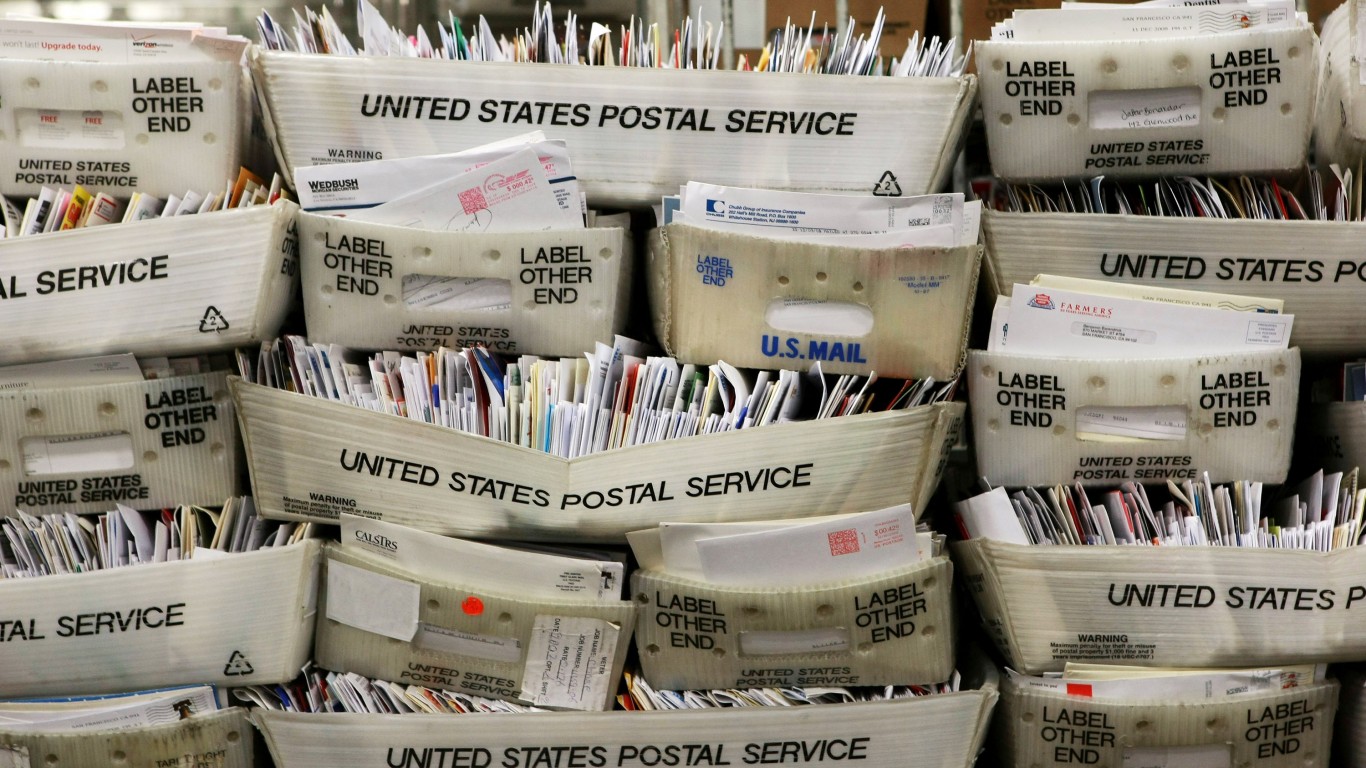
The U.S. Postal Service (USPS) tracks mail delivery against a recently created yardstick it calls “Delivering for America.” Part of this 10-year plan is to have 95% of all mail, regardless of class, delivered on time. Much of this effort is made to deliver junk mail quickly. The USPS calls these letters and parcels “Marketing Mail.” USPS helps for-profit enterprises deliver junk mail as quickly as possible. It is another example of the wasted efforts of the organization.
[in-text-ad]
In its most recent report on mail delivery, the USPS said its goal is to deliver mail in an average of 2.5 days. In its recent report, which covered January 1 to January 27, 91.8% of First-Class mail was delivered on time. A total of 94.3% of Marketing Mail was delivered on time. That means junk mail delivery outperformed First-Class mail numbers. About 53% of all mail deliveries are Marketing Mail.
[nativounit]
The USPS is built around several functions that are no longer good foundations for a national package and mail delivery system. First, it supports, at a loss, the delivery of junk mail. Second, it delivers mail six days a week. Third, it maintains over 32,000 post offices, many of which are in small villages. By any reasonable yardstick, many of these locations have to lose money. (Last year, the USPS lost $473 million on revenue of $78.5 billion.) (Click here for 18 ways the Post Office helps Americans.)
[wallst_email_signup]
Marketing Mail has several things in common with First-Class when viewed through the lens of whether it needs to be available to Americans. The USPS has not forced marketers to turn to electronic delivery, which is already a major part of e-commerce business models. If marketing material-based businesses were forced to deliver more content online, many of USPS’s costs could be eliminated. This means fewer postal workers and fewer locations.
[recirclink id=1193858]
The ability to cut these also would be increased if the USPS encouraged Americans to use email and email attachments instead of First-Class mail. And Americans should be encouraged to turn to FedEx and UPS for package delivery.
There is no reason for the USPS to be anywhere near as large as it is. One way to cut this is to phase out Marketing Mail.








 Top Gaining Stocks
 Top Losing Stocks