



24/7 Wall St. is looking at the driving forces that may have started to create an oversold position here.
Raymond James was the latest firm to cool the bullishness on airlines. The firm slashed its ratings on American Airlines Group Inc. (NASDAQ: AAL), Delta Air Lines Inc. (NYSE: DAL) and United Continental Holdings Inc. (NYSE: UAL). While the firm cited pricing softness and an inability to pass through higher ticket costs, Southwest Airlines Co. (NYSE: LUV) also plays a role here.
The call also addressed higher fuel cost concerns for the second half of 2015 and into 2016. Maybe the airlines want to charge more, but the reality is that the airlines are getting a huge boost here compared to a year ago. The current view is that $90 and $100 oil are gone. So if oil prices briefly went down to under $50 and then came back up to $60, are we really considering higher or lower jet fuel prices?
ALSO READ: US and European Airlines Will Attack Subsidies to Mideast Carriers
Southwest Airlines recently ran into booking issues and is increasing its capacity for more flights ahead. It also has been growing outside of its traditional routes, giving some pressure for flights south of the United States now.
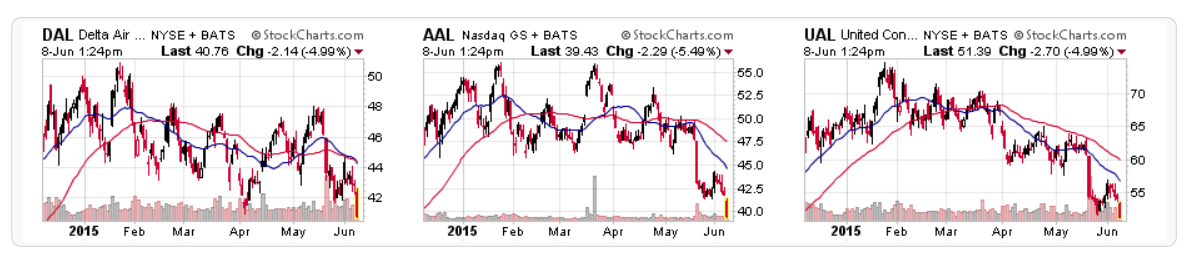
United Continental was down 5% at $51.32 as Raymond James cut its rating to Outperform from Strong Buy. Still, its 52-week range is $36.65 to $74.52 and the consensus price target went over $80. United now trades at roughly five times expected earnings, but those earnings are expected to have doubled from 2014. Still, its shares were at $70 in late March.
Delta’s shares were down 5% at $40.71 after Raymond James cut the rating to Outperform from Strong Buy. Its 52-week range is $30.12 to $51.06, and the consensus price target is just over $60.00. When Delta hit $50, it was in late January. Now shares hit the lowest price in 2015. Delta is valued at nine times expected 2015 earnings and 7.5 times expected 2016 earnings.
American Airlines was down almost 6% to $39.40 after Raymond James cut its rating to Market Perform from Outperform, against a 52-week range of $28.10 to $56.20. Its shares are now at 2015 lows, and it was above $50 as recently as April. American trades at only about four times expected 2015 earnings and less than six times 2016 expected earnings.
Southwest shares were down 3.5% to $35.85 in mid-Monday trading, in a $25.47 to $47.17 range over the trailing 52-week period. Southwest’s consensus analyst price target is $52.50. Southwest trades at about 10 times forward earnings.
ALSO READ: 9 Analyst Stock Picks Under $10 With Massive Upside Calls
Despite some recent downgrades from other analysts, the price targets showing 50% and higher upside just still feel too high. On the surface, these airline stocks look oversold, given how much they have sold off in recent days and weeks. Still, many of these analyst price targets showing upside of 50% or more feel like some analyst-based normalization needs to keeping coming back into play.
The end game is that airline stocks look like they are getting oversold. Just do not be shocked when more analysts trim either their forward earnings expectations or valuations. Sometimes oversold stocks can keep looking oversold.
Warren Buffett always says he will never own another airline stock. Still, he did buy NetJets. 24/7 Wall St. has included an expandable three-way Stockcharts.com image to show just how much these stocks have sold off after recent highs.






 Top Gaining Stocks
 Top Losing Stocks