


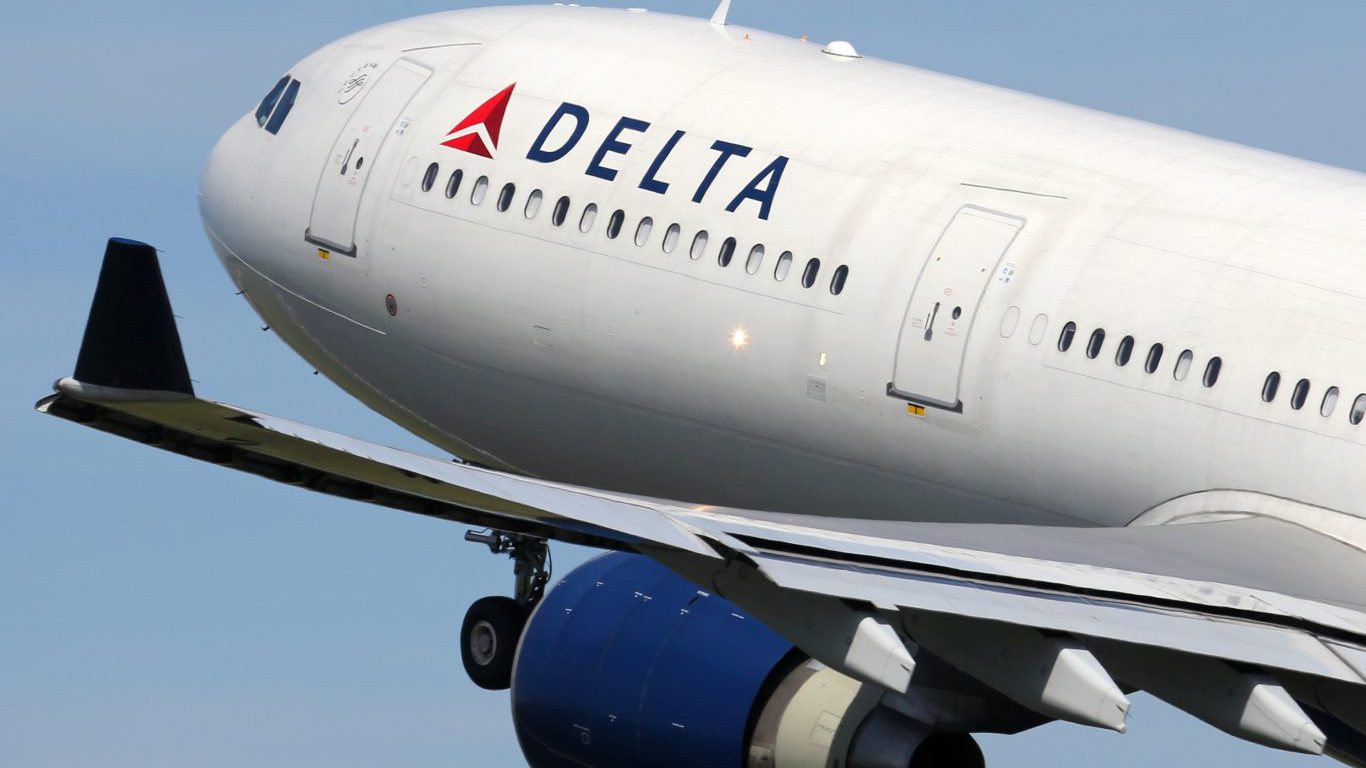
When Delta Air Lines Co. (NYSE: DAL | DAL Price Prediction) reported operating metrics for September on Wednesday morning, revenue for passenger miles and available seat miles were both up year over year, and the year-to-date totals were up 5.6% and 4.5%, respectively. The airline flew more passengers in September than ever before in the month, and the year-to-date total for passengers boarded is up more than 6% to more than 154 million.
Investors were less than impressed. In fact, they were downright surly. Delta’s stock dropped more than 5% after the report was released. The report also weighed on other carriers’ shares: Alaska Air Group Inc. (NYSE: ALK) traded down more than 4%, United Airlines Holdings Co. (NASDAQ: UAL) down about 3.5%, American Airlines Group Inc. (NASDAQ: AAL) down 3.8%, and Southwest Airlines Co. (NYSE: LUV) down 3.0%.
There could be a couple of issues hiding in all those numbers and in those that other airlines will be reporting soon. First, is capacity, or available seat miles. Are the carriers adding more seats than they can fill? Delta’s load factor rose 2.7% in September on domestic flights and 1.5% year to date compared to 2018. Delta’s load factor in the Pacific region dropped by 1.9% in September and is down 1.1% year to date, even while capacity on those flights rose by 3.3% for the month and is up 5.3% for the year to date, the largest capacity addition of any region so far this year.
In a separate announcement, Delta said it expects third-quarter earnings per share (EPS) in a range of $2.20 to $2.30, compared with a consensus estimate of $2.27, and revenue growth of about 6.5%, well above the revenue consensus of $12.66 billion that implies a 5.9% jump. The company reports third-quarter results next Thursday.
The company also said it expects capacity to rise by 4.0% in the September quarter and non-fuel expenses on a unit basis to rise by 2.5%, a bigger increase than previously announced. Non-fuel expenses are now expected to rise by 2.0% for the full fiscal year.
[nativounit]
Another cautionary signal is the amount of cargo Delta carried. Cargo ton-miles fell by 10.5% in September and is down 9.0% for the year to date. These numbers are both consistent with industry expectations and getting worse, which is also what cargo industry analysts expect for the rest of 2019.
Delta’s shares have recovered a bit and traded down about 3.9% at $54.78 in mid-morning action Wednesday. The stock’s 52-week range is $45.08 to $63.44, and the consensus 12-month price target is $69.83.
United’s stock traded down 3.2%, at $84.98 in a 52-week range of $77.02 to $97.85. The stock’s consensus price target is $109.19.
American shares traded down 1.7%, at $26.34 in a 52-week range of $24.23 to $40.58 and a consensus price target of $37.35.
Southwest traded down about 2.3% at $52.14 a share, in a 52-week range of $44.28 to $62.00. The consensus price target on the stock is $60.71.
[recirclink id=581797]
[wallst_email_signup]








 Top Gaining Stocks
 Top Losing Stocks