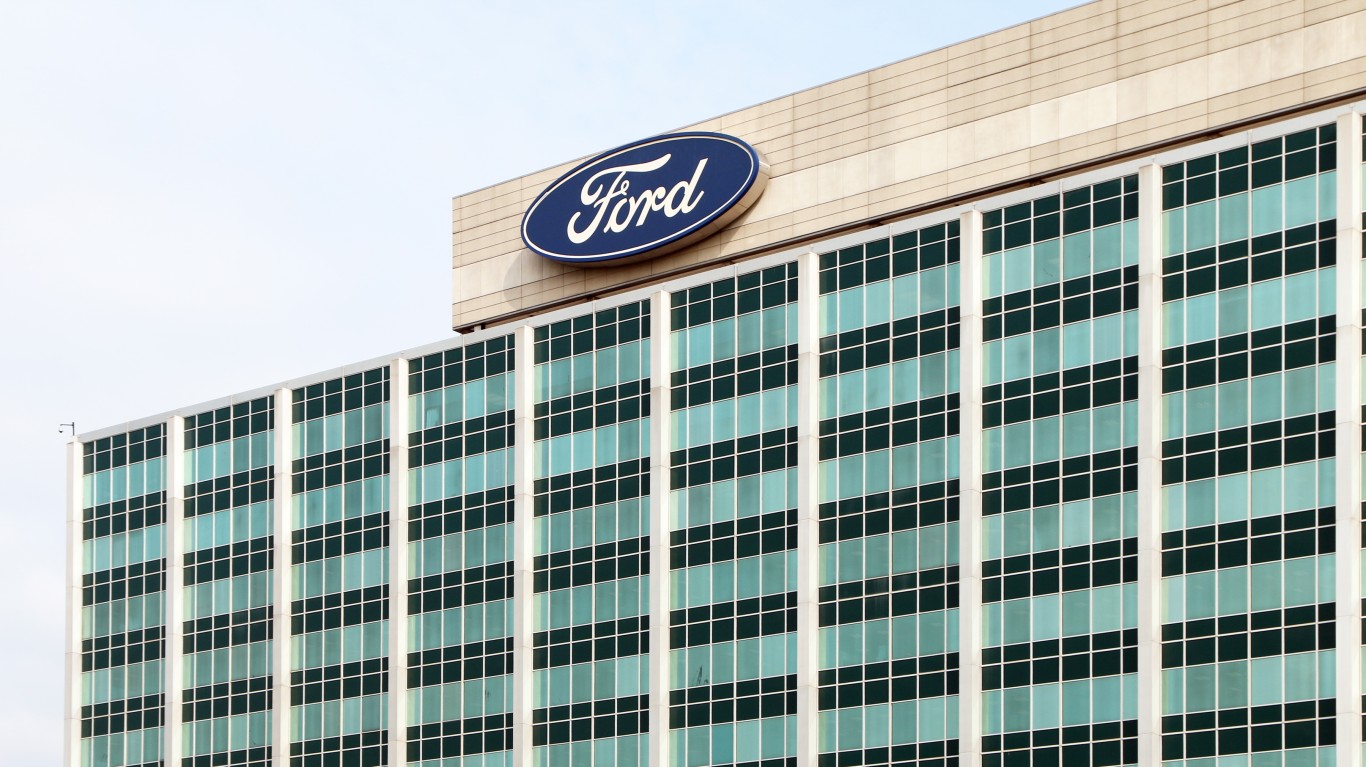
Ford Could Cut More Jobs

Photo of Douglas A. McIntyre
By Douglas A. McIntyre Published
This post may contain links from our sponsors and affiliates, and Flywheel Publishing may receive compensation for actions taken through them.
Ford Could Cut More Jobs

© TennesseePhotographer / iStock Editorial via Getty Images

Ford Motor Co. (NYSE: F | F Price Prediction) management said it would cut 3,000 jobs. None of these appear to be at its factories. White collar workers and contractors got hit. The figure represents a tiny part of the manufacturer’s global worker count. As the car industry hits more headwinds, additional cuts may be contemplated.
[in-text-ad]
Ford’s evolution into an electric car company was cited as a reason for the layoffs. Ford wants to be leaner as it moves out of the gasoline-powered vehicle sector. It already has carved the parent company into two pieces. CEO Jim Farley said people cannot work on two businesses. They require “different mindsets,” according to a New York Times interpretation of his viewpoint. That is an oversimplification, since the two types of vehicles share so much in common. Maybe he just wanted an excuse for making his workforce smaller.
[nativounit]
A few things stand out about the Ford job cuts. The first is that “efficiency” may be the reason Ford made the decision. However, the economy worldwide is on the brink of a recession (or one already has started). U.S. gross domestic product will contract, and the same will be true in Europe. While China’s GDP may not shrink, the slowdown that has begun signals that its economy has started to tank.

One hard and fast rule about recessions is that car sales suffer. They are too large a portion of household costs for this not to be true. Ford’s U.S. sales have risen recently. A sharp reversal of GDP improvement will end that. The other rule about recessions is that car companies cut workers.
[wallst_email_signup]
One advantage for Ford and other car companies is pent-up demand, triggered by kinks in supply chains. Many models are barely available, and people have to wait months for some vehicles they want to purchase. Recessions change behavior from “want” to “can’t afford.” The average age of a car on the road in the United States is 12 years. A hard hit to the economy will lengthen that.
[recirclink id=1163453]
Ford may say it has continued to seek efficiency and job cuts are part of that. However, efficiency has been joined by economic trouble, which is a bad marriage of problems.

Photo of Douglas A. McIntyre
About the Author Douglas A. McIntyre →

Douglas A. McIntyre is the co-founder, chief executive officer and editor in chief of 24/7 Wall St. and 24/7 Tempo. He has held these jobs since 2006.

McIntyre has written thousands of articles for 24/7 Wall St. He is an expert on corporate finance, the automotive industry, media companies and international finance. He has edited articles on national demographics, sports, personal income and travel.

His work has been quoted or mentioned in The New York Times, The Wall Street Journal, Los Angeles Times, The Washington Post, NBC News, Time, The New Yorker, HuffPost USA Today, Business Insider, Yahoo, AOL, MarketWatch, The Atlantic, Bloomberg, New York Post, Chicago Tribune, Forbes, The Guardian and many other major publications. McIntyre has been a guest on CNBC, the BBC and television and radio stations across the country.

A magna cum laude graduate of Harvard College, McIntyre also was president of The Harvard Advocate. Founded in 1866, the Advocate is the oldest college publication in the United States.

TheStreet.com, Comps.com and Edgar Online are some of the public companies for which McIntyre served on the board of directors. He was a Vicinity Corporation board member when the company was sold to Microsoft in 2002. He served on the audit committees of some of these companies.

McIntyre has been the CEO of FutureSource, a provider of trading terminals and news to commodities and futures traders. He was president of Switchboard, the online phone directory company. He served as chairman and CEO of On2 Technologies, the video compression company that provided video compression software for Adobe’s Flash. Google bought On2 in 2009.

Featured Reads

Our top personal finance-related articles today. Your wallet will thank you later.

Continue Reading

Top Gaining Stocks

CBOE Vol: 1,568,143
PSKY Vol: 12,285,993
STX Vol: 7,378,346
ORCL Vol: 26,317,675
DDOG Vol: 6,247,779

Top Losing Stocks

LKQ
LKQ Vol: 4,367,433
CLX Vol: 13,260,523
SYK Vol: 4,519,455
MHK Vol: 1,859,865
AMGN Vol: 3,818,618